

Portable 3D Scan Object Workflows Reach a Tipping Point in 2026 Industrial Manufacturing
Several forces are converging. The push for shorter quality feedback loops—waiting hours or days for CMM results is no longer viable in high-mix production
Macro Drivers Behind the Shift
Several forces are converging. The push for shorter quality feedback loops—waiting hours or days for CMM results is no longer viable in high-mix production. The materials mix has also changed: dark plastics, bare aluminum, and polished tool steels are common, and older red-laser triangulation systems struggle without contrast-enhancing sprays.
At the same time, digital twin and model-based definition (MBD) initiatives demand dense, accurate point clouds that can be aligned to CAD in real time. Finally, experienced metrology specialists are retiring, and the tools must be usable by line operators with minimal training.
Term Notes
Several forces are converging.
Key Trend 3: AI-Powered Reconstruction Reduces Operator…AI algorithms now handle scan alignment, hole filling, and feature extraction automatically, lowering the skill barrier.
Data from portable scanners no longer sits in isolation.
INSVISION’s Role in These TrendsINSVISION’s AlphaScan and its broader platform are designed around the realities of shop-floor metrology.
Key Trend 1: Blue Laser Scanning Moves from the Lab to the Line
Modern structured-light scanners project 30 to 42 blue laser lines that maintain accuracy on challenging surfaces and under shop-floor illumination. This eliminates the need for coating and darkroom conditions. The technical requirement is clear: scanners must offer multiple scan modes to handle large flat areas, deep cavities, and fine details without switching devices.
The business impact is equally direct—first-article inspection and in-process checks happen at the point of production, reducing scrap and rework.
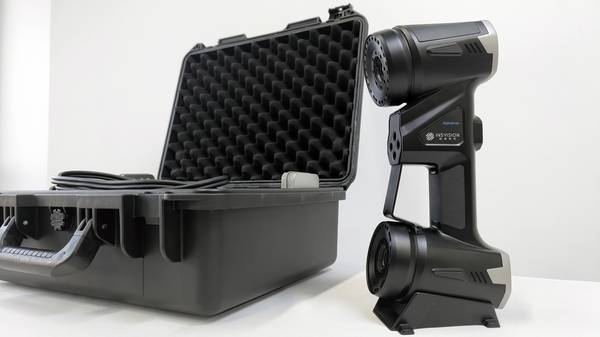
INSVISION’s AlphaScan illustrates this capability. It provides cross lines for rapid coverage of broad surfaces, a single line for deep concave geometry, and seven fine-detail lines for intricate corners, all with a volumetric accuracy of 0.02 mm. One device replaces several specialized tools, and the blue laser source holds its accuracy on dark plastics and bare metal without spraying.
Key Trend 2: 3D Scan Object Data Becomes a Supply Chain Collaboration Standard
As OEMs and tier suppliers distribute manufacturing globally, the ability to share a digital twin of a physical part—complete with GD&T annotations and deviation color maps—is becoming a requirement. Instead of shipping suspect parts back and forth, a supplier scans a first-off part, uploads the point cloud, and the OEM reviews it against the CAD model within hours.
The technical requirement: software must support common formats (STEP, IGES, STL) and generate reports that align with ASME Y14.5 or ISO GPS standards. The business impact: faster approvals, reduced logistics costs, and fewer line-down situations. INSVISION’s software ecosystem enables direct export of inspection reports and deviation maps, facilitating this cross-enterprise workflow without proprietary lock-in.
Key Trend 3: AI-Powered Reconstruction Reduces Operator Dependency
AI algorithms now handle scan alignment, hole filling, and feature extraction automatically, lowering the skill barrier. A production technician can capture metrology-grade data without understanding point cloud processing. The technical requirement is on-board or edge-computing capability that delivers real-time meshing and analysis.
The business impact: wider deployment across shifts, less reliance on a single metrology expert, and consistent data quality. This trend turns the 3D scan object into a routine shop-floor tool rather than a specialist instrument.
Key Trend 4: 3D Scan Object Workflows Integrate with Digital Quality Systems
Data from portable scanners no longer sits in isolation. It feeds into statistical process control (SPC) software, manufacturing execution systems (MES), and closed-loop quality platforms. Scanners become IoT nodes, triggering alerts when a process drifts. The technical requirement: open APIs, wireless data transfer, and compatibility with QIF (Quality Information Framework) or similar standards.
The business impact: predictive quality, reduced inspection bottlenecks, and full traceability for audits. A 3D scan object captured at the line can automatically update the digital twin and flag non-conformances before parts move downstream.
Key Trend 5: The Lifecycle of a 3D Scan Object Expands Beyond Inspection
Portable scanning is increasingly used for reverse engineering legacy parts, tooling wear analysis, and augmented reality-assisted assembly verification. This broadens the ROI case. The technical requirement: software must handle both inspection and reverse engineering workflows seamlessly, from mesh generation to CAD comparison.
The business impact: a single hardware investment serves multiple departments—maintenance, design, and quality—turning the 3D scan object into a multi-purpose digital asset.
Actionable Steps for Manufacturers
- Audit current measurement bottlenecks. Identify where CMM queues or coating requirements slow down production.
- Pilot a portable blue laser scanner on a specific part family with challenging surfaces. Measure time savings and scrap reduction against the existing workflow.
- Evaluate software compatibility with your CAD/PLM and quality systems. Ensure the scanner can export data in the formats your supply chain already uses.
- Plan operator training that emphasizes process integration, not just button-pushing. Build scan templates for recurring parts to accelerate routine inspections.
- Start building a digital library of scan templates and acceptance criteria. This makes repeat inspections faster and less operator-dependent.
INSVISION’s Role in These Trends
INSVISION’s AlphaScan and its broader platform are designed around the realities of shop-floor metrology. The three-mode scanning approach directly addresses the surface and geometry variability found in real production. The system’s accuracy and ambient light tolerance align with the trend toward lab-grade results outside the lab.
The software’s reporting and data export capabilities support the supply chain collaboration trend. Rather than a standalone gadget, it functions as a data-acquisition front end for a digital quality ecosystem—capturing the 3D scan object and feeding it into the systems that drive decisions.
What to Watch in the Coming Months
The integration of portable 3D scanning with collaborative robots (cobots) for automated scanning cells is accelerating. Augmented reality overlays that guide operators during scanning and visualize deviations directly on the part are moving from pilot to production. Manufacturers should monitor these developments as they plan their next capital equipment cycles.
Summary
Portable 3D scan object technology has reached a maturity point where it can fundamentally change how quality is managed on the factory floor. The trends point toward faster, more distributed, and more data-rich inspection processes. Companies that adopt these workflows now will build a foundation for digital manufacturing agility—turning every scanned part into a source of actionable intelligence.
Hangzhou Insvision Technology Co., Ltd.
Address: Building 1, No. 1399 Liangmu Road, Yuhang District, Hangzhou, Zhejiang 311121, China
Copyright © Hangzhou Insvision Technology Co., Ltd. All rights reserved.
Copyright © Hangzhou Insvision Technology Co., Ltd. All rights reserved.