

Operational Value of 3D Scanner AI for Industrial Metrology
See how INSVISION 3D scanner AI improves inspection flow, reduces rework risk, eases labor pressure, and strengthens quality traceability across global plants.

This article looks at 3D scanner AI from a factory management perspective rather than a purely technical one. The focus is on where traditional inspection workflows consume time and labor, how AI-enabled 3D scanning improves those cost drivers, and how manufacturers can evaluate the business value of systems such as INSVISION AlphaScan in real production environments.
Cost Pain Points in Traditional Inspection Workflows
Before investing in a new metrology tool, operations teams need to understand where the current workflow leaks value. In many discrete manufacturing environments, the inspection process itself becomes a hidden constraint.
Offline measurement bottlenecks are common when coordinate measuring machines are shared across departments. A CMM can be highly accurate, but parts may wait in queue before measurement begins. If a first-article inspection is delayed, the production team may have to hold the machine setup, slow the next operation, or continue production without timely dimensional confirmation.
Data cleanup labor also adds cost. Earlier handheld scanners improved portability, but point clouds often required manual stitching, noise filtering, and surface cleanup before inspection reports could be issued. This work usually depends on trained metrology personnel, which means skilled labor is absorbed by data preparation instead of root-cause analysis.
Late defect detection increases the cost of non-conformance. When dimensional issues are found after a batch has been completed, the affected quantity may already include multiple parts, assemblies, or production lots. Rework, sorting, scrap, and schedule recovery all become more expensive as the detection point moves further from the process that created the deviation.
Inconsistent reporting can create friction with customers and suppliers. If reports are manually compiled or interpreted differently by different technicians, dimensional evidence becomes harder to defend during audits, claims, or corrective action reviews.
Dependence on specialist availability creates scheduling risk. CMM programming, inspection plan setup, and advanced data interpretation require experience. When that expertise is unavailable on a shift, quality release can slow down even if production capacity is available.
How 3D Scanner AI Improves Cost Efficiency Across Inspection Steps
3D scanner AI changes the cost equation by compressing the measurement, alignment, analysis, and reporting cycle. Instead of treating inspection as a separate downstream activity, manufacturers can bring dimensional verification directly to the part, fixture, or production cell.
Inspection Cycle Time
Pain point: Parts wait for offline measurement, manual setup, or specialist availability.
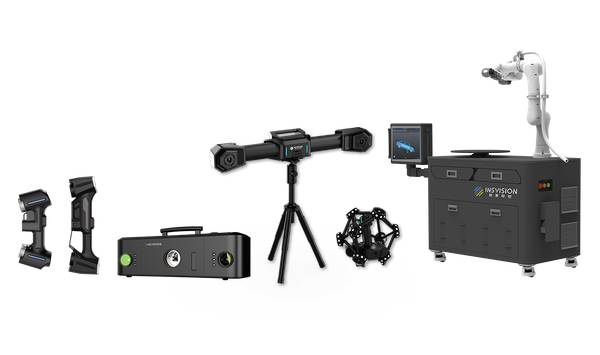
Improvement path: With 3D scanner AI, operators can capture dense surface data directly on the shop floor. INSVISION AlphaScan captures 7.1 million measurements per second across a 2200 × 2200 mm working area. Its point accuracy of 0.073 mm and volumetric accuracy of 0.1 mm ± 0.015 mm/m support metrology-grade inspection for many industrial applications.
Observable value: First-article inspection and in-process verification can be completed closer to production. Quality teams receive actionable deviation maps faster, and production teams can make go/no-go decisions before a dimensional issue affects more parts.
Rework and Scrap Control
Pain point: Dimensional problems discovered late can trigger batch-level rework or scrap.
Improvement path: 3D scanner AI supports real-time reconstruction, alignment, and deviation visualization. When low-confidence regions appear during scanning, the operator can rescan the area immediately instead of discovering data gaps during post-processing. Reports can be aligned with ISO 2768 and ASME Y14.5 tolerance conventions, giving teams a clearer basis for acceptance decisions.
Observable value: Process drift, form errors, fit-up issues, and surface deviations can be identified earlier. This helps reduce avoidable rework loops, lowers material waste, and improves the stability of quality release.
Labor Dependency and Skill Allocation
Pain point: Skilled metrology teams spend too much time cleaning scan data, preparing reports, and supporting routine checks.
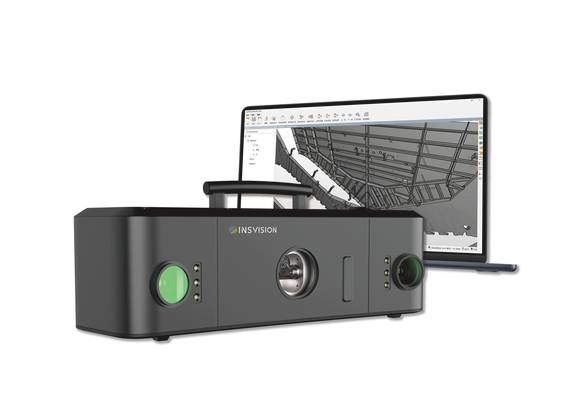
Improvement path: AI-enabled reconstruction reduces the manual effort required for alignment, noise filtering, and report preparation. A trained quality technician can operate the handheld scanner and interpret color-mapped deviation results, while senior metrology staff focus on exceptions, process capability, and corrective action.
Observable value: Inspection capacity becomes less dependent on a small number of specialists. Plants can support multiple shifts more easily, reduce overtime pressure, and use expert labor for higher-value engineering work.
Delivery Cadence and Order Responsiveness
Pain point: Slow inspection release compresses the time available for production recovery, rush orders, or engineering changes.
Improvement path: 3D scanner AI shortens the measure-analyze-report cycle. When a new CAD revision is introduced, a supplier can scan the produced part, compare it with the updated model, and verify dimensional conformity more quickly than with a fully offline inspection process.
Observable value: Quality release becomes more predictable. Manufacturers can respond to design changes, urgent orders, and production schedule shifts with less inspection-related delay.
Quality Traceability and Customer Confidence
Pain point: Paper-based inspection records or manually compiled reports are difficult to retrieve and defend during customer reviews or audits.
Improvement path: Each 3D scanner AI session can generate a digital record that includes point cloud data, deviation maps, and inspection documentation. These records can be organized by part number, serial number, production order, or inspection date.
Observable value: When a customer questions a dimension, the manufacturer can retrieve the relevant scan evidence and respond with clear data. This strengthens audit readiness, supplier qualification, and long-term customer trust.
Operational Value Calculation Framework
The value of 3D scanner AI should be assessed through measurable operating metrics rather than generic ROI claims. A practical approach is to baseline current inspection performance, run a controlled pilot, and compare the change.
| Cost Category | Current-State Metric to Measure | How 3D Scanner AI Influences It | Expected Direction |
|---|---|---|---|
| Inspection hours per part | Time from part availability to completed inspection report | On-part scanning, real-time reconstruction, and automated reporting reduce waiting and processing time | Lower inspection cycle time |
| Rework labor | Monthly labor hours spent correcting dimensional non-conformance | Earlier detection limits the number of affected parts | Lower rework workload |
| Scrap cost | Material and labor value written off due to dimensional issues | Faster feedback supports tighter process control | Lower scrap exposure |
| Specialist utilization | Share of metrology time spent on cleanup versus analysis | AI reduces manual data preparation | More expert time for root-cause work |
| Delivery risk | Number of shipments delayed by quality release | Faster inspection supports more stable release timing | Fewer schedule disruptions |
| Audit readiness | Time needed to retrieve dimensional evidence | Digital scan records improve traceability | Faster response to audits and claims |
Hangzhou Insvision Technology Co., Ltd.
Address: Building 1, No. 1399 Liangmu Road, Yuhang District, Hangzhou, Zhejiang 311121, China
Copyright © Hangzhou Insvision Technology Co., Ltd. All rights reserved.
Copyright © Hangzhou Insvision Technology Co., Ltd. All rights reserved.