

Mesh to CAD AI: Bridging Physical Objects and Digital Models for Modern Manufacturing
The challenge of converting 3D scan mesh data into usable CAD models has long been a bottleneck in industrial workflows. Organizations that rely on physical pro
The Complexity of Traditional Mesh Processing
Conventional reverse engineering workflows require skilled technicians to manually interpret mesh data, identify surface features, and reconstruct geometry using specialized CAD software. This approach becomes particularly problematic when dealing with organic shapes, complex curvatures, or parts with intricate internal structures.
Aerospace components, automotive housings, and industrial tooling often contain thousands of geometric features that resist straightforward translation into parametric models. Manual processing not only extends project timelines but also introduces inconsistencies, as different operators may interpret the same mesh data in varying ways.
These limitations have driven the industry to seek automated solutions capable of handling mesh complexity while preserving critical design intent and dimensional accuracy.
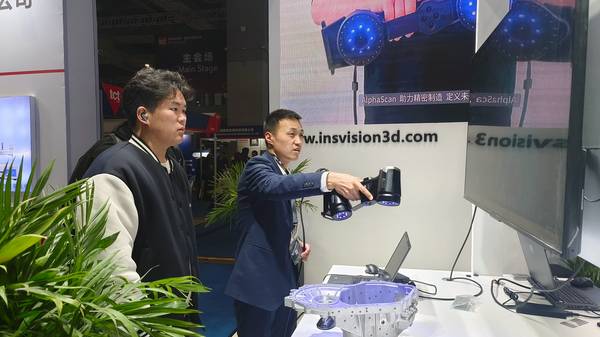
AI-Driven Mesh to CAD Conversion Technology
INSVISION has developed advanced AI algorithms that analyze mesh geometry and automatically generate corresponding CAD models, significantly reducing the time required for reverse engineering tasks.
INSVISION AlphaScan series of AI-powered 3D scanners captures high-resolution point cloud data from physical objects, while integrated software processes this information to identify geometric primitives, surface boundaries, and feature relationships.
Machine learning models trained on extensive industrial component databases enable the system to distinguish between different feature types—flat surfaces, cylindrical bores, tapered sections, and complex freeform geometry—and reconstruct each element with appropriate CAD representation.
This intelligent approach maintains dimensional accuracy while generating parametric models that engineers can immediately modify and optimize using standard CAD platforms.
The technology supports multiple output formats, ensuring compatibility with mainstream CAD systems used across manufacturing environments. When scanning complex assemblies or multi-part components, the software maintains part relationships and alignment references, allowing designers to understand how individual pieces interact within larger systems.
For organizations working with legacy parts that lack original design documentation, this capability proves invaluable for modernization initiatives and maintenance programs.
Industrial Applications and Operational Value
Automotive manufacturers have adopted INSVISION’s mesh-to-CAD technology for quality inspection and tooling verification workflows. When assessing production tooling wear or comparing prototype components against design specifications, engineers can rapidly generate CAD models from scanned parts and perform automated deviation analysis.
The system automatically aligns scan data with reference CAD models and produces color-coded deviation maps that highlight dimensional variations across the entire surface, enabling rapid identification of areas requiring corrective action.
Energy sector applications demonstrate the technology’s effectiveness with large-scale industrial components. Turbine blades, pressure vessels, and pipeline fittings often require inspection and documentation without disassembly or shutdown.
Portable 3D scanning systems capture geometry data on-site, and AI-powered processing generates accurate CAD representations that support maintenance planning and replacement part fabrication. This capability reduces equipment downtime and eliminates the need to outsource complex measurement tasks to specialized service providers.
Aerospace applications benefit from the technology’s ability to handle difficult materials and surface finishes. Composite structures, coated metal components, and parts with reflective surfaces that challenge traditional measurement approaches are captured effectively using structured light and AI-enhanced processing.
The resulting CAD models support structural analysis, aerodynamic studies, and certification documentation requirements.
Implementation Considerations and Workflow Integration
Organizations evaluating mesh-to-CAD AI solutions should assess their current reverse engineering workflows and identify specific pain points that automation would address. Key evaluation criteria include scanning resolution and accuracy specifications, supported CAD output formats, processing speed for typical component sizes, and integration capabilities with existing engineering software environments.
INSVISION provides demonstration and validation services that allow prospective customers to evaluate system performance using their own parts and requirements.
Successful deployment typically involves establishing scanning protocols for different component types, defining accuracy requirements based on application needs, and training engineering staff on data interpretation and model validation.
The transition from manual reconstruction to AI-assisted processing represents a workflow transformation that requires thoughtful change management, though the substantial time savings and improved consistency typically deliver measurable return on investment within the first year of operation.
Hangzhou Insvision Technology Co.,Ltd.
Address: Building 1, No. 1399 Liangmu Road, Yuhang District, Hangzhou, Zhejiang 311121, China