

Handheld 3D Vision Inspection with INSVISION AlphaScan for Lean Manufacturing Efficiency
Explore how handheld 3D vision inspection reduces rework and shortens cycles. A practical operational guide for manufacturing leaders evaluating INSVISION AlphaScan.
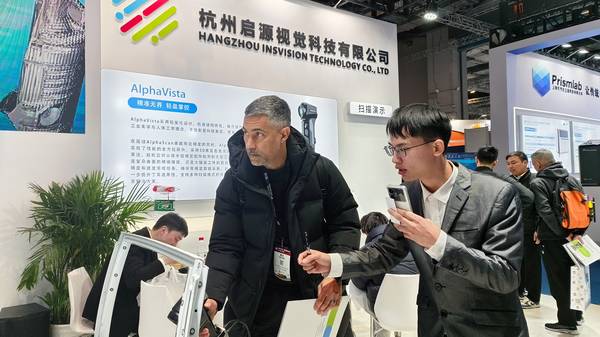
Manufacturing operations today face a tightening vise: customer tolerances are shrinking, delivery windows are compressing, and the skilled metrology technicians who once bridged the gap are harder to find and retain. In this environment, inspection is no longer a neutral quality gate. It is either a bottleneck that inflates lead times and rework costs, or a lever that compresses them.
The difference often comes down to where and how dimensional data is captured.
Traditional inspection workflows carry hidden operational costs that rarely appear on a capital equipment requisition. Moving large parts to a fixed CMM consumes material-handling hours and creates waiting waste. Manual tools—calipers, micrometers, height gages—leave complex freeform surfaces unmeasured, pushing fit problems downstream.
When a first-article inspection fails, the rework loop can stall an entire production batch. And when legacy components arrive without CAD models, the reverse-engineering effort can tie up engineering talent for days.
Handheld 3D vision inspection changes the cost structure of these workflows. It moves measurement to the part, rather than the part to measurement. It captures full-field surface data in a single pass, eliminating the sampling guesswork of point-based tools. And it generates a digital twin that feeds directly into GD&T analysis, traceability records, and, when needed, parametric CAD reconstruction.
This article examines the operational value of that shift—where the savings accumulate, how to evaluate them in your own plant, and which applications deliver the fastest payback with a system like the INSVISION AlphaScan.
Where Traditional Inspection Erodes Margins
Before quantifying gains, it helps to map the cost centers that conventional inspection creates. Four categories consistently surface in plants that run a mix of manual tools, fixed CMMs, and first-generation optical systems.
Transportation and waiting waste. A large weldment or composite layup that must travel to a climate-controlled metrology lab is not adding value while it moves or while it waits for an available CMM. Those hours inflate overall lead time and often force production to run on assumption until the report arrives.
Rework amplification. When a manual check catches a dimensional error only at final inspection, the part has already accumulated all its processing cost. Scrapping or reworking it at that stage is far more expensive than catching the deviation in-process. Even when the part is salvageable, the rework itself consumes capacity that could have produced good parts.
Skill bottlenecks. Tactile measurement of complex profiles, deep bores, or tight radii depends heavily on operator technique. As experienced inspectors retire, the tacit knowledge of how to fixture a part, probe a feature, and interpret borderline readings leaves with them. Junior staff need months to reach the same throughput, and during that ramp-up, inspection becomes a pacing constraint.
Data discontinuity. A quality manager who must export point clouds from a scanner, align them in a second software package, and run GD&T in a third is paying a tax in engineering hours and version-control risk. Every manual handoff between tools is an opportunity for error and a drain on talent that should be solving problems, not stitching files together.
These costs are real, but they are also addressable. The next section maps how a handheld 3D vision inspection platform can restructure the workflow to remove them.
How 3D Vision Inspection Restructures Inspection Costs
The operational impact of a handheld 3D vision inspection system becomes visible when you trace it through the typical manufacturing inspection sequence. Below are the key intervention points.
Part handling and setup.
*Pain point:* Moving large, heavy, or immovable assemblies to a fixed measurement station.
*Improvement:* A handheld scanner travels to the part—whether it sits in a weld cell, on an assembly jig, or at a machining center. The INSVISION AlphaScan performs automatic part alignment through geometric feature recognition, so dedicated fixtures are unnecessary for most applications.
*Observable value:* Material-handling hours drop; inspection can begin minutes after the last manufacturing operation, rather than after a transport queue.
Data acquisition speed.
*Pain point:* CMM touch-probe routines that sample discrete points, or manual tools that capture only linear dimensions, leaving complex surfaces uninspected.
*Improvement:* Multi-line blue laser scanning captures millions of points per second, generating a dense point cloud that represents the entire surface. The AlphaScan’s cross-line mode (up to 34 intersecting laser lines) covers large areas rapidly; single-line mode isolates fine details on edges, pockets, and radii—all from the same Class 2M eye-safe source.
*Observable value:* Per-part inspection cycle times shrink significantly compared to tactile methods, especially on parts with numerous GD&T callouts. The scanner also handles high-reflective and dark surfaces without developer spray, eliminating a consumable step and its associated time.
Rework and defect prevention.
*Pain point:* Discovering dimensional non-conformance only at final inspection, after all value-added operations are complete.
*Improvement:* In-process or near-line scanning gives operators and engineers a deviation map against the CAD nominal within minutes. The AlphaScan’s onboard AI-driven noise filtering preserves sharp edges and geometric transitions, so the data is metrology-ready without manual point-cloud cleaning.
*Observable value:* Shifting detection earlier in the process reduces the cost of correction. A deviation caught after machining but before surface treatment saves the finishing cost and avoids cascading delays. Over time, trend data from frequent scans can highlight tool wear or process drift before it produces scrap.
Reverse engineering and legacy parts.
*Pain point:* No CAD model exists for a replacement part, forcing manual measurement and iterative prototyping.
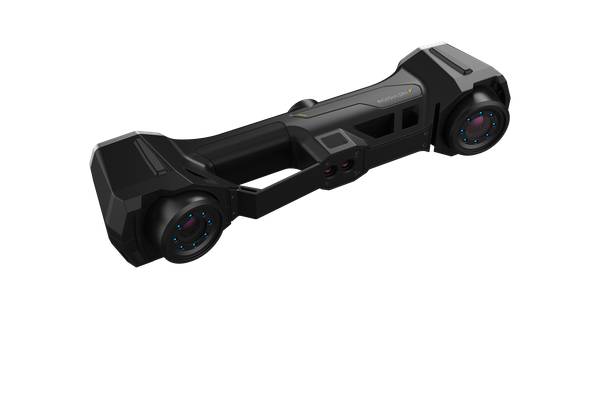
*Improvement:* A full 3D scan captures complex freeform surfaces directly to a mesh that can be converted into a parametric CAD model. The AlphaScan’s ability to merge multiple scans with reference targets supports large assemblies.
*Observable value:* Engineering hours spent reconstructing geometry drop from days to hours. For MRO operations, this means faster turnaround on repair quotes and less machine downtime waiting for a dimensional definition.
Quality documentation and traceability.
*Pain point:* Inspection reports that are manually compiled, stored as static PDFs, and difficult to retrieve during customer audits.
*Improvement:* The unified INSVISION software platform handles scanning, alignment, GD&T evaluation (per ASME Y14.5), and reporting in one environment. Color-mapped deviation plots and tabular results are generated automatically.
*Observable value:* Audit preparation time shrinks because traceable records are already organized. For suppliers serving regulated industries, this digital thread aligns with Industry 4.0 requirements and can strengthen customer confidence during source inspections.
An Operational Value Framework for Your Own Evaluation
Every plant has a different cost structure, so a universal ROI figure would be misleading. Instead, the table below provides a self-assessment framework. For each cost category, estimate your current baseline and observe how a handheld 3D vision inspection system would shift the numbers. The goal is to identify which levers matter most in your operation.
| Cost Category | What to Measure | How Handheld 3D Vision Inspection Changes It |
|---|---|---|
| Inspection cycle time | Hours per part from last operation to approved report | Reduced by eliminating transport, fixturing, and multi-step data processing |
| Rework and scrap cost | Percentage of parts reworked or scrapped due to dimensional issues | Lowered by earlier detection and in-process deviation mapping |
| Metrology labor | Hours of skilled inspector time per batch | Decreased by automated alignment, AI filtering, and faster data capture; less dependence on senior technicians for complex geometries |
| Material handling | Forklift/crane moves and waiting time for CMM availability | Minimized when the scanner goes to the part, especially for large assemblies |
| Engineering time for reverse engineering | Hours to create a CAD model from a physical part | Compressed by direct mesh-to-CAD workflows from full-field scan data |
| Audit and documentation cost | Person-days spent preparing inspection records for customers or regulators | Reduced by integrated reporting that maintains a digital thread from scan to report |
| Consumables and preparation | Cost of developer sprays, fixturing, and surface preparation | Eliminated or reduced; blue laser handles reflective and dark surfaces without coating |
To use this framework, pick one part family or workcell that currently creates a recurring inspection bottleneck. Measure the current-state metrics for a representative sample. Then run a pilot with a handheld 3D vision inspection system on the same parts and compare. The difference, annualized across the volume that flows through that cell, gives you a conservative estimate of operational savings.
This approach avoids the trap of top-down ROI projections that don’t reflect your actual mix.
Where INSVISION AlphaScan Creates Perceptible Operational Improvement
The AlphaScan platform from INSVISION incorporates several design choices that translate directly into the cost categories above. Understanding these choices helps an operations team see beyond specifications to shop-floor impact.
Handheld portability and multi-mode scanning. A single device moves between a cramped automotive weld cell, a large aerospace composite layup, and a machining center without altering the production line. The dual-mode laser—cross-line for speed, single-line for detail—means the same tool handles both rapid large-area acquisition and high-resolution feature capture.
This eliminates the need for multiple scanning systems and reduces the training burden on operators.
AI-driven point cloud processing. Reflective and dark surfaces are a persistent challenge in industrial metrology. The AlphaScan’s onboard algorithms distinguish surface data from reflections and ambient artifacts in real time, preserving sharp edges that matter for GD&T. For the operator, this means no manual point-cloud cleaning—a step that can consume 20–30% of post-processing time with some systems.
The time saved goes directly into analysis and decision-making.
Unified software ecosystem. Scanning, alignment, inspection, and reporting live inside a single 3D INSVISION software environment. There is no exporting between packages, no version mismatches, and no re-importing data. For a quality team, this removes a daily friction point and lets engineers focus on interpreting results rather than managing file formats.
Metrology-grade validation. Accuracy specifications are anchored to ISO 10360 acceptance tests, the same framework used for CMMs. This means a quality manager can map the AlphaScan’s capabilities directly into an existing uncertainty budget. CE and FCC marks, plus CNAS-accredited lab validation, satisfy documentation requirements for global supply chains.
For an engineering team, this reduces the compliance risk of adopting a new measurement technology.
Lean waste mapping. Each of these capabilities maps to a classic lean manufacturing waste category. Portability cuts transportation and waiting waste. AI filtering cuts defect waste (bad data) and overprocessing waste (manual cleaning). Unified software cuts talent waste (hours spent on data wrangling). The system becomes an operational decision, not just a technical purchase.
Implementation Rhythm: Where to Start
For a plant that has not yet deployed handheld 3D vision inspection, a phased approach reduces risk and builds internal buy-in. The following sequence targets applications where the operational value is most visible.
Phase 1: In-process inspection of a bottleneck workcell. Identify one cell where parts frequently wait for CMM capacity or where dimensional issues surface late. Deploy the AlphaScan at or near the cell to perform rapid first-article checks and in-process spot inspections. The immediate goal is to cut the inspection waiting time and catch deviations before the part leaves the cell.
This phase typically delivers a visible reduction in lead time and rework within weeks.
Phase 2: Reverse engineering and legacy part digitization. Many plants carry a backlog of spare parts or tooling with no CAD definition. Assign the scanner to capture these components during planned downtime or as part of a digital inventory initiative. The output—parametric models—becomes a long-term asset that reduces future engineering hours and procurement lead times.
Phase 3: Expand to supplier quality and in-line monitoring. Once internal teams are comfortable with the workflow, extend the system to incoming inspection of supplier parts and to periodic monitoring of production tooling for wear trends. The same device can move between receiving, the shop floor, and the tool crib, providing a consistent measurement method across the plant.
At this stage, the data stream from regular scans begins to feed a process capability database that supports predictive maintenance and continuous improvement.
Throughout these phases, the key metric is not just scan speed, but the reduction in total time from “part ready to inspect” to “decision made.” That metric captures the combined effect of handling, scanning, processing, and reporting—and it is the one that shows up on the production schedule.
Summary
Handheld 3D vision inspection is not a replacement for every measurement tool on the shop floor. Calipers and micrometers still have their place for quick linear checks. Fixed CMMs remain the gold standard for certain high-precision, high-repeatability tasks.
But for the growing share of manufacturing work that involves complex geometries, high-mix production, large assemblies, and tight delivery schedules, the operational math favors moving inspection to the part.
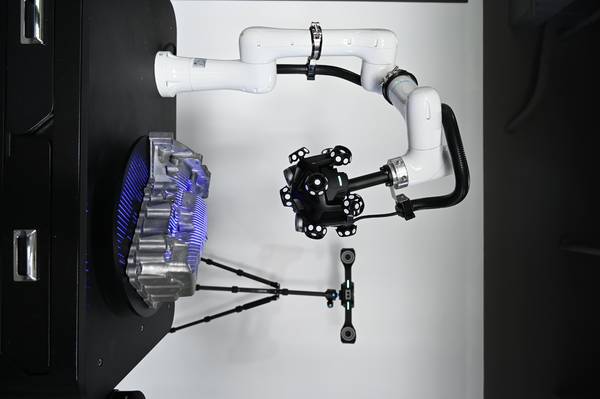
The INSVISION AlphaScan platform addresses the cost centers that erode margins in traditional workflows: transportation, waiting, rework amplification, skill bottlenecks, and data discontinuity. By compressing inspection cycle times, reducing rework, and creating a digital thread from scan to report, it turns dimensional inspection from a cost of quality into a driver of throughput.
For a plant manager or operations director, the question is not whether the technology works—it is which bottleneck to tackle first.
Hangzhou Insvision Technology Co., Ltd.
Address: Building 1, No. 1399 Liangmu Road, Yuhang District, Hangzhou, Zhejiang 311121, China
Copyright © Hangzhou Insvision Technology Co., Ltd. All rights reserved.
Copyright © Hangzhou Insvision Technology Co., Ltd. All rights reserved.