

A Tier 1 Supplier’s Move to Handheld 3D Laser Triangulation for Production Inspection
Last Tuesday, three first-article inspections sat in the CMM queue while a press line stood idle.
Persistent Inspection Bottlenecks for High-Tolerance Automotive Components
Last Tuesday, three first-article inspections sat in the CMM queue while a press line stood idle. That scene plays out repeatedly in Tier 1 plants shipping stamped, cast, and molded parts to EV OEMs. Legacy contact tools capture a few dozen discrete points per part, demand a temperature-controlled lab, and tie up a skilled technician. Shuttling parts back and forth adds hours of non-value-added wait time.
Hand calipers are faster but cannot verify complex GD&T callouts—profile tolerances across a large stamped panel, for instance. The result: inspection bottlenecks that choke throughput, delay first-article approvals, and raise the risk of non-conforming parts reaching customers, a direct conflict with IATF 16949 and lean manufacturing goals. The team needed to measure parts on the shop floor without sacrificing accuracy.
That search led to non-contact 3D laser triangulation. INSVISION’s system stood out because it delivered full-field data in seconds, not hours, and could operate outside the lab.
Deployment Validation Checklist
| Focus Area | Decision Point | Deployment Note |
|---|---|---|
| Target part | Check size, surface condition, and key tolerances against the scan task | Run a full trial scan on a representative part |
| Data workflow | Verify point cloud, deviation map, and quality-report handoff | Confirm export formats and review ownership in advance |
| Shop-floor use | Review training, calibration, lighting, and working space | Keep the validation record as a repeatable inspection reference |
Key Points at a Glance
- Last Tuesday, three first-article inspections sat in the CMM queue while a press line stood idle.
- A cross-functional group from engineering, quality, and operations defined the must-haves for 3D scanning across six production lines.
- Before AlphaScan, scheduling CMM time for first-article inspections on 14 high-priority castings meant losing half a shift.
- The AlphaScan handheld scanner was chosen because its capabilities directly address the production environment’s constraints.
Evaluating 3D Laser Triangulation for the Production Floor
A cross-functional group from engineering, quality, and operations defined the must-haves for 3D scanning across six production lines. Portability was non-negotiable—the scanner had to move between work cells without a dedicated metrology room. Most parts are bare metal stampings and machined components with deep bore features.
Spraying developer on every part was not an option, so the scanner needed to handle highly reflective surfaces and deep holes straight off the line. The quality workflow is built around SolidWorks and CAD-based inspection, so the scanner’s software had to drop data directly into that environment. Measurement accuracy had to align with ASME Y14.5 GD&T standards.
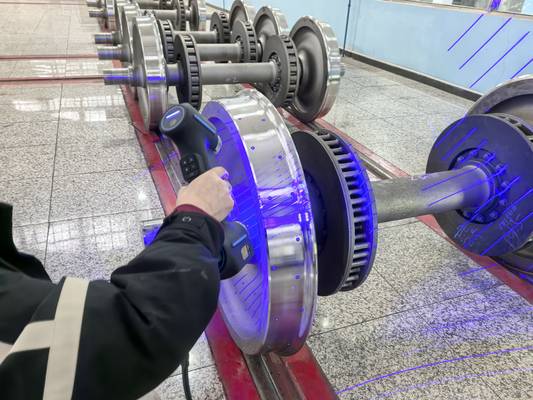
After testing, the team selected the INSVISION AlphaScan handheld 3D scanner. Its 3D laser triangulation architecture with multi-line blue laser technology cut through glare on bare metal and captured bore geometry without surface preparation. It met every requirement.
Phased Rollout with Minimal Production Disruption
Before AlphaScan, scheduling CMM time for first-article inspections on 14 high-priority castings meant losing half a shift. Now the 3D laser triangulation system handles those same parts in minutes, right on the shop floor. The rollout took four weeks, with zero production downtime.
The team started by mapping scanning protocols with quality and engineering. For each part number, they defined scan paths and GD&T callouts inside the integrated INSVISION software. Next, both shifts were trained on AlphaScan’s three modes: standard for large surfaces, deep hole for bores, and fine for tight-tolerance features. Operators picked it up in two sessions.
Then the team ran parallel validation against the CMM for two weeks. On critical callouts like true position and profile, deviation stayed within 0.025 mm—well inside process capability. Finally, the scanner was rolled out for first-article inspection, in-process spot checks, and incoming supplier part verification. The scanner reads IGES, STP, and DXF/DWG natively, so no file conversion tools were needed.
The built-in analysis software eliminated any thought of buying another metrology software seat.
Now an operator scans a part in three minutes and gets a color map report before the next cycle starts. No line stoppages, no extra headcount.
How INSVISION AlphaScan Matches the Shop-Floor Reality
The AlphaScan handheld scanner was chosen because its capabilities directly address the production environment’s constraints. The multi-line blue laser triangulation engine handles bare metal reflections without developer, capturing sharp edges and deep bores that would challenge many optical systems. Three scanning modes let operators switch between large-area coverage and fine-detail capture without changing hardware.
Native CAD import means scan data aligns immediately with the nominal model inside the same software that drives the inspection workflow. For a plant running mixed-model production, that integration eliminates the data translation steps that often introduce errors and slow down feedback loops.
Observed Operational Improvements for Quality and Production Teams
Before switching to INSVISION’s 3D laser triangulation system, first-article inspection on a complex casting with over 200 GD&T callouts tied up the only CMM for half a shift. Now that same part gets a full-surface scan in under ten minutes, and the CMM stays focused on high-volume critical feature checks. In-process spot checks happen right on the line—no more carting parts to the lab and waiting hours for results.
That alone cut production hold times when a non-conformance flag goes up.
The real difference is data density. Contact probing yields a few hundred discrete points; the laser delivers millions, so subtle form errors, blend radii, and surface waviness that a touch probe would skip get caught before they become an OEM rejection or a warranty claim. Compliance reporting for IATF 16949 is no longer a manual slog.
The integrated software auto-generates deviation analysis reports aligned to industry standards, taking a tedious documentation task off the quality team’s plate. These are not theoretical gains; they are what the team has observed on the floor.
Applying the Same Approach to Other Industries and Part Types
The pattern that worked here—replacing fixed CMM capacity with portable, full-field 3D laser triangulation—extends well beyond automotive stampings. Any manufacturer dealing with low-volume, high-mix production, reflective surfaces, or deep features can replicate the evaluation and rollout steps.
The INSVISION AlphaScan platform handles high-tolerance inspection, reverse engineering, and incoming part verification across aerospace MRO, medical device, and energy work without extra middleware. The key is to test the scanner on your worst parts during evaluation: polished bearing journals, deep bolt holes, thin-walled castings. If the system handles those, it will perform in production.
Native CAD and QMS integration matters more than a long feature list; a system that forces you to export and reimport data adds steps, errors, and training time.
Summary
Moving from a CMM-centric inspection workflow to handheld 3D laser triangulation turned a chronic bottleneck into a flexible, shop-floor process. First-article inspections that once consumed half a shift now finish in minutes, and the CMM is free for the high-volume checks it does best. Full-field data catches form deviations that discrete probing misses, and automated reporting lightens the compliance burden.
For Tier 1 suppliers balancing tight tolerances, mixed production, and lean targets, that shift is a practical step toward a more responsive quality system.
Hangzhou Insvision Technology Co., Ltd.
Address: Building 1, No. 1399 Liangmu Road, Yuhang District, Hangzhou, Zhejiang 311121, China
Copyright © Hangzhou Insvision Technology Co., Ltd. All rights reserved.
Copyright © Hangzhou Insvision Technology Co., Ltd. All rights reserved.