

Faster Inspection and Lower Rework Costs Using a 3D Scanner for Car Parts
Discover how a 3D scanner for car parts reduces rework, compresses lead times, and improves inspection throughput for automotive suppliers and OEMs.
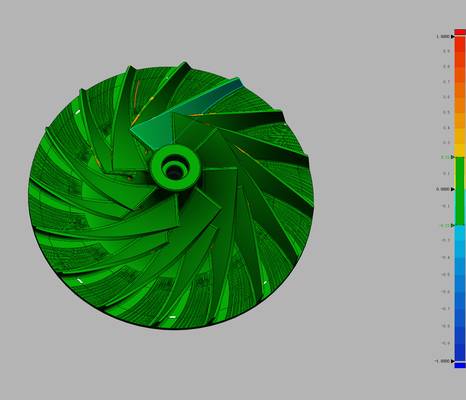
That assumption is worth revisiting. Handheld 3D scanning has matured into a metrology-grade tool that can reshape how car part inspection fits into production, not as a standalone capital purchase but as a lever for reducing rework, compressing lead times, and building a digital thread that pays back across multiple programs.
This article maps the operational cost drivers that legacy inspection workflows create, outlines where a 3D scanner for car parts changes the economics, and provides a framework for evaluating the investment in terms a plant manager or CFO can act on.
Where Traditional Inspection Erodes Margin
Most automotive part inspection still relies on coordinate measuring machines (CMMs), dedicated gauges, or manual hand tools. Each method carries structural costs that compound as part complexity and mix increase.
The first bottleneck is programming and setup time. A CMM program for a new casting or stamped part can take days to validate, and any design revision forces a rework of the inspection routine. During that window, production either waits or runs at risk, generating inventory that may later be scrapped. Dedicated gauges solve speed but lock the line into a single part number;
a mid-cycle refresh or an engineering change can render a six-figure gauge obsolete overnight.
The second cost is the feedback loop. When a CMM report flags a deviation, the data is often a sparse set of points on a 2D print. The quality engineer then translates that into a root cause hypothesis, which may require another setup on the CMM to verify. Hours pass. Meanwhile, the press or machining center keeps cycling, potentially producing more nonconforming parts.
The lag between detection and correction is a direct multiplier of scrap and rework expense.
Third, the labor model is fragile. CMM programmers and skilled layout inspectors are in short supply. When they leave, tribal knowledge leaves with them. A shop that depends on a few experts to keep measurement moving is one retirement away from a capacity crisis.
These dynamics show up in financial statements as excess material variance, premium freight charges, and unplanned overtime—all traceable to an inspection cadence that cannot keep pace with production.
How Handheld 3D Scanning Changes the Cost Equation
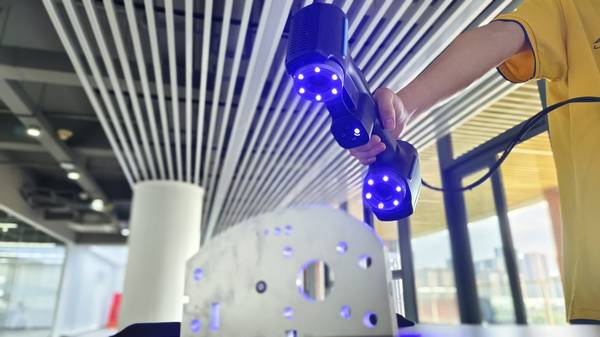
A handheld 3D scanner for car parts does not merely replace a CMM; it redistributes measurement work across the production timeline, often shifting first-article and in-process checks from a centralized lab to the shop floor. The operational impact breaks down into several measurable areas.
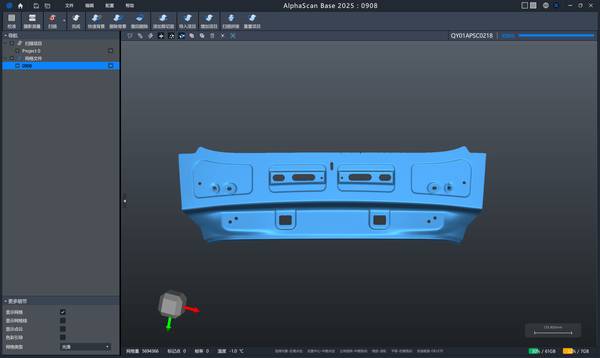
Inspection throughput and measurement cycle time. A structured-light handheld scanner captures full-field data—millions of points across a part surface—in minutes, not hours. For a complex bracket, a stamped panel, or a cast housing, the scan itself may take under ten minutes, and the software generates a deviation color map against the CAD model almost immediately.
This compresses the first-article approval window, allowing production to start sooner and reducing machine idle time. For in-process checks, a quick scan can verify critical features between tool changes, catching drift before it produces scrap.
Rework and scrap reduction. Because a 3D scanner delivers a dense point cloud rather than discrete touch points, the quality team sees the entire surface condition. Warpage, springback, and localized thinning become visible in a single view. This richer data set shortens root cause analysis.
Instead of iterative CMM runs, the team can overlay scan data onto the CAD model, identify the deviation pattern, and adjust the process—often within the same shift. The result is fewer nonconforming parts produced between detection and correction, which directly lowers material waste and rework labor.
Labor flexibility and skill dependency. Handheld scanners reduce the programming burden. An operator can be trained to scan a part and run a pre-configured inspection template in days, not weeks. This makes measurement capacity more scalable and less dependent on a single specialist. When a new part number enters the cell, the scan-to-report workflow can be set up quickly, avoiding the bottleneck of a CMM programming queue.
For plants running high-mix production, this flexibility translates into faster changeovers and more consistent quality oversight across all part numbers.
Delivery cadence and customer confidence. When dimensional validation keeps pace with production, shipment schedules become more predictable. A supplier that can provide full-field inspection reports with every batch—not just a handful of CMM points—gives its OEM customer a higher level of assurance.
This can reduce the frequency of incoming inspection at the customer site, lower the risk of line-side rejections, and strengthen the supplier’s position during sourcing decisions. The operational value here is not just cost avoidance; it is the ability to ship on time with documented conformance, which protects revenue.
Data as a long-term asset. Every scan creates a digital record of the as-built part. Over time, this archive becomes a reference for tool wear analysis, process capability studies, and engineering changes. When a tool shows progressive deviation, the scan history reveals the trend before it violates tolerance, enabling predictive maintenance rather than reactive rework.
For automotive programs that span years, this data continuity is a hard-to-replicate operational advantage.
A Practical ROI Framework for Plant-Level Evaluation
Rather than rely on vendor-supplied payback claims, a factory team can build its own assessment using internal cost data. The table below outlines the key variables to track before and after introducing a 3D scanner for car parts.
| Cost Category | What to Measure | How 3D Scanning Influences It |
|---|---|---|
| Inspection cycle time | Hours from part availability to approved report | Full-field scan and automated reporting reduce cycle time; measure the delta per part number. |
| Machine idle waiting for approval | Downtime minutes per shift attributed to measurement delay | Faster first-article release increases cutting time; track machine utilization before and after. |
| Internal scrap and rework | Cost of material and labor for parts rejected due to dimensional issues | Earlier detection and richer deviation data reduce the volume of parts produced out of spec. |
| Overtime and expediting | Premium labor hours and freight charges tied to late shipments | Predictable inspection cadence lowers the frequency of last-minute rushes. |
| Metrology labor allocation | Hours spent on CMM programming, fixture setup, and manual layout | Redeploy skilled metrology staff to higher-value analysis while operators handle routine scans. |
| Customer returns and chargebacks | Cost of returned lots, sorting, and penalties | Full-field documentation can reduce disputes and incoming inspection triggers. |
The exercise is not about producing a single ROI percentage. It is about identifying which of these line items carries the most weight in a specific plant and then measuring the shift over a defined pilot period. For many automotive suppliers, the largest initial gain comes from compressing the first-article inspection window on new or revised parts, because that directly frees up machine capacity that is already paid for.
Where INSVISION AlphaScan Fits into the Workflow
The INSVISION AlphaScan platform is built for the surface conditions and part scales common in automotive production. Its metrology-grade structured-light engine handles reflective machined surfaces, dark castings, and recessed mold cavities without spraying or coating—a practical requirement when scanning parts straight off the machining center or out of the press.
For large workpieces such as bumper fascias, door inners, or instrument panel substrates, the AlphaScan maintains volumetric accuracy across the full scan envelope, reducing the need for stitching multiple setups. For small, detail-critical components like connector housings or sensor brackets, the system resolves fine features that would be time-consuming to probe with a CMM.
This range means a single device can cover first-article inspection, tooling verification, and spot checks on the shop floor, simplifying the equipment footprint.
From an operational standpoint, the value of INSVISION’s approach shows up in three areas. First, the scan-to-report workflow is designed to be repeatable by production staff, not just metrology specialists, which addresses the labor bottleneck directly.
Second, the software’s deviation mapping and GD&T annotation tools let quality engineers communicate results to machining or stamping teams in a visual format that speeds up corrective action.
Third, INSVISION provides application documentation—covering automotive redesign workflows, large-workpiece accuracy benchmarks, small-object capture, and high-reflective recessed mold scanning—that procurement teams can use to validate performance against their own part geometries before committing.
Phased Implementation: Where to Start
A full-scale deployment is rarely the right first step. The plants that extract the most value from a 3D scanner for car parts typically begin with one or two high-pain-point applications, prove the impact, and then expand.
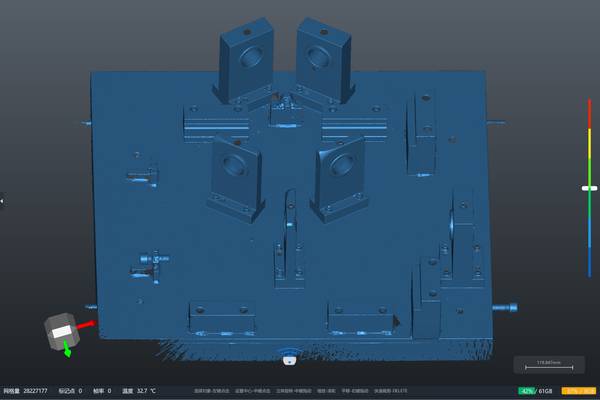
Phase 1: First-article inspection on new or revised parts. This is the most common entry point because the cost of delay is visible and the comparison to CMM lead time is straightforward. Select a part family that currently waits hours or days for first-article approval.
Run parallel scans alongside the existing CMM process for a defined trial period, tracking the time from part availability to approved report and any machine downtime avoided.
Phase 2: In-process checks for tool wear and process drift. Once the team is comfortable with the scanning workflow, move the device to the production cell for periodic checks. Scan a part at tool change or at set intervals, overlay the data on the CAD model, and watch for deviation trends. This shifts the quality function from post-process sorting to in-process control, which is where the scrap and rework savings accumulate.
Phase 3: Supplier quality and incoming inspection. For plants that receive castings, forgings, or stamped blanks from outside processors, a handheld scanner can accelerate incoming inspection and provide data to drive supplier corrective actions. The same scan data can travel with the part to downstream operations, creating a digital birth certificate that supports traceability requirements.
At each phase, the plant should capture the operational metrics outlined in the ROI framework. This builds an internal business case that is grounded in the plant’s own numbers, not a vendor’s generic claims.
The Bottom Line
Measurement is not a value-adding activity in the eyes of the customer, but it is a necessary cost of delivering conforming parts. The operational question is how efficiently that cost is carried. When inspection becomes a bottleneck, it stops being a quality safeguard and starts being a drain on throughput, labor, and customer responsiveness.
A handheld 3D scanner for car parts, deployed with a clear operational charter, can reverse that dynamic—turning measurement from a constraint into a source of faster feedback, fewer surprises, and more predictable delivery.
The technology is ready. The more pressing question for plant leadership is whether the current inspection workflow is costing more than it should, and whether the data exists to know the answer.
Reference Materials
- Application Case: Scanning for Automotive Part Redesign
- Defining 3D Scanning Accuracy for Large Workpieces: INSVISION AlphaScan
- Application Case: Small Object Scanning
- Application Case: Scanning High-Reflective Recessed Molds
Hangzhou Insvision Technology Co., Ltd.
Address: Building 1, No. 1399 Liangmu Road, Yuhang District, Hangzhou, Zhejiang 311121, China
Copyright © Hangzhou Insvision Technology Co., Ltd. All rights reserved.
Copyright © Hangzhou Insvision Technology Co., Ltd. All rights reserved.