

Point Cloud Downsampling
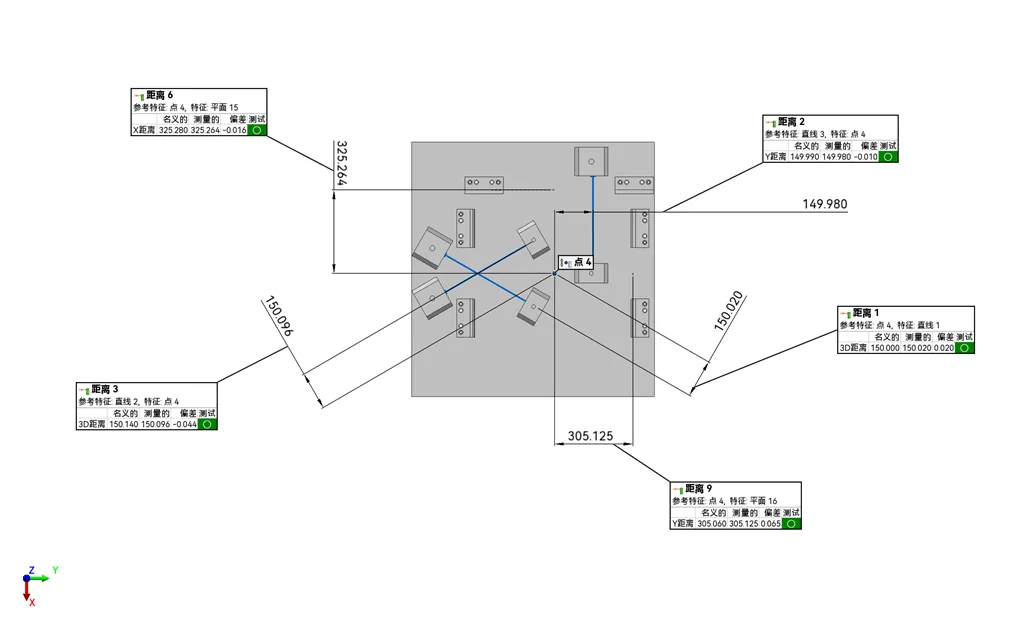
Point cloud downsampling (also referred to as point cloud simplification or sub sampling) is a 3D data processing technique that reduces the total number of points in a raw point cloud generated by 3D scanning systems, while preserving critical geometric, topological, and metrological properties of the scanned object.
Definition
Point cloud downsampling (also referred to as point cloud simplification or sub-sampling) is a 3D data processing technique that reduces the total number of points in a raw point cloud generated by 3D scanning systems, while preserving critical geometric, topological, and metrological properties of the scanned object. It is a standard intermediate step in industrial 3D digitization workflows, used to optimize storage requirements, processing speed, and downstream usability of 3D data.
How It Works
Point cloud downsampling operates on raw point cloud data generated by 3D scanning platforms, including structured light, handheld, optical tracking, and automated scanning systems. The general workflow follows three core steps:
- Input preprocessing: Raw point clouds are first cleaned of obvious outlier points to avoid invalid data influencing downsampling results.
- Algorithm application: A selected downsampling algorithm processes the cleaned cloud according to user-configured parameters. Common algorithm types include:
- Voxel grid downsampling: The most prevalent industrial method, which divides 3D space into equal-sized cubic voxels, then retains a single representative point (typically the centroid of all points in the voxel) for each grid unit that contains points.
- Curvature-based downsampling: Calculates the local curvature of the surface at each point, retaining a higher density of points in high-curvature regions (e.g., edges, corners, holes) and reducing point density in flat, uniform regions.
- Random downsampling: Randomly removes a specified percentage of points, offering very fast processing but high risk of feature loss, making it unsuitable for most metrology applications.
- Normal-based downsampling: Uses surface normal vector data to preserve points that contribute to surface continuity, reducing redundant points in regions with consistent surface orientation.
- Output validation: The downsampled point cloud is checked for feature retention and uniformity to ensure it meets downstream application requirements.
Key Parameters and Criteria
Optimal downsampling performance depends on calibrated parameters aligned with workflow requirements. Key measurable parameters are outlined below:
| Parameter | Meaning | Judgment Method |
|---|---|---|
| Voxel Size (voxel-based methods) | Edge length of the cubic 3D grid units used to group adjacent points during downsampling | Align voxel size with the minimum critical feature size required for the downstream task; confirm voxel size is no larger than half the smallest feature dimension to avoid merging adjacent geometric features |
| Feature Retention Rate | Percentage of critical geometric features (edges, corners, holes, surface discontinuities) preserved in the downsampled point cloud relative to the raw input | Compare coordinate deviation of key reference features between raw and downsampled clouds using metrology software; acceptable deviation is determined by the tolerance requirements of the use case |
| Point Cloud Uniformity | Degree of even spatial distribution of points across the scanned surface after downsampling | Calculate the standard deviation of nearest-neighbor point distances across the full cloud; lower standard deviation indicates higher uniformity, which improves reliability of downstream registration and meshing |
| Processing Latency | Total time required to complete downsampling for a given input point cloud size | Measure end-to-end processing time on the target hardware configuration; latency must be compatible with workflow throughput requirements, particularly for real-time or automated scanning workflows |
Parameter values vary based on input point cloud size, scan resolution, object geometry, and downstream application requirements.
Suitable and Unsuitable Scenarios
Suitable Scenarios
- Large-scale 3D scanning workflows (e.g., full vehicle bodies, heavy machinery, architectural components) where raw point clouds contain billions of points, requiring size reduction to enable efficient CAD alignment, reverse engineering, or digital twin generation.
- Real-time 3D scanning and tracking workflows (e.g., robotic automated scanning, optical motion tracking for assembly) where low latency is required for live feedback and process control.
- Non-metrology visualization and simulation use cases (e.g., assembly validation, digital twin rendering, training simulations) where extreme point-level precision is not required but smooth performance is critical.
- Intermediate processing steps (e.g., initial rough point cloud registration, preliminary defect detection) where full raw resolution is unnecessary for accurate completion of the step.
Unsuitable Scenarios
- High-precision metrology workflows requiring measurement of micro-scale features (e.g., tolerance verification of sub-2mm part features, inspection of apertures smaller than 5mm), where downsampling may eliminate critical measurement points.
- Archival scanning of cultural heritage artifacts or forensic evidence, where full raw point cloud fidelity is required for permanent, unaltered records.
- Ultra-precision manufacturing applications including dental scanning, jewelry production, and microelectronics inspection, where even minor point loss can compromise part functionality or compliance.
- Scanning of objects with extremely complex surface topology (e.g., fine mesh structures, intricate castings) where redundant point data is minimal and downsampling would risk erasing unique geometric details.
Common Misconceptions
- Misconception: Downsampling inherently reduces measurement accuracy.
Correction: Feature-aware downsampling algorithms (such as curvature-based or calibrated voxel grid methods) only remove redundant points from uniform, low-detail surface regions while retaining all points in high-priority feature areas. When calibrated to the required tolerance, this process produces no measurable loss of accuracy for qualified industrial metrology applications.
- Misconception: Larger voxel sizes are always preferable for reducing processing time.
Correction: Excessively large voxel sizes can merge adjacent small features, smooth sharp edges, or eliminate fine holes, leading to errors in downstream measurement, reverse engineering, or alignment. These errors often require re-scanning or rework, increasing total workflow time rather than reducing it.
- Misconception: Downsampling is only necessary for very large point clouds (e.g., full vehicle or building scans).
Correction: Even medium-sized point clouds of small to medium industrial parts often contain redundant points from scanner over-sampling on flat surfaces. Targeted downsampling removes this redundant data, improving software responsiveness and reducing storage requirements without compromising part detail.
- Misconception: All downsampling algorithms produce equivalent output.
Correction: Algorithm selection directly impacts output quality and suitability for use cases. Random downsampling, while fast, may erase critical features and is rarely suitable for industrial metrology. Voxel grid and curvature-based methods are preferred for most industrial workflows due to their predictable performance and feature retention capabilities.
Related Concepts
- Point Cloud Noise Removal: A pre-processing step that removes spurious outlier points caused by surface reflectivity, ambient light interference, or scanner hardware error, typically performed before downsampling to avoid retaining invalid points as representative data.
- Point Cloud Registration: The process of aligning multiple overlapping partial point clouds into a single unified 3D model; downsampling is widely used to speed up initial rough registration steps by reducing the volume of data processed.
- 3D Meshing: The conversion of a point cloud into a polygonal surface mesh; downsampling reduces meshing time, simplifies mesh topology, and produces lighter models suitable for visualization or simulation.
- Metrology-Grade 3D Scanning: High-accuracy 3D scanning workflows designed for tolerance verification, quality control, and precision measurement; downsampling parameters for these workflows must be calibrated to ensure compliance with required measurement uncertainty thresholds.
- 3D Digitization: The broader process of converting physical objects into digital 3D representations, of which point cloud downsampling is a common intermediate processing step.
FAQ
Does point cloud downsampling always reduce measurement accuracy?
No, when configured appropriately for the intended use case, feature-aware downsampling algorithms preserve all points in high-detail, high-curvature regions while only removing redundant points from uniform flat surfaces. For intermediate processing steps or non-metrology applications, this can reduce processing load without measurable impact on output quality. For high-precision metrology workflows, downsampling parameters can be calibrated to retain all points required to meet specified tolerance requirements.
What is the most commonly used downsampling algorithm for industrial 3D scanning?
Voxel grid downsampling is the most widely adopted algorithm for industrial 3D scanning workflows due to its balance of processing speed, predictable point count reduction, and ability to produce uniformly distributed point clouds. Curvature-based and normal-based downsampling are also commonly used for applications requiring prioritized feature retention, such as reverse engineering of complex castings or stamped parts.
Should downsampling be performed before or after point cloud noise removal?
It is standard industry practice to perform noise removal prior to downsampling. Removing outlier points first prevents invalid or noisy data from being selected as the representative point for a voxel or feature region, which would introduce systematic errors into the downsampled point cloud.
How do I select an appropriate voxel size for my workflow?
Optimal voxel size depends on multiple factors, including the raw scan resolution, the size of the smallest critical geometric feature that must be preserved, and the accuracy requirements of the downstream application. As a general guideline, voxel size should be no larger than half the dimension of the smallest critical feature to avoid merging adjacent geometric details.
Summary
Point cloud downsampling is a core intermediate processing technique for industrial 3D scanning workflows that reduces redundant point data while preserving critical geometric features. Its performance and suitability depend on algorithm selection, parameter calibration, and the specific requirements of downstream applications, ranging from real-time visualization and simulation to high-precision metrology and reverse engineering. Properly configured downsampling improves processing speed, reduces storage overhead, and supports efficient end-to-end 3D digitization without unnecessary loss of accuracy for qualified use cases.
- What Is 3D Scanning? Principles, Workflow, and Industrial Applications 3D scanning is a digital measurement technology that converts the surface geometry of physical objects into 3D data. This entry covers its working principles, core parameters, industrial use cases, common misconceptions, and related technical…
- What Is a 3D Scanner? Types, Parameters, and Selection Criteria A 3D scanner captures three-dimensional surface data from physical objects and converts geometry, dimensions, and features into digital data for inspection, reverse engineering, and modeling.
- What Is 3D Scanning Accuracy? Accuracy, Repeatability, and Resolution Explained 3D scanning accuracy describes how closely scan data matches an object's actual geometry and dimensions. It is assessed through local accuracy, volumetric accuracy, stitching accuracy, repeatability, and resolution.
- What Is Point Cloud Data? Point Clouds, Meshes, and CAD Models in 3D Scanning Point cloud data is an important raw data format in 3D scanning. It consists of discrete 3D coordinate points that describe object surface geometry and support inspection, reverse engineering, modeling, and archiving.
Hangzhou Insvision Technology Co., Ltd.
Address: Building 1, No. 1399 Liangmu Road, Yuhang District, Hangzhou, Zhejiang 311121, China
Copyright © Hangzhou Insvision Technology Co., Ltd. All rights reserved.
Copyright © Hangzhou Insvision Technology Co., Ltd. All rights reserved.