

How to Evaluate reverse engineering for Industrial Inspection
Most cost overruns in reverse engineering don’t originate from hardware price tags. They stem from three operational gaps that inflate total cost of owners
Where Reverse Engineering Costs Really Accumulate
Most cost overruns in reverse engineering don’t originate from hardware price tags. They stem from three operational gaps that inflate total cost of ownership long after the purchase order is signed.
The first is low-resolution or manual data capture. When operators rely on touch probes, fixed CMM routines, or handheld tools that produce sparse point clouds, measurement passes get repeated. Hours of manual data cleaning follow, stalling the scan-to-CAD pipeline. The result is longer supplier lead times and a metrology team that spends more time fixing data than delivering usable models.
The second gap is inflexible measurement setups. Moving large or installed parts to a dedicated metrology room adds logistics costs, machine downtime, and the risk of damage in transit. For aerospace MRO providers or automotive tier-ones dealing with 800 kg molds, that unplanned downtime hits the rework budget and delays production schedules.
The third gap is siloed measurement data. When scan outputs require manual translation into CAD software, human error creeps in. Model finalization drags on, and non-conformance risks rise—especially in regulated industries where traceability gaps under ISO and ASME standards can delay certifications and trigger compliance findings.
These gaps share a common thread: they consume skilled metrology talent, extend engineering lead times, and turn reverse engineering into a recurring cost center rather than a lean process step.
How 3D Scanning Compresses the Cost Structure
A procurement-focused view of total cost of ownership reveals that the heaviest burdens are labor, rework, and schedule delays—not the scanner itself. Modern structured-light 3D scanning attacks those burdens at multiple points.
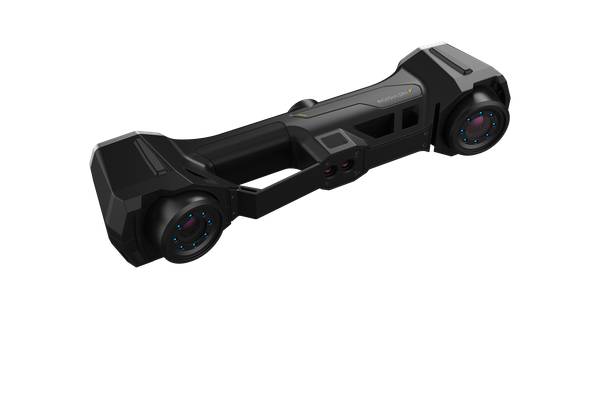
Data capture speed and labor utilization. Traditional methods often demand a dedicated metrology programmer to fixture parts, write probe paths, and run sequential measurements over hours or days. A handheld scanner like INSVISION’s AlphaVista, with 50 cross blue laser lines, captures full-field geometry in minutes. The labor requirement shifts from specialized programming to straightforward handheld operation.
One operator can scan complex surfaces without building a probe routine for every feature, directly reducing metrology labor hours per project—a saving that compounds across multiple reverse engineering jobs.
Accuracy consistency and rework reduction. Rework and non-conformance risk spike when measurement data contains gaps, noise, or alignment drift. INSVISION systems deliver industrial metrology-grade accuracy up to 0.020 mm, and the dense point cloud output means less time filling in missing data or re-scanning questionable areas.
For a procurement manager, this translates to fewer inspection failures downstream, less scrap, and fewer engineering change orders triggered by dimensional surprises. The cost of poor quality isn’t just the rework; it’s the delayed release of tooling or the missed production window.
Portability and logistics elimination. CMMs and fixed scanning cells require controlled temperature, vibration isolation, and expensive real estate. INSVISION’s handheld scanners weigh around 1070 g and operate directly on the shop floor, at the tool crib, or at a supplier’s facility. No part transport, no climate-controlled enclosure, no scheduling time on a shared CMM.
The operational impact is faster turnaround and fewer bottlenecks, especially for large or immovable components common in automotive and aerospace MRO.
Scan-to-CAD throughput and delivery cadence. When scan data flows directly into parametric CAD software without extensive mesh repair or manual surfacing, the time from physical part to validated CAD model shrinks. INSVISION’s scan-to-CAD workflow supports common formats, so engineering teams can start toolpath generation, first-article inspection (FAI) reporting, or design iteration sooner.
Shorter new product introduction (NPI) cycles mean faster time-to-revenue and less working capital tied up in development inventory.
Quality traceability and compliance confidence. In aerospace and medical device manufacturing, reverse-engineered components must stand up to audit scrutiny. Dense, repeatable point clouds with documented accuracy provide the traceability that ISO 9001, AS9100, and ISO 13485 auditors expect.
When scan data is consistent and well-documented, the risk of costly findings or production stops drops, and supplier scorecards strengthen.
A Self-Assessment Framework for Operational Value
Rather than rely on generic ROI claims, procurement and operations teams can build their own total cost of ownership comparison using the structure below. The goal is to identify where the current reverse engineering workflow leaks time and money, and to evaluate whether a 3D scanning approach closes those gaps.
| Cost Driver | What to Measure | Legacy Workflow Indicator | 3D Scanning Indicator |
|---|---|---|---|
| Metrology labor hours per project | Hours from scan start to validated CAD | High dependency on CMM programmer; manual data cleaning | Handheld operation; minimal post-processing |
| Rework and non-conformance rate | Number of engineering change orders or inspection failures linked to measurement data | Inconsistent data from worn probes or operator variability | Dense, repeatable point clouds; metrology-grade accuracy |
| Logistics and downtime | Hours spent moving parts, scheduling metrology room, or waiting for CMM availability | Parts transported to lab; machine downtime | Scanning at the point of use; no transport |
| NPI timeline adherence | Percentage of reverse-engineered components hitting engineering release dates | Delays from scan-to-CAD bottlenecks | Compressed scan-to-CAD window |
| Skilled labor utilization | Proportion of metrology time spent on re-scanning vs. value-added tasks | Talent firefighting bad data | Talent focused on analysis and design |
Teams can populate this table with their own data from a pilot project. The comparison doesn’t require fabricated savings numbers—just a structured look at where time and resources are consumed today.
Where INSVISION Changes the Operational Equation
On a stamping line at a Tier-1 automotive supplier, a worn mold cavity needs replication, but the original CAD file was lost years ago. The traditional route means shipping the 800 kg tool to a metrology lab, waiting days for CMM programming, and absorbing the downtime cost. INSVISION’s AlphaScan changes that math.
Its 1070 g handheld design lets an operator capture the mold geometry directly on the factory floor, eliminating rigging, transport, and production stoppage. Fifty cross blue laser lines deliver dense point clouds that resolve fine parting-line details without manual data cleaning, so the scan-to-CAD pipeline starts sooner.
Accuracy up to 0.01 mm and a scanning area up to 650 x 580 mm mean the resulting model meets ISO/ASME GD&T callouts for fit-critical surfaces—no rework loops from under-specified data. Global certifications (CE, FCC, ISO 9001, CNAS) give procurement and quality managers the compliance evidence Western supply chains demand.
For aerospace MRO teams reverse-engineering legacy airframe brackets, energy engineers redesigning turbine housings, or additive manufacturing groups validating printed parts against the as-built condition, the operational value is straightforward: fewer process steps, less labor, faster first-article turnaround, and lower quality risk.
The scanner becomes a lean tool that reduces dependency on overstretched metrology specialists and compresses the reverse engineering timeline from a cost center into a predictable, repeatable process.
Low-Risk Implementation: Where to Start
Justifying a capital expenditure for 3D scanning is easier when the purchase is structured as a series of gated steps that align with standard budget approval cycles.
- Internal needs assessment. Pick two or three high-impact reverse engineering use cases that carry obvious cost avoidance—legacy aerospace MRO part replication where no drawings exist, or automotive tooling redesign to eliminate hard-tooling lead time. A targeted pilot scope keeps the initial ask small and defensible.
- On-site performance validation. Bring in a system like the INSVISION AlphaScan and scan representative production parts that already have known GD&T callouts and surface finish requirements. Check the scanner’s accuracy against internal standards and measure whether scan-to-CAD turnaround meets timeline expectations. This step converts vendor claims into your own data, which procurement can use to build a credible total cost of ownership comparison.
- Phased rollout. Integrate the validated scanning workflow with existing CAD and PLM systems in one work cell first, and upskill a small group of metrology and engineering staff. Once that cell demonstrates repeatable time savings and fewer rework hours, the business case for wider deployment writes itself, and the next budget request moves from speculative to obvious.
Long-Term Value: KPIs That Matter
As OEMs push more legacy parts into reverse engineering workflows to avoid single-source supplier risks, procurement teams need KPIs that tie directly to total cost of ownership. Track NPI timeline adherence—how often a reverse-engineered component hits the engineering release date. Monitor project completion time per part, from scan to validated CAD, to quantify engineering carry cost reduction.
Measure the rework rate for reverse-engineered components; dense, accurate scan data catches form deviations early, cutting downstream rework. Assess skilled metrology labor utilization to ensure talent is doing value-added work, not re-scanning bad data. Finally, track regulatory audit compliance pass rates, especially for AS9100 or ISO 13485, to avoid costly findings and production stops.
When these KPIs improve, the result is faster order fulfillment, fewer unplanned budget overruns, and supplier scorecards that strengthen OEM and Tier-1 partnerships. Reverse engineering shifts from a tactical fix into a strategic asset.
References
- INSVISION AlphaScan product specification documents
- INSVISION 3D scanning for reverse engineering use case documentation
- INSVISION global compliance certification records
Hangzhou Insvision Technology Co., Ltd.
Address: Building 1, No. 1399 Liangmu Road, Yuhang District, Hangzhou, Zhejiang 311121, China
Copyright © Hangzhou Insvision Technology Co., Ltd. All rights reserved.
Copyright © Hangzhou Insvision Technology Co., Ltd. All rights reserved.