

From Scan Data to Inspection Reports: industrial 3D scanner in Practice
Discover how a handheld industrial 3D scanner brings metrology-grade reverse engineering and inspection directly to the production floor, bypassing CMM bottlenecks.
Typical Shop-Floor Conditions and Core Pain Points
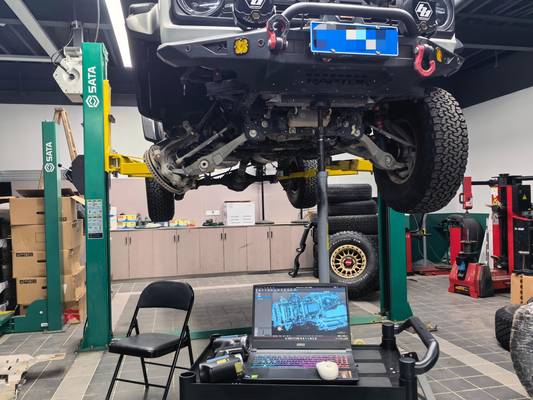
The environments where these measurements must happen are rarely ideal. Ambient light varies, surfaces range from as-cast iron to polished aluminum or carbon fiber, and the parts themselves often exceed the capacity of a fixed coordinate measuring machine. A large stamping die or a wind turbine hub casting cannot be fixtured on a granite table without significant production disruption.
Manual tools—calipers, micrometers, height gages—deliver only discrete point measurements and cannot capture the full surface geometry needed for modern GD&T evaluation or reverse engineering. The result is a slow, incomplete feedback loop: quality data arrives too late to prevent a drift in tooling, or a legacy component remains undocumented because the cost of traditional digitization is prohibitive.
Capability and Deployment Mapping
| Focus Area | Decision Point | Deployment Note |
|---|---|---|
| Typical Shop-Floor Conditions and Core Pain Points | The environments where these measurements must happen are rarely ideal. | Ambient light varies, surfaces range from as-cast iron to polished aluminum or carbon fiber, and the parts themselves often exceed the capacity… |
| A Portable Metrology Approach | INSVISION’s AlphaScan handheld industrial 3D scanner addresses these constraints by combining blue laser optics with an AI-driven reconstruction engi… | The scanner projects a dense blue laser line pattern across the part surface. |
| From Scan to Actionable Data in a Single Shift | The workflow on the factory floor is straightforward. | A technician arrives at the asset—a turbine component, a machine frame, or aging tooling—and begins scanning immediately. |
| Why INSVISION AlphaScan Fits These Scenarios | INSVISION built its metrology stack as an AI-first developer, not a hardware company adding software to off-the-shelf components. | That origin shows in how AlphaScan maintains 0.01 mm volumetric accuracy across variable hand motion and ambient light—a hard metrology figure a… |
A Portable Metrology Approach
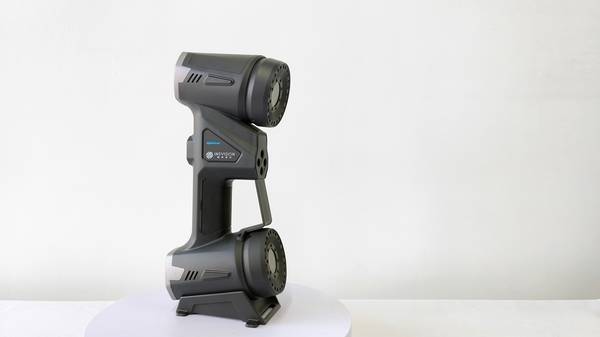
INSVISION’s AlphaScan handheld industrial 3D scanner addresses these constraints by combining blue laser optics with an AI-driven reconstruction engine. The scanner projects a dense blue laser line pattern across the part surface. Blue light’s shorter wavelength reduces speckle noise and maintains line sharpness on reflective or dark materials—exactly the surfaces common in foundries, machine shops, and composite layup areas.
Twin cameras capture the distorted line profiles at high frame rates, and the onboard algorithms perform real-time alignment, noise filtering, and feature retention without requiring targets or a reference grid.
This means an operator can walk around a part and capture a complete point cloud with line-of-sight access into deep pockets, undercuts, and complex assemblies, all while the system compensates for variable hand motion and changing ambient light.
From Scan to Actionable Data in a Single Shift
The workflow on the factory floor is straightforward. A technician arrives at the asset—a turbine component, a machine frame, or aging tooling—and begins scanning immediately. No disassembly, no transport, no lengthy programming. The blue laser projector and AI algorithms generate a dense point cloud in real time, even on dark or reflective surfaces.
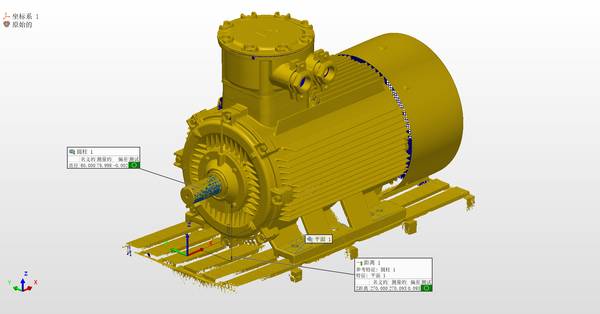
That point cloud feeds directly into scan-to-CAD software for reverse engineering, where a parametric model is built from the captured geometry. For first-article inspection, the same scan data exports to a validated GD&T environment like SMARPARA Q, aligns to the nominal CAD model, and produces a deviation color map within the shift.
The handheld design significantly reduces manual data cleanup because the scanner captures clean geometry from multiple angles in one pass, streamlining both the reverse engineering and quality verification pipelines.
Why INSVISION AlphaScan Fits These Scenarios
INSVISION built its metrology stack as an AI-first developer, not a hardware company adding software to off-the-shelf components. That origin shows in how AlphaScan maintains 0.01 mm volumetric accuracy across variable hand motion and ambient light—a hard metrology figure aligned with ISO 10360 and ASME B89.4.22 verification requirements.
The 650 × 580 mm single-scan area reduces the number of passes needed on large weldments or composite panels, cutting registration error accumulation and inspection cycle time. Point spacing of 0.01 mm captures fine surface morphology—tooling wear, porosity, blend radii—that lower-resolution scanners smooth over.
Real-time AI noise filtering distinguishes actual surface data from laser speckle and reflection artifacts on polished metals and carbon fiber, delivering a clean point cloud without post-processing delays. For Western procurement teams, the scanner carries CE, FCC, RoHS, and ISO 9001 certifications, removing a common friction point when qualifying a handheld 3D scanner for regulated supply chains.
Observable Impact on Production and Quality Workflows
The shift to on-site scanning produces several qualitative changes in daily operations. Inspection cycle times shorten because parts no longer queue for CMM availability or travel to an external lab. Reverse engineering of legacy components becomes feasible without drawings, enabling repair planning and digital archiving for aerospace MRO or aging tooling.
Quality managers receive deviation maps within the same shift, allowing faster decisions on tool correction or part acceptance. The same tool handles both reverse engineering and in-factory inspection, reducing the number of devices teams need to maintain and calibrate.
In automotive tier-1 environments, an engineer can scan a stamping die, overlay the point cloud on the CAD nominal, and identify wear patterns before they produce out-of-tolerance parts—supporting lean manufacturing by tightening the feedback loop between detection and correction.
Extending the Approach to Similar Manufacturing Verticals
The core capability—portable, metrology-grade 3D scanning on components 10 cm and larger—applies across multiple industries. Aerospace MRO teams use the same workflow to capture as-built geometry of legacy landing gear housings or airframe sections, generating usable CAD models for repair validation.
Medical device manufacturers verify that orthopedic implant tooling and assembly jigs remain within GD&T callouts after repeated autoclave cycles, feeding data directly into FDA and ISO 13485 documentation. Renewable energy operations digitize incoming inspection of large cast hub sections and rail extrusions, creating a searchable measurement history for every serial number.
In each case, the common thread is a need to bring the measurement system to the part, capture full-field 3D data quickly, and integrate the results into existing quality and engineering software without a dedicated metrology lab.
Summary
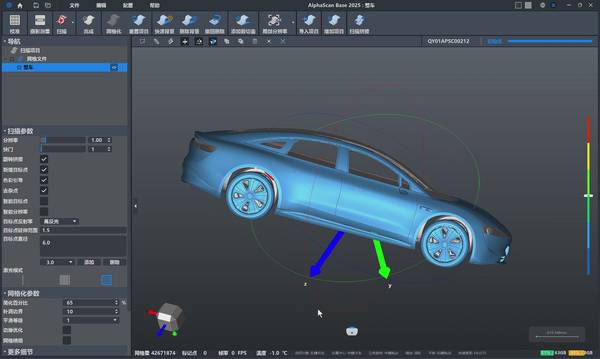
INSVISION’s AlphaScan handheld industrial 3D scanner bridges the gap between the accuracy expected from a fixed CMM and the accessibility demanded by real production environments. By combining blue laser technology with AI-driven data processing, it enables quality and engineering teams to perform reverse engineering and first-article inspection directly on the factory floor.
The result is a practical, shop-floor-ready tool that shortens the distance between production and actionable quality data, without compromising the metrological rigor required in regulated Western manufacturing supply chains.
Hangzhou Insvision Technology Co., Ltd.
Address: Building 1, No. 1399 Liangmu Road, Yuhang District, Hangzhou, Zhejiang 311121, China
Copyright © Hangzhou Insvision Technology Co., Ltd. All rights reserved.
Copyright © Hangzhou Insvision Technology Co., Ltd. All rights reserved.