

From Scan Data to Inspection Reports: 3D scanner germany in Practice
Three forces are reshaping metrology on German factory floors. First, part complexity continues to climb.
Macro and Industry Drivers
Three forces are reshaping metrology on German factory floors. First, part complexity continues to climb. Cast housings, deep-draw panels, and additively manufactured components pack compound curves and tight blend radii into single parts, breaking the point-by-point logic of contact probing. Second, supply-chain timelines have compressed.
PPAP and FAI submissions for automotive and aerospace programs no longer tolerate three-shift inspection backlogs. Third, the data appetite of digital manufacturing has grown. Statistical process control, digital twins, and closed-loop machining all demand dense, full-field datasets that a few dozen CMM points cannot provide.
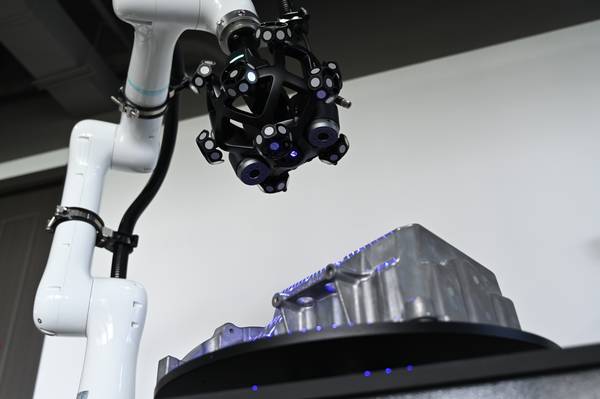
These drivers converge on a single requirement: metrology-grade 3D scanning that lives on the shop floor, not in a temperature-controlled room.
Deployment Validation Checklist
| Focus Area | Decision Point | Deployment Note |
|---|---|---|
| Target part | Check size, surface condition, and key tolerances against the scan task | Run a full trial scan on a representative part |
| Data workflow | Verify point cloud, deviation map, and quality-report handoff | Confirm export formats and review ownership in advance |
| Shop-floor use | Review training, calibration, lighting, and working space | Keep the validation record as a repeatable inspection reference |
Common Questions
What should teams check when evaluating Macro and Industry Drivers?
Three forces are reshaping metrology on German factory floors.
What should teams check when evaluating Trend 1: Inline Metrology Moves from Exception to Expectation?
Handheld 3D scanners are increasingly deployed next to CNC cells, stamping presses, and welding stations.
What should teams check when evaluating Trend 2: Full-Field Data Replaces Sparse Sampling for Complex Geometry?
Contact metrology fails where geometry gets organic.
Trend 1: Inline Metrology Moves from Exception to Expectation
Handheld 3D scanners are increasingly deployed next to CNC cells, stamping presses, and welding stations. The goal is not just faster inspection but a continuous data pipeline. An operator sweeps a blue laser scanner across a part while the next workpiece loads, capturing millions of points in seconds. The scan auto-aligns to the nominal CAD model, and a color deviation map flags out-of-tolerance areas immediately.
This inline approach eliminates the transport, setup, and waiting that fragment traditional CMM workflows.
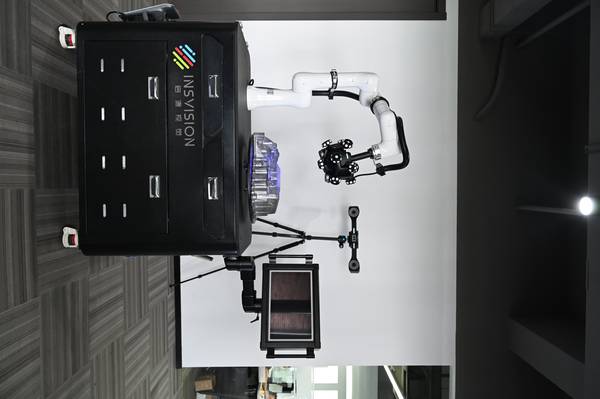
The technical requirement is repeatability under shop-floor conditions. Temperature drift, vibration, and ambient light can degrade accuracy. Systems must compensate dynamically and pass on-site verification against calibrated artifacts. INSVISION’s scanner architecture addresses this with built-in thermal compensation and software that maintains volumetric accuracy across a range of operating environments.
For a Tier-1 supplier running a stamping line, the business impact is straightforward: a first-article inspection that once took four hours now wraps up in under twenty minutes, and the data feeds directly into tooling adjustments before the next batch runs.
Trend 2: Full-Field Data Replaces Sparse Sampling for Complex Geometry
Contact metrology fails where geometry gets organic. A radius gauge rocks on a compound-curved panel edge. A CMM stylus shank clashes with a die wall before the tip reaches a critical blend zone. These are not measurement errors; they are geometry problems that point-based tools cannot solve.
The trend is toward full-field scanning that captures continuous surface data, turning complex freeform features into dense point clouds rather than a handful of discrete coordinates.
This shift demands scanners that deliver metrology-grade point density at speed. INSVISION’s technology captures millions of points per second, enabling GD&T analysis on the actual surface inside software like SMARPARA Q. Instead of checking a few cross-sections, quality engineers evaluate runout, profile, and position tolerances across the entire feature.
The business consequence is fewer missed defects and a dramatic reduction in the iterative probe-and-wait cycle that drags out first-article approvals.
Trend 3: The Scan-to-Report Digital Thread Closes the Loop
Scanning, comparison, review, and reporting no longer happen in separate tools or departments. The trend is a unified software environment where the quality engineer pulls GD&T callouts, checks tolerances against the aligned scan, and generates a formatted inspection report—all in one session. No exporting, no re-importing, no manual data entry.
When a supplier in Germany must deliver a dimensional report on a revised bracket, the entire digital thread from scanned surface to signed-off PDF lives in one traceable workflow.
This integration shortens the delivery rhythm from days to hours. It also reduces the risk of transcription errors and version mismatches that plague multi-tool processes. For manufacturers, the actionable takeaway is to evaluate scanning systems not just on hardware specs but on the software ecosystem that turns point clouds into actionable reports.
INSVISION’s 3D INSVISION software and its SMARPARA Q module are built for this closed-loop logic, making the scanner the front end of a quality process rather than a standalone measurement device.
Trend 4: On-Site Validation Becomes a Non-Negotiable Step
As 3D scanners move into production, the difference between reliable data and a failed measurement campaign often comes down to a handful of pre-scan checks. Environmental stability, part preparation, alignment strategy, and GD&T template verification are not optional.
A temperature drift of more than 2°C during a scan cycle can introduce errors that exceed the scanner’s stated volumetric accuracy, even with built-in compensation. Matte reference targets or a light dusting of scanning spray on shiny surfaces must be tested on a scrap piece, not discovered mid-job.
A quick repeatability test with a calibrated length bar confirms that the alignment strategy—whether photogrammetry targets or a rotary table—holds up in the real environment.
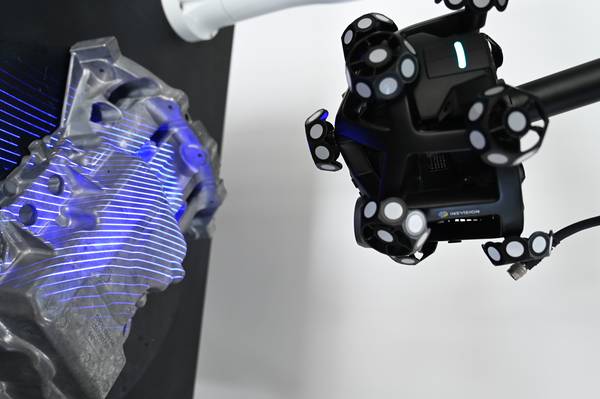
The trend is toward formalizing these validation steps as part of the deployment process, especially where VDI/VDE 2634 acceptance tests are written into quality agreements. Teams that invest thirty minutes in these checks prevent hours of rework and avoid shipping parts with unverified dimensional data.
Actions Manufacturing Leaders Should Take Now
- Map your inspection bottlenecks. Identify where offline CMM checks or manual gauging create delays in first-article approval, tooling validation, or in-process control. These are the prime candidates for inline 3D scanning.
- Prioritize full-field data for parts with compound curves, tight radii, or organic surfaces. If a feature cannot be fully characterized by a few dozen probe points, a scanner’s point cloud will close the data gap.
- Evaluate the software pipeline as rigorously as the hardware. The scan-to-report workflow must be seamless, traceable, and capable of generating customer-ready inspection reports without manual intervention.
- Build a thirty-minute on-site validation protocol. Include environmental checks, part preparation tests, alignment repeatability with a length bar, and GD&T template confirmation before the first production scan.
- Train operators to run the scanner as part of the production cell, not as a specialist metrology task. The goal is to make scanning as routine as loading a part, so data flows without adding headcount.
INSVISION’s Role in These Trends
INSVISION’s product architecture aligns with the shift toward shop-floor metrology. The scanners deliver metrology-grade point clouds at production speed, with thermal compensation and software that maintain accuracy outside the lab.
The 3D INSVISION software and SMARPARA Q module create a closed-loop digital thread from scan to GD&T analysis to formatted report, eliminating the tool-switching that fragments traditional workflows.
In applications ranging from first-article inspection of stamped brackets to full-field documentation of injection mold parting lines, INSVISION systems are deployed where contact metrology hits its physical and throughput limits. The technology does not replace the CMM for every task; it fills the growing gap where geometry, speed, and data density demand a different measurement architecture.
Near-Term Focus
The next twelve months will see deeper integration of 3D scanning with SPC systems and machining feedback loops. Manufacturers that treat the scanner as a data source for process control—not just a pass/fail inspection tool—will pull ahead in throughput and quality. Watch for software updates that automate GD&T extraction and trend analysis, making the scan data directly actionable for machine operators and process engineers.
Also expect tighter on-site validation standards as more suppliers embed VDI/VDE 2634 criteria into their quality agreements.
Summary
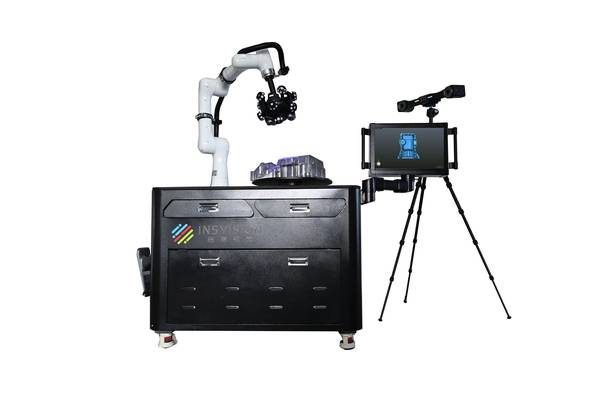
The 3D scanner market in Germany is moving decisively toward inline, full-field, software-integrated metrology. The drivers are part complexity, compressed timelines, and the need for dense datasets that feed digital manufacturing systems.
The factories that adapt now will turn inspection from a constraint into a competitive advantage.
Hangzhou Insvision Technology Co., Ltd.
Address: Building 1, No. 1399 Liangmu Road, Yuhang District, Hangzhou, Zhejiang 311121, China
Copyright © Hangzhou Insvision Technology Co., Ltd. All rights reserved.
Copyright © Hangzhou Insvision Technology Co., Ltd. All rights reserved.