

3D Part Inspection That Cuts Rework, Speeds Delivery, and Strengthens Compliance
Walk through most fabrication or machining facilities and you’ll find the same pattern.
Where Traditional Inspection Leaks Value
Walk through most fabrication or machining facilities and you’ll find the same pattern. First-article inspections stack up behind a coordinate measuring machine that requires a dedicated programmer. Production operators wait for a quality sign-off before they can run the next batch. When a nonconformance surfaces days later, the root cause is buried in paper records or scattered point files.
The financial damage shows up in four areas.
Inspection cycle time ties up working capital. Every hour a part sits in the metrology queue is an hour it isn’t generating revenue. For contract manufacturers, delayed first-article approvals push out delivery dates and can trigger penalties. Rework and scrap compound the loss.
Catching a dimensional drift after a full shift of production means the labor, machine time, and material already invested in those parts are wasted—and the disruption ripples into downstream assembly. Skilled labor dependency creates a fragile throughput model. When only one or two metrology specialists can program the CMM or interpret GD&T callouts, any absence becomes a bottleneck.
The organization’s ability to inspect scales with headcount, not with demand. Finally, compliance gaps introduce business risk. Auditors for ISO 9001, AS9100, or FAA Part 21 expect traceable, unalterable inspection records. Manual documentation and scattered digital files turn audit prep into a costly scramble and can undermine customer confidence.
These aren’t hypotheticals. They’re the daily reality for automotive tier suppliers, aerospace MRO shops, medical device machining cells, and renewable energy component lines. The common thread: inspection is treated as a cost center rather than a process control lever.
How Production-Floor 3D Scanning Changes the Cost Equation
Moving 3D part inspection out of the lab and onto the shop floor attacks each of those cost drivers directly. The technology—handheld structured-light scanners paired with GD&T analysis software—doesn’t just measure faster; it redistributes labor, prevents scrap, and builds a digital quality record that pays off in audits and continuous improvement.
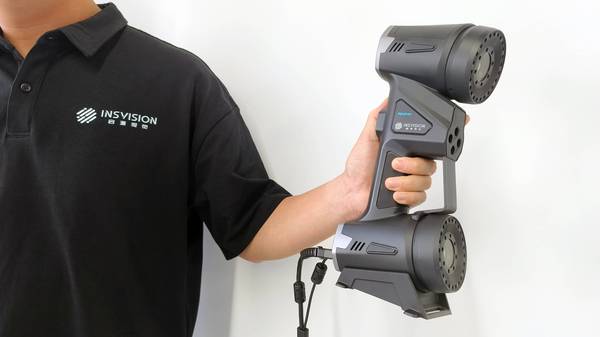
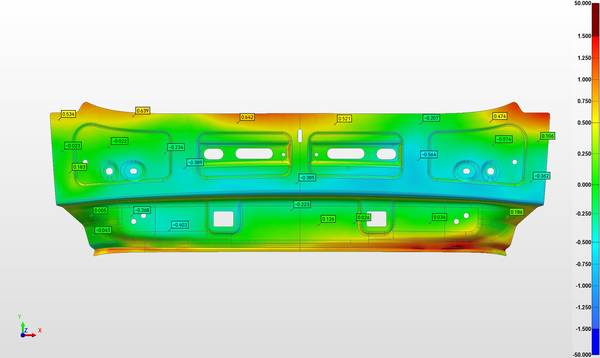
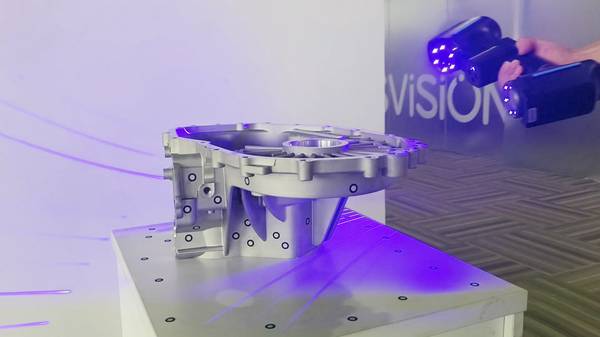
Inspection cycle efficiency. A handheld scanner like INSVISION’s AlphaScan captures full-field geometry at over seven million measurements per second. An operator can scan a sheet metal stamping or a machined casting in under a minute, right at the press or machining center. The 3D INSVISION software then automates alignment to the nominal CAD model, runs a deviation comparison, and generates a color-mapped report.
What previously required an hour of setup, programming, and sequential probing now completes in minutes. The result isn’t just speed—it’s predictable production cadence. When inspection keeps pace with the line, delivery commitments become more reliable, and lead times no longer need to pad for metrology queues.
Rework and scrap reduction. Real-time CAD comparison flags out-of-tolerance conditions while the part is still fixtured. An operator sees a deviation map highlighting exactly where the surface has drifted, adjusts tool offsets, and saves the piece before it becomes scrap. Catching drift early shrinks both the scrap bin and the rework bench.
It also prevents nonconforming parts from reaching assembly, where the cost of correction multiplies. For high-mix, low-volume shops, this capability turns first-article inspections from a multi-day gate into a same-hour feedback loop.
Labor optimization. INSVISION designed its inspection workflow so that a cross-trained production operator can run routine checks after minimal training. The software guides them through scan, alignment, and report generation. That frees senior metrology engineers to focus on complex first-article inspections, process capability studies, and continuous improvement projects—the work that actually improves yields.
The organization isn’t cutting headcount; it’s reallocating expertise to where it generates the most value.
Compliance and traceability. Every scan feeds into a centralized digital inspection database that creates a time-stamped, unalterable trail for each part. During a customer audit or a regulatory review, quality managers can pull up the full inspection history in seconds.
This reduces the labor cost of compliance and, more importantly, signals to customers that the quality system is under control—a factor that often decides repeat business in regulated supply chains.
A Framework for Calculating Operational Value
Rather than rely on generic ROI claims, plant managers and controllers can build a business case using their own baseline numbers. The table below outlines the key cost categories, the internal metrics to track, and the improvement levers that a production-floor 3D part inspection system can pull.
| Cost Category | Internal Baseline Metric | Improvement Lever |
|---|---|---|
| Inspection labor | Hours per part or per batch | Faster cycle time per inspection; routine checks run by production operators |
| Rework and scrap | Monthly scrap cost + rework hours | Earlier defect detection reduces scrapped parts and rework labor |
| Delivery performance | On-time delivery rate; lead time padding for inspection | Predictable inspection cadence shortens order-to-ship cycles |
| Compliance overhead | Staff hours spent on audit prep; cost of quality escapes | Digital, time-stamped records reduce audit labor and risk of findings |
| Skilled labor utilization | Ratio of senior metrologist time spent on routine vs. high-value tasks | Routine inspections shift to trained operators; specialists focus on process improvement |
To use the framework, start with current-state measurements for each category. Then estimate the shift that a faster, more accessible inspection process would create. For example, if a first-article inspection currently consumes four hours of a senior engineer’s time and the new workflow cuts that to 45 minutes, the labor savings alone can be substantial over a year of new product introductions.
The scrap reduction lever is often even larger: a single batch of complex machined parts scrapped due to undetected tool wear can cost tens of thousands of dollars. The framework doesn’t require industry averages—it runs on your own shop-floor data.
Where INSVISION’s Technology Delivers Tangible Improvement
INSVISION’s approach to 3D part inspection is built on a full-stack digitization platform that combines proprietary AI algorithms with high-precision structured light scanning. The AlphaScan handheld scanner operates in three modes—standard, deep hole, and fine scan—allowing a single device to capture everything from large automotive stampings to tiny injection-molded features.
Deep hole mode reaches cavities that fixed CMM probes struggle with, while fine scan mode resolves sub-millimeter details. Because the scanner is handheld, inspection happens at the point of production, not in a climate-controlled lab.
On the software side, SMARPARA Q brings PTB-certified inspection algorithms directly into the production environment. Built-in GD&T tools handle flatness, profile, position, and runout callouts per ASME Y14.5 and ISO standards. Multi-source data alignment merges scans from different angles into a single coordinate system.
The 3D INSVISION platform unifies scanning, inspection comparison, and model generation in one interface, so an operator doesn’t jump between acquisition software, alignment tools, and reporting modules. The workflow is linear: scan, align, analyze, report.
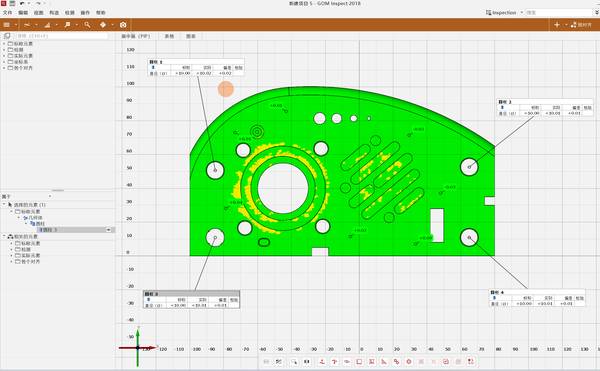
Underneath, AI-powered algorithms handle point cloud cleaning, mesh generation, and feature extraction automatically. This directly addresses the skilled labor bottleneck—when the software does the tedious alignment and meshing work, a junior technician can produce inspection reports that previously required years of metrology experience.
The algorithms also improve noise filtering and edge detection over repeated use on similar part families, making the system more capable the more it’s used.
These capabilities translate into the operational improvements described earlier: faster cycle times, earlier defect detection, broader labor participation in inspection, and a digital audit trail.
For quality managers fighting rework loops and engineers chasing true position callouts on complex castings, the shift means first-article turnaround that moves from days to hours without sacrificing the traceability that regulated sectors demand.
A Low-Risk Path to Scaling 3D Part Inspection
Teams that achieve the fastest payback don’t overhaul their entire quality system at once. They start with tightly scoped, high-pain workflows where measurement data directly reduces rework, scrap, or supplier disputes. Three use cases consistently prove value before broader rollout.
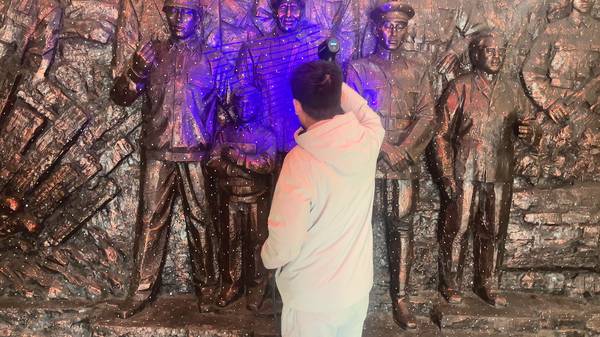
Incoming inspection of high-volume purchased components. Instead of sampling a few dimensions with hand tools and hoping the rest of the batch conforms, a full-field 3D scan captures thousands of points in minutes. Deviations from CAD or GD&T callouts surface immediately, letting quality engineers quarantine nonconforming lots before they reach the assembly line.
The downstream savings in rework hours and line stoppages often justify the equipment cost within a few supplier shipments.
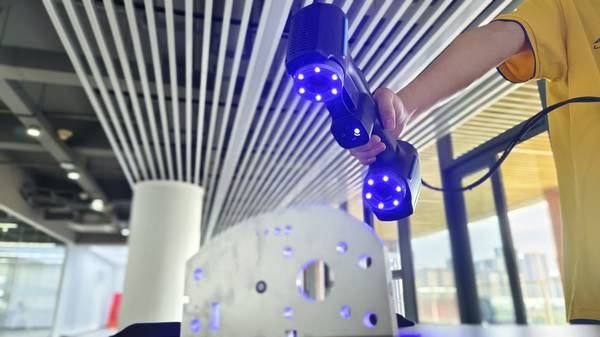
First article inspection for new product introductions. Traditional FAI reports can take days, especially when multiple setups and manual reporting slow the approval cycle. With a structured 3D scanning workflow, the entire part geometry is digitized, aligned to the nominal CAD model, and compared automatically.
Color-mapped deviation reports replace pages of handwritten measurements, cutting report generation time and giving customers confidence in the data integrity. For contract manufacturers, faster FAI approvals directly compress time-to-market and strengthen customer relationships.
Periodic tooling and mold wear monitoring. Stamping dies and injection molds degrade gradually, often producing borderline parts long before anyone notices. By scanning a set of parts at regular intervals—say, every 10,000 shots—teams can trend surface deviations and spot wear patterns early. This shifts maintenance from reactive to condition-based, avoiding the large scrap events that erode margins and delivery performance.
INSVISION supports these implementation paths with a global technical team familiar with Western manufacturing quality standards, including ASME Y14.5 GD&T and ISO dimensional tolerancing. The software platforms receive regular updates that keep pace with evolving industry requirements.
For factories with multi-site operations, the ability to standardize inspection routines across plants reduces variability and builds a common quality language.
Over time, the data collected from these targeted applications becomes a foundation for continuous process improvement. AI-powered 3D part inspection doesn’t just flag defects—it reveals patterns in dimensional drift that can be traced back to tool wear, process parameters, or supplier shifts.
That visibility feeds directly into long-term Industry 4.0 smart factory initiatives, where quality data drives predictive maintenance, adaptive process control, and closed-loop manufacturing. Starting small with one of these three use cases gives operations teams a practical, measurable on-ramp to that future.
The Bottom Line
Inspection doesn’t have to be a bottleneck that consumes skilled labor and delays shipments. By moving 3D part inspection to the production floor with handheld scanning and automated GD&T analysis, manufacturers can shorten cycle times, catch defects before they become scrap, and build a digital quality record that satisfies both customers and auditors.
The operational value shows up in reduced rework, better labor utilization, and more predictable delivery cadence—all measurable with a simple internal framework. The first step is picking one high-pain workflow and proving the economics. From there, the data and confidence build naturally.
Hangzhou Insvision Technology Co., Ltd.
Address: Building 1, No. 1399 Liangmu Road, Yuhang District, Hangzhou, Zhejiang 311121, China
Copyright © Hangzhou Insvision Technology Co., Ltd. All rights reserved.
Copyright © Hangzhou Insvision Technology Co., Ltd. All rights reserved.