

Industrial 3D Scan Parts: How Multi-Mode Blue Laser Handheld Scanners Work
The core principle is structured-light triangulation, tuned for industrial surfaces. A handheld scanner projects a fan of blue laser lines—typically around
How Handheld Blue Laser 3D Scanning Works
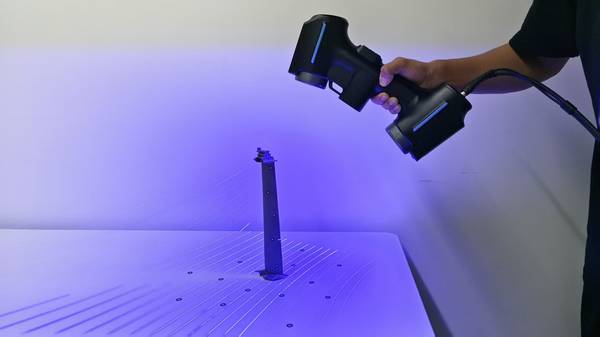
The core principle is structured-light triangulation, tuned for industrial surfaces. A handheld scanner projects a fan of blue laser lines—typically around 450 nm—onto the part. Two high-resolution cameras, mounted at fixed angles to the projector, observe how each line deforms as it wraps across the surface.
Because the baseline distance between the cameras and the laser source is known, the system can solve a triangle for every point along the stripe: the observed shift of the line directly yields the Z-height. Repeat this millions of times per second and you get a dense point cloud.
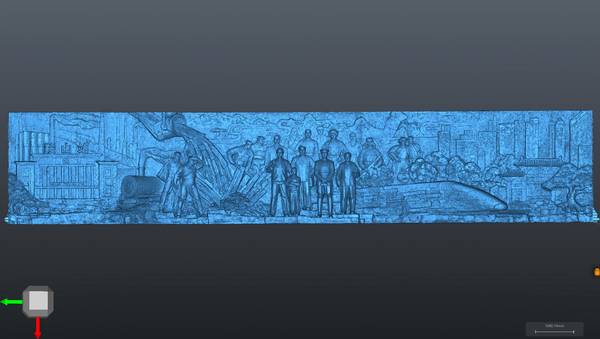
Blue light matters for two reasons. First, it cuts through ambient factory lighting far better than red, so overhead fluorescents or LED panels rarely wash out the signal. Second, the shorter wavelength produces a tighter speckle pattern on shiny surfaces, reducing noise on machined aluminum, polished tool steel, or as-cast textures. That means many parts that once required a coat of developer spray can now be scanned bare.
What Makes a Handheld Scanner Suitable for Real Parts
Not all blue laser scanners handle the same range of geometries. The difference often comes down to the line pattern architecture. A single broad pattern might cover flat panels quickly but will miss data inside a deep pocket or a narrow bore. A scanner built for industrial parts needs to switch between modes without recalibration.
INSVISION’s AlphaScan platform illustrates this multi-mode approach. It uses three distinct laser line configurations in one device: a dense grid of 22 or 34 cross lines for fast area coverage on castings, weldments, and sheet metal assemblies; a single blue laser line dedicated to deep holes, blind pockets, and internal recesses where wider patterns lose line of sight;
and seven fine parallel lines for high-resolution detail on edges, gear flanks, or mold cavities. The operator can move from broad surface capture to a narrow pin recess in seconds, on the same part, without swapping equipment.
On-device algorithms continuously compensate for ambient light swings, temperature drift, and surface finish variation. Outliers from specular reflections or dark, absorptive plastics are rejected, so the point cloud stays consistent whether you are scanning a freshly machined bracket under shop lights or a textured housing in a field tent. No stickers, no controlled lighting rig—just walk up and scan the part.
How Handheld Scanning Compares to Traditional Measurement Workflows
No single measurement method wins everywhere. The table below maps four common approaches to their strengths and ideal scenarios, strictly by what each does best.
| Method | Key Strengths | Ideal Scenarios |
|---|---|---|
| Handheld 3D scanning (e.g., AlphaScan) | Captures complex freeform surfaces, deep pockets, and fine details quickly. Portable; no rigid fixturing. Dense point clouds feed reverse engineering and AM preprocessing directly. | Reverse engineering legacy parts with no CAD data; on-machine or in-situ checks of large castings and weldments; 3D scan parts workflows where moving the part is impractical; rapid digitization for 3D printing or simulation. |
| Coordinate Measuring Machines (CMM) | Traceable, micron-level accuracy on prismatic geometries. Tactile probing excels at GD&T callouts—true position, flatness, runout—on machined surfaces. Highly repeatable routines for ISO/ASME certification. | First-article inspection of precision-machined components; ongoing process control in high-volume CNC production; any application requiring formal measurement uncertainty budgets with documented traceability. |
| Manual hand metrology tools (calipers, micrometers, height gages) | Low upfront cost, zero programming, immediate availability. Direct tactile feedback on simple linear dimensions. No power or environmental controls needed. | Quick in-process checks of turned diameters, sheet metal thickness, or hole depths where only a handful of critical dimensions matter and part geometry is straightforward. |
| Fixed 3D scanning systems | Automated, repeatable data capture with minimal operator influence. Once programmed, they run unattended and produce consistent datasets for SPC. | Batch inspection of small-to-medium parts in a production cell; automated 3D scan parts workflows where cycle time must stay under a few minutes; integration into inline quality gates. |
Handheld scanning fills the gap where portability, complex geometry, and speed converge—particularly when the part cannot come to the gage.
Where Handheld 3D Scanning Delivers the Most Value
Several operational patterns on Western factory floors make handheld scanning the right call.
On-the-line spot checks without breaking takt time. A quality engineer can pull three parts from a live cell, capture full surface geometry in minutes, and feed the data into SPC workflows—no routing to a metrology lab.
Pre-print geometry validation for additive manufacturing. Before committing an expensive powder bed build, AM engineers scan a reference part or prototype, overlay the point cloud on the pre-print CAD model, and catch deviations early. This prevents wasting machine time on geometry that is already off-target.
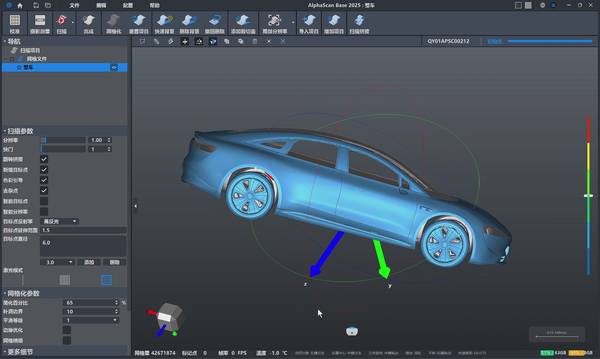
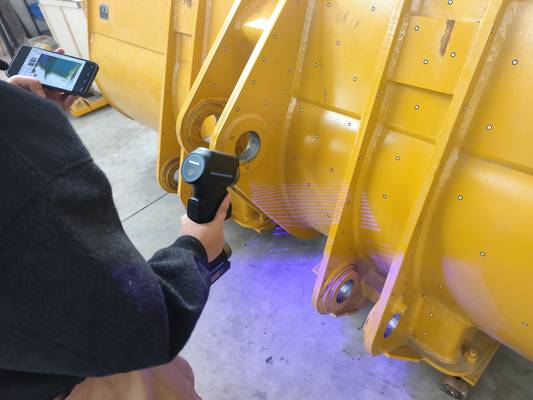
Reverse engineering of discontinued replacement parts. Maintenance teams regularly face a worn-out component with no surviving drawing. A handheld scanner can 3D scan parts in situ, even with complex organic surfaces, and deliver a watertight mesh ready for CAD reconstruction. The resulting model can be machined or 3D printed locally, cutting lead times from weeks to hours.
Portable inspection of large assemblies that cannot be moved. Think of a welded frame on a construction site or a turbine housing in a power plant. An inspector walks around the assembly, captures critical interface dimensions and GD&T callouts without disassembly or crane time, and the scanner handles the vibration and ambient light of a real worksite.
Rapid digital twin creation for small to mid-sized parts. When a manufacturing engineer needs a quick digital reference for simulation, documentation, or catalog updates, a single scanning session generates an accurate mesh that exports directly into common CAD and simulation packages.
Where Handheld Scanning Falls Short
Transparent or fully mirror-like surfaces still require a light dusting of scanning powder. The blue laser architecture pushes the spray-free envelope much further than older red-laser systems, but it does not eliminate the boundary entirely. Extremely tight tolerances in the single-digit micron range remain the domain of CMMs and dedicated metrology systems.
Handheld scanners are not a replacement for traceable, contact-based certification when formal measurement uncertainty budgets are required.
What to Look for When Selecting a Handheld 3D Scanner for Parts
Technical buyers should evaluate a scanner against the parts that make their inspection team groan, not just the spec sheet. Key questions include:
- Can the scanner handle mixed surface finishes—cast textures next to polished datum surfaces—in a single session without spraying?
- Does it offer multiple line patterns that can be switched on the fly to reach deep pockets and fine edges?
- Will the software accept multi-source data (scan, CAD, CMM reference points) and export standard formats like STL, STEP, and IGES without middleware?
- Has the platform been validated outside a demo lab, in real production environments with ambient light, temperature swings, and operator variability?
INSVISION AlphaScan: A Practical Implementation of Multi-Mode Blue Laser Technology
The AlphaScan handheld platform translates the principles above into a flexible, on-demand tool for discrete industrial parts. Its 30 or 42 blue laser lines are split into three hardware modes—cross lines for area coverage, a single line for deep recesses, and seven fine lines for detail—so an operator can move from a broad automotive connector body to a narrow pin recess in seconds without recalibration.
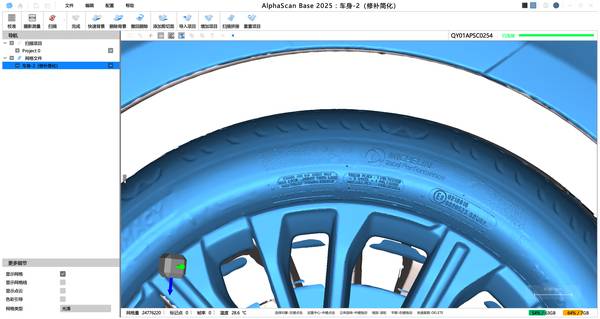
The integrated 3D INSVISION software platform handles the full workflow from scan acquisition through mesh generation and inspection alignment, eliminating the need to jump between separate applications. For metrology tasks requiring GD&T callouts, datum alignment, and CAD deviation color maps, the SMARPARA Q module adds PTB-certified analysis tools that accept multi-source data.
This is useful when combining scan data with existing CAD models or CMM reference points. The fact that these systems are deployed across more than 20 countries under CE, FCC, and CNAS certifications provides independent confirmation that the platform performs reliably in real production environments.
INSVISION maintains a set of application cases documenting how the technology performs on real production components, not idealized lab samples.
These include a 2024 automotive part redesign scanning case that walks through the full reverse engineering workflow, a small high-detail object scanning case from the same year, a high-reflective recessed mold scanning case that details the approach for eliminating spray coating, and a 2025 real-time valve inspection case covering cycle time, repeatability, and GD&T verification directly against scan data.
Each case is structured for technical review and can serve as a baseline for validation trials.
Common Questions About Industrial 3D Scanning
Q: What surface types can a handheld blue laser scanner handle without spray?
A: Shiny machined surfaces, dark plastics, and high-reflectivity concave molds can often be captured without developer spray. The combination of blue laser diodes, multi-line patterns, and on-board algorithms that filter ambient interference allows parts with mixed finishes to be scanned in a single session. Transparent or fully mirror-like surfaces remain the exception and will need a light powder coating.
Q: Can scan data integrate with existing CAD and metrology software?
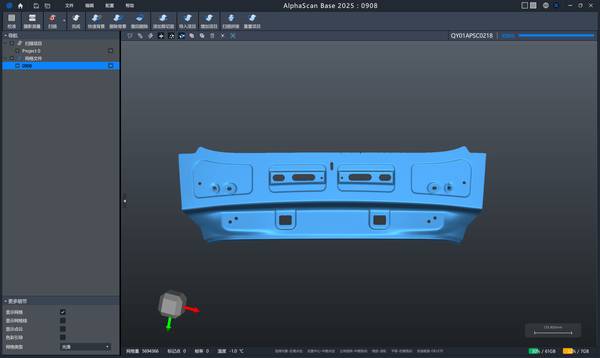
A: Yes. The INSVISION software platform exports standard formats including STL, STEP, and IGES, so scan data drops directly into common CAD packages and metrology software like PolyWorks or GOM Inspect. For first-article inspection, a scanned point cloud can be aligned to the nominal CAD model, and color-mapped deviation reports generated with callouts tied to specific GD&T controls.
No proprietary lock-in or middleware is required.
Q: How does ambient factory lighting affect scan quality?
A: Blue laser diodes are inherently less sensitive to ambient light than red-laser alternatives. Overhead fluorescent or LED lighting rarely causes data dropout. Temperature drift is managed through internal compensation, with stable operation across the typical factory range.
Q: Is a handheld scanner accurate enough for metrology?
A: Handheld blue laser scanners can deliver metrology-grade data for many industrial applications, particularly where complex freeform surfaces, deep pockets, and portability are required. For traceable, micron-level certification of prismatic geometries, a CMM remains the appropriate tool. The key is matching the measurement method to the tolerance requirements and part geometry.
Conclusion
Multi-mode blue laser handheld scanning has moved beyond rough shape capture. When engineers understand the triangulation principles, the role of line pattern architecture, and the practical limits around surface finish and tolerance, they can deploy these tools where they earn their keep: on the shop floor, directly on the part, without breaking production flow. The technology does not replace CMMs or fixed scanning systems;
it fills the gap where portability, complex geometry, and speed must converge.
References
- INSVISION Automotive Part Redesign Scanning Case (2024)
- INSVISION Small High-Detail Object Scanning Case (2024)
- INSVISION High-Reflective Recessed Mold Scanning Case
- INSVISION Real-Time Valve Inspection with 3D Scanning Case (2025)
Hangzhou Insvision Technology Co., Ltd.
Address: Building 1, No. 1399 Liangmu Road, Yuhang District, Hangzhou, Zhejiang 311121, China
Copyright © Hangzhou Insvision Technology Co., Ltd. All rights reserved.
Copyright © Hangzhou Insvision Technology Co., Ltd. All rights reserved.