

Handheld 3D Scanner Thailand: A Technical Guide to the INSVISION AlphaScan for Industrial Teams
This article explains the core technology behind industrial handheld 3D scanners, the boundary conditions that determine scan quality, and how a system lik
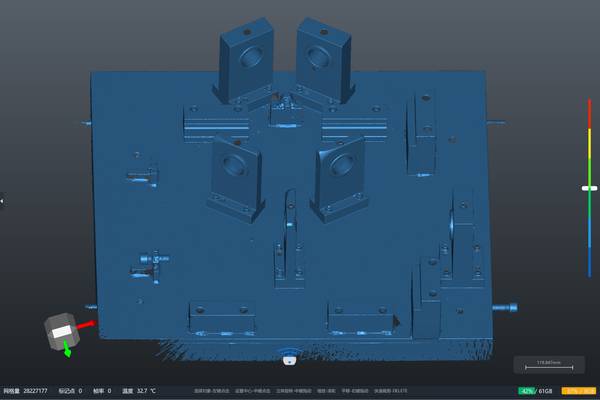
This article explains the core technology behind industrial handheld 3D scanners, the boundary conditions that determine scan quality, and how a system like the INSVISION AlphaScan fits into real production environments.
We draw on examples from Thailand’s automotive, mold, and electronics supply chains—where high humidity, reflective alloys, and legacy machinery create demanding measurement conditions—but the principles apply wherever manufacturing teams need dense, metrology-grade surface data without moving heavy assets to a lab.
What a Handheld 3D Scanner Actually Does
At its heart, a handheld 3D scanner projects a known light pattern onto a part and observes how that pattern deforms. The AlphaScan uses blue laser line triangulation: a 405 nm laser emits a precise line, and a high-speed camera offset at a calibrated angle records the line’s shape as it wraps around the surface. Every pixel shift translates into a 3D coordinate through triangulation math.
Blue light matters because its shorter wavelength scatters less on metallic surfaces than red laser light, producing tighter profiles on the mixed aluminum, steel, and injection-molded plastics common in automotive and electronics manufacturing.
What separates an industrial tool from a consumer-grade device is the laser configuration and the software stack that cleans up the raw data. The AlphaScan projects up to 42 blue laser lines (depending on the variant), with the majority arranged as cross lines for large-area capture and one dedicated fine-scan line for deep holes, sharp edges, and small features that cross-line patterns often miss.
This multi-line geometry generates up to 7.1 million measurements per second and eliminates line-of-sight gaps on complex curvature—think a turbine housing or a motorcycle fairing—capturing full-field geometry in a single pass.
Raw point clouds are noisy by nature. In a Thai factory, high ambient humidity can cause micro-condensation on optics, and overhead bay lights create intermittent glare. Embedded AI algorithms trained on millions of real-world scans classify and discard spurious points from reflections, dust, or stray light in real time, preserving only valid surface data.
The result is a clean, watertight mesh ready for GD&T analysis or reverse engineering, even when scanning a part straight off a hot injection mold.
Key Technical Capabilities of the INSVISION AlphaScan
The AlphaScan’s metrology-grade single-scan accuracy is 0.02 mm, with volumetric accuracy following a 0.03 mm + 0.015 mm/m formula—numbers that hold up on the shop floor, not just in a temperature-controlled lab. The handheld unit weighs under 1 kg and is balanced for one-handed use, even in production areas where ambient temperatures regularly exceed 35°C.
That ergonomic design matters when an inspector needs to scan for hours without introducing shake-induced noise.
Certifications align with international safety and import requirements. The scanner carries CE, FCC, RoHS, IEC 60825 (laser safety), and IEC 62471 (photobiological safety). On the software side, INSVISION’s 3D INSVISION platform handles real-time mesh generation, CAD alignment, and deviation color maps.
For deeper metrology, the SMARPARA Q module adds full GD&T evaluation—true position, profile, runout—referencing ISO 1101 and ASME Y14.5 standards. A single scan session can feed both reverse engineering and first-article inspection reports without exporting to third-party metrology software.
How Handheld 3D Scanning Compares to Traditional Measurement
The table below summarizes the strengths and ideal scenarios of four common industrial measurement approaches.
| Method | Key Strengths | Ideal Scenarios |
|---|---|---|
| Handheld 3D Scanning | Portable, full-field surface data, no fixture setup, works on large immovable assets | On-site measurement across multiple facility locations; large, non-portable assets; reverse engineering of complex surfaces; maintenance and repair |
| Manual Calipers / Height Gauges | Low cost, simple for basic linear dimensions | Quick checks on small, simple parts; low-volume jobs |
| Fixed CMM | High point accuracy, traceable, ideal for GD&T of prismatic parts | First-article inspection; high-precision tolerance verification in a lab |
| Stationary 3D Scanning | High-resolution, automated, repeatable for batch inspection | In-line inspection of medium parts; automated quality control in high-volume production |
Handheld scanning does not replace every measurement tool. It excels when the part cannot be moved, when surface data density matters more than single-point precision, and when inspection must happen at multiple locations across a plant.
Where Handheld 3D Scanning Excels—and Where It Doesn’t
Four operational scenarios show the strongest alignment with handheld 3D scanning technology.
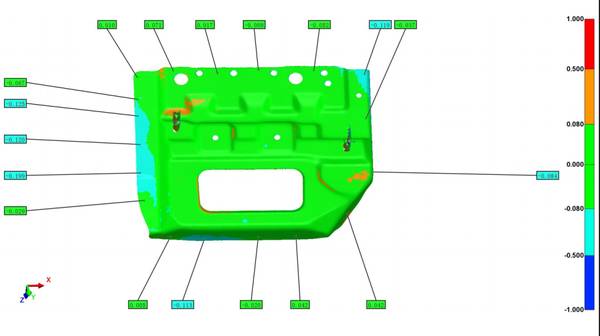
First, on-site quality inspection of large, immovable production assets—injection molding machines, press frames, ship engine blocks—where moving the equipment to a fixed lab is impractical or unsafe. The scanner captures metrology-grade data right at the machine, enabling GD&T checks without disrupting production.
Second, batch measurement of small to medium components for incoming quality control. When a contract manufacturer receives 500 aluminum housings from a tier-two supplier, a measurement rate of 7.1 million points per second makes it practical to scan a statistically valid sample in minutes. The integrated software overlays scan data onto the CAD reference and flags out-of-tolerance features automatically.
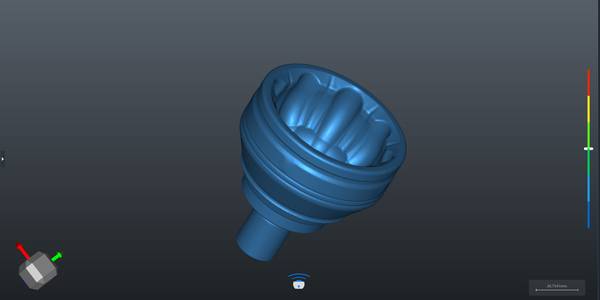
Third, reverse engineering of legacy parts for maintenance and replacement. Many factories run machinery from the 1990s with no surviving CAD files. The AlphaScan captures complex freeform surfaces and deep pockets—common on worn impellers or gearbox housings—and outputs a watertight mesh directly into SMARPARA Q for surface reconstruction.
Fourth, 3D model capture for custom automotive interior and aerospace component design. Whether digitizing a motorsport seat shell for foam mold modification or scanning an aircraft cabin bracket for a retrofit kit, the scanner’s multiple cross-laser modes let operators switch between large-area capture and fine-detail resolution on the same part.
Boundary conditions apply. Highly polished or transparent parts will need a temporary matte coating to maintain scan fidelity—standard practice across all optical scanners. Ambient light must be controlled, and the part should be fixtured to minimize vibration. These are not limitations of a specific scanner but physical requirements for any sub-millimeter optical measurement.
Selecting a Handheld 3D Scanner: What to Evaluate
When evaluating a handheld 3D scanner for industrial use, focus on these criteria:
- Laser class and wavelength: Blue laser (405 nm) offers better performance on shiny metals than red laser. Ensure the scanner meets IEC 60825-1 for laser safety.
- Accuracy and measurement rate: Look for metrology-grade single-scan accuracy (≤0.02 mm) and a measurement rate in the millions of points per second to capture fine details quickly.
- Software integration: The scan data must flow directly into your existing CAD and quality management platforms. Check for native export to STEP, IGES, STL, and support for GD&T evaluation against ISO/ASME standards.
- Ergonomics and weight: A scanner that weighs under 1 kg and is balanced for one-handed use reduces operator fatigue and shake-induced noise during long scanning sessions.
- Certifications: CE, FCC, RoHS, and photobiological safety (IEC 62471) are baseline expectations for equipment imported into regulated markets.
INSVISION AlphaScan in Practice: Thailand Industrial Workflows
On a stamping line at a Tier-1 automotive supplier in Rayong, a quality engineer holds a freshly formed door inner panel. The surface mixes high-reflective die-cast aluminum and deep-draw radii that defeat most contact probes. Manual inspection with height gages and pin checks takes over an hour per part, and the first-article report still leaves gaps in free-form surface validation.
The same part, scanned with an INSVISION AlphaScan, produces a full-field deviation map in under ten minutes, with every contour compared against the CAD nominal.
Mold and die shops around Samut Prakan face a similar challenge: mirror-like polished cores and cavities that cause structured-light scanners to wash out. The AlphaScan’s blue laser array pushes through with minimal or no anti-glare spraying, reducing prep time and scan artifacts.
For reverse engineering, a worn-out gear housing from a 1990s transfer press gets scanned, meshed, and surfaced into a parametric model that drops straight into the shop’s existing CAD software. The color-coded deviation overlay from SMARPARA Q ties the inspection report directly to GD&T callouts, giving the quality team actionable data instead of a stack of handwritten check sheets.
These examples illustrate a broader point: a handheld 3D scanner Thailand production teams can deploy across multiple lines provides a practical alternative to centralized measurement rooms, especially when working with large tooling, castings, or assemblies that cannot be moved.
Common Questions About Handheld 3D Scanning
Q: What safety certifications should a handheld 3D scanner have?
A: For industrial laser-based scanners, baseline expectations include IEC 60825-1 for laser product safety, plus CE and FCC marks. Photobiological safety certification (IEC 62471) is important when operators work in close proximity to the scanner for extended periods. The INSVISION AlphaScan carries all of these, along with RoHS.
Q: Can a handheld scanner handle reflective metal surfaces without spray?
A: Blue laser technology significantly reduces subsurface scattering on shiny metals compared to red laser. The multi-line cross pattern ensures enough data points are captured even when some lines wash out. In practice, engineers can scan polished mold cavities and machined aluminum parts with minimal or no developer spray, though extremely mirror-like finishes may still benefit from a light dusting.
Q: How does scan data integrate with existing CAD and quality software?
A: INSVISION’s SMARPARA Q software handles multi-source alignment, deviation analysis against CAD references, and GD&T callouts, then exports in standard formats—STL, OBJ, STEP, IGES—that drop into existing quality management and PLM systems.
The 3D INSVISION platform bundles scanning, inspection, and model generation into a single workflow, reducing the back-and-forth between separate applications during first-article inspection or tooling validation.
Q: Is a handheld scanner accurate enough for first-article inspection?
A: Yes, when the scanner delivers metrology-grade accuracy (e.g., 0.02 mm single-scan, with volumetric accuracy following a defined formula) and the software supports GD&T evaluation per ISO 1101 and ASME Y14.5. The key is to match the scanner’s accuracy to the tolerance requirements of the part and to control environmental factors like vibration and ambient light.
Bringing Measurement to the Part
Handheld 3D scanning shifts the inspection paradigm from bringing parts to a fixed measurement system to bringing the measurement system to the part.
For quality managers and engineering leads overseeing production in Thailand’s automotive, mold, and aerospace supply chains—or any industrial environment where large, heavy, or immovable assets are the norm—this approach reduces downtime, increases data density, and supports Industry 4.0 digitalization by capturing as-built geometry where the work happens.
The INSVISION AlphaScan embodies this philosophy with a blue laser architecture, AI-driven point cloud cleaning, and a software ecosystem that turns raw scans into inspection reports and parametric CAD models without leaving the platform. By understanding the underlying principles and boundary conditions, technical buyers can make informed decisions that align measurement capability with real production demands.
References
- INSVISION AlphaScan Official Product Documentation
- INSVISION 3D Digitalization Software Technical Specifications
- Thailand Industrial Standards Institute (TISI) equipment import guidelines for manufacturing technology
Hangzhou Insvision Technology Co., Ltd.
Address: Building 1, No. 1399 Liangmu Road, Yuhang District, Hangzhou, Zhejiang 311121, China
Copyright © Hangzhou Insvision Technology Co., Ltd. All rights reserved.
Copyright © Hangzhou Insvision Technology Co., Ltd. All rights reserved.