

2026 Outlook: Why 3D Scanning Machines Are Moving From the Metrology Lab to the Production Line
This isn’t a speculative trend. It’s a structural change driven by three forces: the need to close the data lag between production and engineering, the ret
This isn’t a speculative trend. It’s a structural change driven by three forces: the need to close the data lag between production and engineering, the retirement of experienced metrology specialists, and the maturation of handheld scanning technology to the point where it meets ISO and ASME standards without a dedicated lab.
The following analysis examines how these forces are reshaping quality workflows, what technical capabilities make the shift possible, and what procurement and quality managers should prioritize when evaluating 3D scanning machines for production-floor deployment.
The Data Lag Problem and the Rise of In-Line Scanning
Stationary CMMs, manual calipers, and gauge blocks still have their place, but they deliver discrete point measurements. A quality engineer trying to understand why a mating surface is drifting needs more than a handful of probed coordinates. They need a dense point cloud that reveals the entire surface geometry.
That’s what portable 3D scanning machines provide, and why aerospace suppliers chasing AS9100 traceability and automotive OEMs tightening their ISO 9001 audit trails are moving inspection out of the lab and onto the line.
Scenario Snapshot
A practical way to read the article is through this scenario:
- The Data Lag Problem and the Rise of In-Line Scanni…: Stationary CMMs, manual calipers, and gauge blocks still have their place, but they deliver discrete point measure…
- Three Technical Leaps That Made Handheld Scanning P…: The shift from climate-controlled metrology labs to the production floor didn’t happen overnight.
- From Standalone Instrument to Digital Thread Node: For years, 3D scanning machines sat on the periphery of production—useful for occasional troubleshooting or revers…
The bottleneck was never just the measurement itself. It was the wait. Off-site inspection creates a data lag that separates production teams from engineering decisions. When a machined casting drifts out of spec at 10 a.m., the CMM report might not reach the process engineer until after lunch. By then, more non-conforming parts have been produced. Production-floor scanning closes that gap.
A technician can scan a part right at the cell, run a GD&T comparison inside software like INSVISION’s 3D INSVISION platform, and flag deviations before the next cycle starts. This turns inspection from a gatekeeping function into a real-time process control tool.
Western manufacturers are also confronting a skills gap. Experienced metrology specialists are retiring, and younger engineers expect digital workflows. 3D scanning machines align with that expectation. They generate color-mapped deviation reports that are easier to interpret than a table of CMM probe points. The data feeds directly into CAD comparison tools, reverse engineering workflows, and digital twin pipelines.
INSVISION’s integrated approach, combining scanning hardware with inspection and model generation software, reflects this demand for a seamless digital thread from the shop floor to the engineering office.
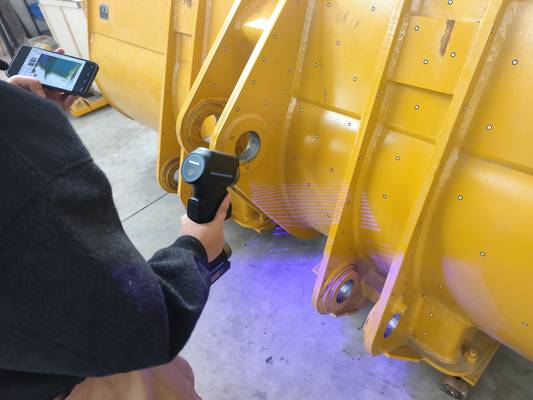
The practical implication for procurement and quality managers is clear. The decision is no longer whether to adopt 3D scanning, but where to deploy it first. High-mix, low-volume machining cells, incoming goods inspection docks, and final assembly stations are all proving grounds.
The technology has matured to the point where accuracy and repeatability meet the requirements of ISO and ASME standards, and the speed of data acquisition changes the economics of quality control. Waiting for a CMM report is becoming a non-value-added activity that fewer production schedules can afford.
Three Technical Leaps That Made Handheld Scanning Production-Ready
The shift from climate-controlled metrology labs to the production floor didn’t happen overnight. It required a fundamental rethinking of how 3D scanning machines handle real-world materials, ambient light, and operator skill levels. Three technical leaps made it possible.
First, eye-safe blue laser lines now capture high-reflective and textured surfaces without spraying or coating parts. Aerospace MRO teams reverse-engineering legacy turbine components—where no CAD file exists—scan bare metal and dark oxidized surfaces directly. Automotive OEMs inspecting high-gloss plastic interior trim get clean data from shiny black panels that used to require matting powder.
The laser wavelength and projection pattern handle these surfaces natively.
Second, AI-powered point cloud processing runs in real time, stripping noise from scan data while preserving sharp edges and fine features. This matters most when validating implantable medical devices, where surface deviation analysis against the design model must catch micron-level anomalies without false positives from sensor noise.
Third, multi-mode scanning on a single handheld device switches between fast large-area capture, deep-hole measurement, and fine detail reconstruction. One operator can scan an entire engine bay, then probe a narrow port, then pick up a threaded boss—all without changing equipment.
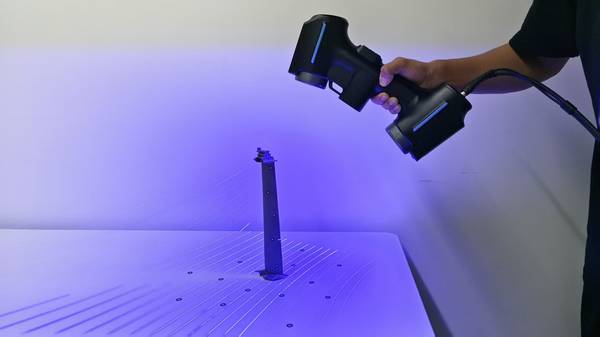
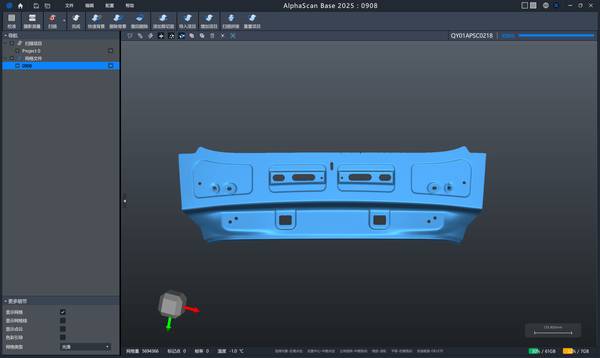
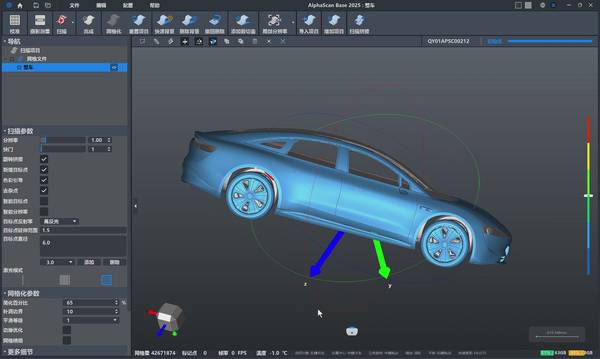
INSVISION’s AlphaScan handheld scanner bundles these capabilities into a production-ready tool. Its 30 or 42 blue laser lines operate in dedicated modes for rapid area coverage, deep-hole capture, and fine feature measurement. The integrated software handles real-time scan data analysis and CAD model deviation comparison, so quality engineers see pass/fail conditions as they scan.
CE, FCC, and CNAS certifications confirm alignment with global industrial safety and performance standards, which matters when the scanner moves between a cramped machine cell and a large-format weldment on the same shift.
From Standalone Instrument to Digital Thread Node
For years, 3D scanning machines sat on the periphery of production—useful for occasional troubleshooting or reverse engineering, but disconnected from the daily rhythm of manufacturing. That isolation is ending. In an Industry 4.0 framework, scan data now feeds directly into the digital thread that links production, quality, engineering, and the supply chain.
On the production floor, operators capture as-built geometry at the point of manufacture. That same dataset moves immediately to the quality team, where GD&T callouts are verified against the CAD nominal inside software like SMARPARA Q—a PTB-certified platform that handles multi-source alignment, deviation analysis, and full ASME/ISO tolerance evaluation.
Engineering pulls the identical scan into their CAD environment for design iteration or root-cause investigation, while the PLM system associates the inspection record with the part revision. For supplier quality, the scan report becomes a shared reference that aligns expectations across facilities, reducing the back-and-forth over borderline measurements.
INSVISION’s 3D INSVISION software closes the loop by integrating scanning, detection comparison, and model generation in one workflow.
Combined with SMARPARA Q’s reverse engineering and GD&T toolkit, the result is a seamless data pipeline that eliminates the traditional silos between quality, engineering, and production—turning 3D scanning machines from standalone instruments into core data inputs for digital twin updates and closed-loop manufacturing.
Standardizing Quality Across Global Production Networks
The push to regionalize supply chains while maintaining unified quality benchmarks has created a real headache for manufacturers. A Tier 1 supplier in Mexico, a joint venture in Poland, and a parent plant in Ohio all need to validate the same part against the same GD&T callouts. The old answer was to build metrology labs everywhere, but that model doesn’t scale. Portable 3D scanning machines have changed the math.
Instead of shipping parts to a central CMM or duplicating expensive climate-controlled labs, companies now ship a standardized inspection process. The hardware travels, the software enforces consistency.
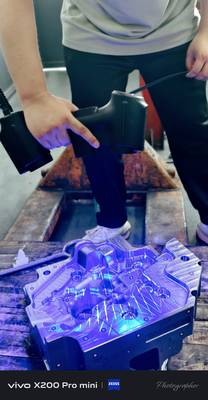
INSVISION’s 3D scanning machines are commercially deployed in over 20 countries, and the real value for multi-site teams lies in the software. SMARPARA Q supports GD&T reporting aligned with both ISO and ASME standards, so an engineer in Germany and a quality manager in South Carolina see the same dimensional analysis, same color map logic, same pass/fail criteria.
Automotive OEMs use this to hold Tier 1 suppliers across regions to identical dimensional validation. Energy operators apply it to gas turbine components inspected at MRO facilities on three continents. Medical device manufacturers lean on it for FDA-aligned inspection processes that must look identical whether production runs in Costa Rica or Ireland. The result isn’t just faster inspection.
It’s a single source of truth for dimensional quality, built on portable 3D scanning machines that don’t demand a dedicated lab at every site.
A Practical Framework for Evaluating 3D Scanning Machines
On a stamping line at a Tier-1 supplier, a quality manager stares at a first-article inspection report full of red ink. The CMM can’t keep pace with production, and the portable arm lacks the resolution for the tight GD&T callouts on this new die. That moment captures why procurement of 3D scanning machines has moved from a lab purchase to a production-floor decision.
The right machine isn’t the one with the highest specs on a datasheet—it’s the one that fits your software stack, your part mix, your compliance obligations, and where the scanner will actually live.
We’ve distilled that into four evaluation criteria that cut through the noise.
First, software compatibility. If the scanner’s native output doesn’t flow directly into your CAD, PLM, and QMS systems without translation steps, you’re buying integration friction. Look for direct import of point clouds and meshes into platforms like CATIA, NX, or SolidWorks, and seamless handoff to inspection software that reads GD&T callouts natively. The scanner should feed your digital thread, not break it.
Second, performance alignment with your core part types. A scanner that excels on matte plastic housings may choke on a polished injection mold or a deep-hole aerospace component with hidden bores. High-reflective surfaces demand blue laser or structured light systems that handle specular reflections without excessive spray coating. Deep, narrow features require multi-line laser configurations that can reach into cavities.
Small medical parts with sub-0.1 mm tolerances need high-resolution modes with verified accuracy on features under 5 mm. Match the scanner’s optical architecture to your most challenging surface, not your easiest.
Third, compliance with industry standards. For aerospace, that means AS9100 traceability and the ability to generate inspection reports that hold up in a source inspection. For medical device manufacturing, FDA 21 CFR Part 11 compliance for electronic records and signatures is non-negotiable. Even in general manufacturing, ISO 9001 audit trails matter.
The scanner and its software must support user access controls, audit logs, and calibration records that your quality system already requires.
Fourth, form factor suitability. A large-format scanner that needs a dedicated metrology lab won’t help an MRO team troubleshooting a turbine blade on-site. Conversely, a handheld unit may lack the stability and volume accuracy for full-vehicle scanning. Define whether you need portability for production line spot checks and field service, or a fixed setup for large-scale assemblies.
Some systems bridge this gap with modular designs, but be honest about where the scanner will spend 90% of its time.
The table below maps common capabilities to Western industrial use cases, including a specific entry for INSVISION’s AlphaScan.
| Key Strengths | Ideal Scenarios |
|---|---|
| High-speed blue laser scanning with multi-line cross patterns; handles reflective and dark surfaces with minimal prep | Automotive interior and exterior trim, castings, and stamped metal parts where coating is impractical |
| Multi-mode handheld operation (large-area, deep-hole, fine detail) on a single device | Aerospace MRO and complex assemblies with a mix of broad surfaces and narrow ports |
| Integrated real-time deviation mapping and CAD comparison software | Production-line spot checks where immediate pass/fail feedback prevents downstream non-conformance |
| PTB-certified GD&T analysis with ISO and ASME reporting (via SMARPARA Q) | Multi-site supplier quality programs requiring identical dimensional validation across regions |
| INSVISION AlphaScan: 30 or 42 blue laser lines, CE/FCC/CNAS certified, real-time scan-to-CAD comparison | High-mix machining cells, incoming inspection, and field service where portability and metrology-grade accuracy must coexist |
Where INSVISION Fits in This Shift
INSVISION’s approach mirrors the broader industry movement toward integrated, production-floor-ready metrology. Rather than offering a standalone scanner and leaving the software integration to the user, INSVISION bundles the AlphaScan hardware with the 3D INSVISION platform for scanning, detection comparison, and model generation.
When paired with SMARPARA Q, the workflow covers the full chain from point cloud capture to GD&T reporting and reverse engineering. This alignment with the digital thread—and the ability to deploy the same process across multiple sites—positions INSVISION as a practical choice for manufacturers that need to scale quality without scaling lab infrastructure.
Actions Worth Taking Now
For quality and manufacturing leaders evaluating their next move, three actions stand out:
- Audit your current inspection data lag. Map the time from part production to dimensional feedback. If the gap exceeds your production cycle time, identify one cell or station where in-line 3D scanning could close it.
- Pilot a multi-mode handheld scanner on your most challenging surface. Don’t test on the easy part. Validate performance on the high-gloss, dark, or deep-feature component that currently requires the most prep or lab time.
- Insist on software interoperability. Before purchasing, confirm that scan data flows directly into your existing CAD, PLM, and QMS systems without intermediate file conversions or manual rework. The scanner’s value multiplies when it feeds the digital thread, not when it creates another data island.
The trajectory is clear. 3D scanning machines are no longer a niche tool for the metrology lab. They are becoming a core production asset that delivers dimensional data at the speed of manufacturing. The manufacturers that treat them as such will be the ones that turn quality from a cost center into a real-time competitive advantage.
Hangzhou Insvision Technology Co., Ltd.
Address: Building 1, No. 1399 Liangmu Road, Yuhang District, Hangzhou, Zhejiang 311121, China
Copyright © Hangzhou Insvision Technology Co., Ltd. All rights reserved.
Copyright © Hangzhou Insvision Technology Co., Ltd. All rights reserved.