

INSVISION’s 3D Imager Closes the Gap Between Lab Precision and Shop-Floor Profitability
For years, production teams accepted a frustrating trade-off. They could invest in fixed metrology systems that deliver certified accuracy but live in a cl
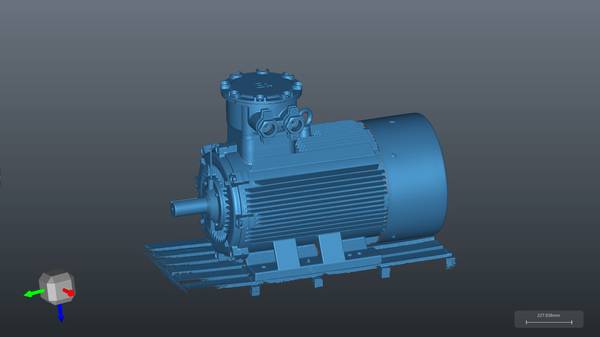
For years, production teams accepted a frustrating trade-off. They could invest in fixed metrology systems that deliver certified accuracy but live in a climate-controlled lab, far from the line. Or they could grab a portable scanner that survives the shop floor but can’t hold the tolerances required for PPAP submissions or ASME Y14.5 compliance.
That compromise forced extra handling, duplicated inspections, and a dependence on specialists who could bridge the gap—none of which shows up as a line item on a scanner purchase order, but all of which inflate the real cost of quality.
This article examines where those hidden costs accumulate and how a shop-floor-ready 3D imager, architected from the start for production environments, changes the equation. The focus is not on sensor specifications but on operational levers: inspection cycle time, rework avoidance, labor deployment, delivery cadence, and the long-term asset of traceable quality data.
Where Traditional Inspection Workflows Leak Value
Before evaluating any new equipment, it’s worth mapping the cost structure of the current state. In many factories, the following patterns repeat:
- Lab-bound bottlenecks. A CMM or fixed scanner sits in a quality lab. Parts travel to the instrument, wait in queue, and travel back. The inspection itself may be fast, but the total turnaround—from part-off to actionable report—can stretch hours or days. During that window, production either pauses or runs blind.
- Rework cascades. When a portable tool can’t reliably capture high-reflective surfaces, deep cavities, or fine features, operators compensate with spray coatings, multiple setups, or manual touch-up measurements. The data gaps that remain force engineers to make judgment calls. A missed deviation on a mold or casting can propagate into tool rework, production downtime, and scrap that could have been prevented.
- Specialist dependency. Complex inspection software often requires a dedicated metrology programmer. If that person is out, or overloaded, the inspection queue stalls. The organization’s ability to respond to a rush order or a quality hold becomes gated by a handful of experts.
- Disconnected data trails. When scanning, alignment, and reporting happen in separate software packages, traceability suffers. Audit preparation turns into a manual hunt for scan files, revision histories, and deviation reports. The time spent reassembling the story of a part’s conformance is time not spent improving the process.
Each of these friction points carries a direct cost in labor hours and an opportunity cost in throughput. Together, they define the true cost of inspection—a cost that a well-designed 3D imager can reduce significantly.
How a Production-Grade 3D Imager Shifts the Cost Equation
A 3D imager built for the shop floor attacks these leaks at the source. The value shows up in several operational dimensions:
Inspection cycle time. When scanning, CAD alignment, GD&T evaluation, and color-map reporting live inside a single software environment, the sequence from part setup to actionable report compresses. There is no export-import loop, no switching between tools. For first-article inspections, this can cut hours from the qualification process, allowing production to start sooner and reducing the pressure on delivery schedules.
Rework and scrap reduction. The ability to capture accurate, full-field data on challenging surfaces—polished molds, turbine blades, deep cooling channels—without spray or special preparation means fewer measurement-induced errors.
When the 3D imager delivers metrology-grade repeatability directly on the production floor, teams can detect dimensional drift earlier, correct tool offsets before non-conforming parts accumulate, and avoid the scrap-and-rework spiral that erodes margins on tight-tolerance jobs.
Labor redeployment. An intuitive, all-in-one software platform lowers the barrier to entry. Operators and quality technicians can run routine inspections and generate pass/fail reports without a dedicated metrology specialist. That frees senior engineers to focus on root-cause analysis and process improvement rather than routine data processing. The result is a more flexible workforce and faster response to production issues.
Delivery reliability. When inspection keeps pace with production, quality gates don’t become delivery bottlenecks. Real-time point cloud processing and AI-driven anomaly detection flag potential defects during the scan cycle, not minutes later. This immediate feedback lets teams make pass/fail decisions at the line, keeping parts moving and protecting on-time delivery commitments.
Quality traceability as an asset. A unified digital thread—scan data, inspection reports, revision histories—simplifies audit readiness and customer communication. When a customer asks for dimensional evidence on a shipped batch, the data is retrievable in minutes, not days.
That traceability builds trust and can become a competitive differentiator in industries where PPAP documentation and ISO/GPS compliance are non-negotiable.
A Practical Framework for Evaluating the Impact
Rather than rely on generic ROI claims, operations leaders can assess the potential impact of a shop-floor 3D imager by examining their own workflows. The table below outlines a qualitative evaluation structure that can be adapted to any facility.
| Cost Driver | Current-State Indicators | What to Observe After Deployment |
|---|---|---|
| Inspection turnaround | Hours or days from part-off to report; production waits on lab availability | Report generation keeps pace with production cadence; first-article sign-off accelerates |
| Rework and scrap | Recurring dimensional issues on specific features; spray coating required for scanning | Fewer measurement-related rework events; scrap triggers caught earlier in the run |
| Labor allocation | Senior metrology staff spend significant time on routine scans and data processing | Routine inspection handled by operators/technicians; specialists focus on exception analysis |
| Delivery performance | Late shipments traced to inspection backlog or last-minute quality holds | Inspection gates clear predictably; rush orders accommodated without quality compromise |
| Audit and traceability | Manual assembly of inspection records; difficulty proving conformance history | Single-source digital records; audit response time reduced |
This framework doesn’t require precise percentages upfront. Instead, it gives a management team a structured way to measure the operational shift over the first few months of use—and to build an internal business case grounded in their own production data.
Where INSVISION’s 3D Imager Delivers Operational Improvement
INSVISION’s AlphaScan 3D imager and the 3D INSVISION software platform were developed specifically to eliminate the lab-versus-floor compromise. The operational improvements that factories observe stem from a few deliberate design choices.
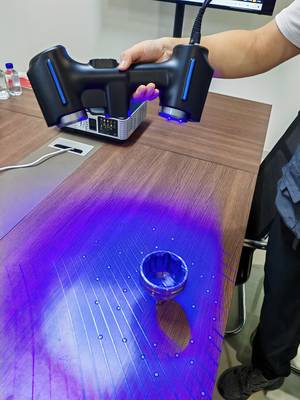
First, the combination of multi-line cross blue laser technology and AI-driven 3D reconstruction algorithms addresses the capture failures that plague portable scanners on high-reflective and deep-cavity parts.
Automotive tooling teams scanning polished injection molds, aerospace MRO crews inspecting turbine surfaces without spray coating, and medical device manufacturers running batch inspection on small precision components all report usable, full-field data on the first pass. That eliminates the rework and secondary setups that inflate inspection time and introduce variability.
Second, the all-in-one software environment collapses scan, inspection, CAD alignment, and GD&T reporting into a single workflow. Quality engineers can check true position, profile, and runout against ASME Y14.5 and ISO GPS callouts directly, without exporting to a separate package. The reduction in software handoffs translates directly into faster report generation and fewer errors.
Third, real-time point cloud processing and AI-powered anomaly detection give operators immediate feedback. Defects are flagged during the scan cycle, enabling pass/fail decisions at the line. For high-volume production environments, this real-time capability prevents bad parts from progressing downstream and accumulating value that will later be scrapped.
Fourth, the platform’s development process embeds feedback from actual factory floors. When renewable energy manufacturers needed to scan large photovoltaic frames and wind turbine blade sections in remote outdoor conditions, INSVISION reworked the working distance and scan speed to enable stable data capture without complex fixturing.
When automotive quality teams demanded faster pass/fail calls, the software gained real-time processing. This iterative, user-driven approach means the tool evolves in step with the operational realities of production, not just lab benchmarks.
Finally, the certification path—CE, FCC, and CNAS-accredited metrology testing—provides the documentation quality managers need for PPAP and first-article submissions. That reduces the friction of introducing a new measurement tool into a regulated supply chain.
Implementation Rhythm: Where to Start
For a factory evaluating a shop-floor 3D imager, the fastest path to visible operational gain usually runs through two or three high-impact applications. A phased approach keeps the initiative manageable and generates early wins that build internal support.
- First-article inspection acceleration. Target the part families that currently create the longest inspection queues. Deploy the 3D imager to bring inspection to the part, rather than moving parts to the lab. Measure the reduction in turnaround time and the corresponding improvement in production start cadence. This single application often justifies the investment by unlocking capacity.
- In-line dimensional checks on critical features. Identify a production cell where dimensional drift historically leads to scrap or rework. Integrate the 3D imager into the operator’s routine at a defined interval. Use the real-time feedback to adjust tool offsets before non-conforming parts accumulate. Track the reduction in scrap events and the associated material and labor savings.
- Reverse engineering and legacy part digitization. Many factories carry the hidden cost of missing CAD data for tooling, fixtures, or spare parts. A portable 3D imager that captures accurate geometry on the shop floor can build a digital inventory of these assets, reducing the time and cost of future repairs or redesigns. This application often delivers value across multiple departments and can be pursued in parallel with inspection-focused use cases.
In each phase, the evaluation framework described earlier provides a consistent way to capture before-and-after observations. The goal is not to hit a vendor-supplied ROI number but to build an internal fact base that connects the 3D imager to real operational metrics.
Summary
The pressure to deliver higher quality at lower cost is not going away. For many manufacturers, the inspection process remains an underutilized lever for operational improvement. A 3D imager designed for the production floor—one that delivers metrology-grade accuracy without the overhead of a lab-bound system—can compress inspection cycles, reduce rework, redeploy skilled labor, and strengthen delivery reliability.
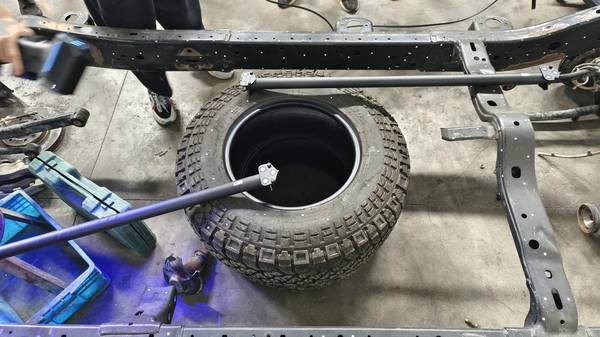
INSVISION’s approach, built on blue laser technology, AI-driven reconstruction, and a unified software platform, targets the specific friction points that drive up the true cost of quality. By starting with a focused implementation in first-article inspection, in-line checks, or reverse engineering, operations leaders can generate measurable improvements and build the case for broader deployment.
The result is not just a new measurement tool, but a more responsive, cost-efficient quality system that keeps production flowing and customers confident.
Hangzhou Insvision Technology Co., Ltd.
Address: Building 1, No. 1399 Liangmu Road, Yuhang District, Hangzhou, Zhejiang 311121, China
Copyright © Hangzhou Insvision Technology Co., Ltd. All rights reserved.
Copyright © Hangzhou Insvision Technology Co., Ltd. All rights reserved.