

Scanned Object Datasets in Industrial Metrology Principles and Application Fit
Understand how handheld 3D scanners capture metrology-grade scanned object data. This guide covers blue laser technology, accuracy limits, and selection criteria.
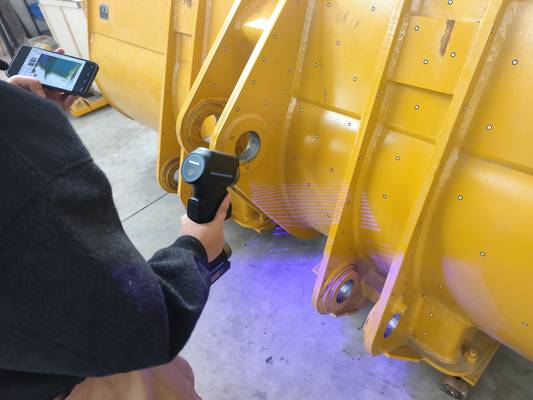
This article unpacks the technology behind INSVISION’s AlphaScan handheld 3D scanner, explains how it produces reliable scanned object data, and clarifies the boundary conditions that determine whether it belongs in your inspection workflow. The focus is on principles, not promotion—so you can evaluate the approach against real production requirements.
What a Scanned Object Dataset Actually Is
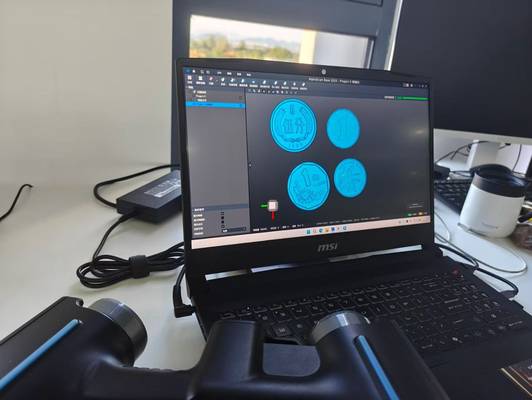
A scanned object, in the context of industrial 3D scanning, is a digital twin captured as a dense, measured point cloud and then converted into a watertight mesh model. Unlike a handful of discrete CMM touch points, a scanned object represents the entire visible surface—freeform contours, blend radii, pocket floors, and all.
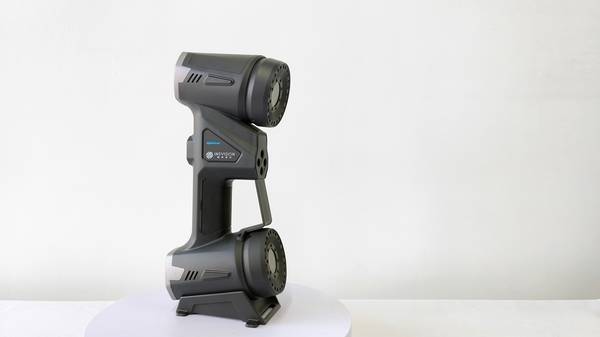
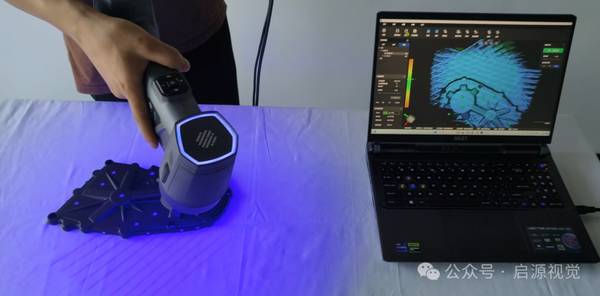
INSVISION’s AlphaScan builds that dataset through a cross blue laser architecture. Fifty laser lines project onto the part surface simultaneously. Onboard cameras record the reflected profiles at high frame rates, and internal processing strips noise, aligns the profiles, and outputs a calibrated point cloud directly from the device. No external stitching software is needed during capture.
The operator simply walks around the part, and the scanner maintains alignment in real time. At 1,070 grams, the handheld form factor reaches into undercuts and deep cavities that would force a fixed system into multiple setups.
The resulting point cloud is held to a volumetric accuracy of 0.020 mm. That cloud feeds directly into meshing, producing a metrology-grade model ready for first-article inspection, GD&T callouts, or reverse engineering—without stitching artifacts or manual scaling corrections.
Key Technical Elements That Determine Data Quality
Consistent scanned object data on challenging industrial surfaces doesn’t happen by chance. Three design choices in the AlphaScan directly address the most common failure modes in handheld scanning.
Blue laser wavelength (450 nm). Shiny, dark, or black surfaces often cause data dropout because longer wavelengths scatter beneath the surface or reflect specularly away from the cameras. The 450 nm blue laser minimizes subsurface scattering and specular reflection, so high-gloss molds and black ABS housings can be scanned without developer spray.
The point cloud retains density and edge definition where red-laser or white-light systems typically lose lock.
Handheld ergonomics and line count. The 50 cross laser lines create a wide capture swath that maintains point density even when the scanner is angled into a deep pocket or narrow seam. At 1,070 g, the device is light enough for one-handed operation over extended periods, and the walk-around workflow eliminates the line-of-sight constraints of tripod-mounted systems.
Geometry that would otherwise require part repositioning or multiple setups—internal undercuts, occluded corners on large assemblies—gets captured in a single continuous scan.
Regulatory compliance as a reliability signal. Full compliance with CE, FCC, RoHS, IEC 60825 (laser safety), and IEC 62471 (photobiological safety) confirms that the scanner operates predictably within North American and European industrial environments. For quality managers, this removes questions about measurement drift, electrical safety, or regulatory risk when deploying the device on a shop floor or at a customer site.
Real-World Performance on Problem Parts
The gap between a scanner’s spec sheet and its behavior on a polished injection mold or a sand casting is where many systems stumble. INSVISION’s application data shows the AlphaScan holding 0.020 mm volumetric accuracy across several traditionally difficult surfaces.
On a mirror-finish injection mold cavity, the raw point cloud captured sharp edge definition without the blooming artifacts that plague many structured-light systems. The resulting mesh was immediately usable for GD&T callouts and first-article inspection. Black ABS automotive housings—notorious for absorbing enough light to produce sparse data—scanned at full resolution with no developer spray.
Complex sand castings with internal undercuts and narrow ports resolved cleanly; the cross-line pattern reached into features that single-line or lower-count systems miss.
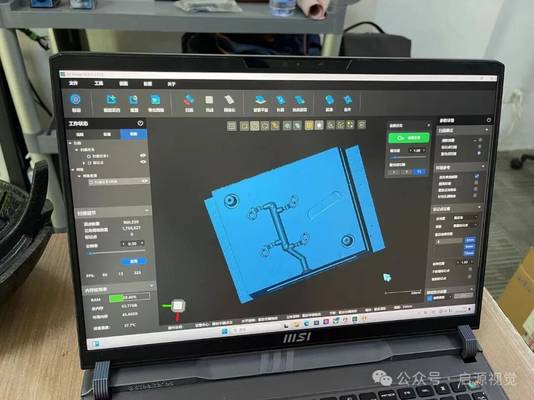
The practical outcome is a shorter path from physical part to actionable metrology data. Fewer manual interventions, less rework, and no need to coat the part surface.
How Full-Field Scanning Compares to Legacy Measurement Methods
The choice between a 3D scanner and traditional metrology tools isn’t about which is better—it’s about which data type the inspection task demands.
| Aspect | AlphaScan 3D Scanning Workflow | Legacy Measurement Methods (CMM, calipers, height gauges) |
|---|---|---|
| Data type | Dense, full-surface point cloud; watertight mesh | Discrete point measurements; linear, diametral, and positional readings |
| Surface coverage | Captures entire visible surface in one setup, including freeform contours and blend radii | Measures only probed or contacted features; full-field mapping requires extensive programming |
| Portability | Handheld, 1,070 g; usable on the shop floor, in a tooling bay, or at a field service site | CMMs are fixed; handheld tools are portable but collect sparse data |
| Best for | Reverse engineering of castings, forgings, molded parts; first-article inspection of complex brackets or housings; in-situ wear assessment; full-field CAD comparison | In-process checks of prismatic turned/milled parts; final inspection of bearing seats, dowel holes, and mating faces; calibration of go/no-go gauges |
| Metrology integration | Outputs standard mesh formats (STL, OBJ, PLY) for direct import into PolyWorks, Geomagic, or CAD platforms | Results align directly with decades of ISO/ASME GD&T callouts and operator training |
Neither workflow replaces the other. A quality engineer might use a height gauge to qualify a reference surface, then scan the full part to map how that surface blends into surrounding geometry. The AlphaScan adds the ability to digitize an entire scanned object quickly and portably, feeding downstream analysis without sacrificing metrological rigor.
Where a Scanned Object Dataset Delivers the Most Value—and Where It Doesn’t
The AlphaScan is optimized for industrial parts roughly 10 cm and larger, with hole features 5 mm and wider. Within that envelope, the 50 cross blue laser lines and 0.020 mm accuracy produce dense, reliable point clouds that match real inspection demands.
Strong-fit scenarios:
- Automotive Tier 1 suppliers reverse engineering legacy components, capturing hole positions and diameters for GD&T assembly compliance.
- Aerospace MRO teams comparing as-built geometry against OEM models to quantify erosion or fretting on structural parts.
- Energy sector
Hangzhou Insvision Technology Co., Ltd.
Address: Building 1, No. 1399 Liangmu Road, Yuhang District, Hangzhou, Zhejiang 311121, China
Copyright © Hangzhou Insvision Technology Co., Ltd. All rights reserved.
Copyright © Hangzhou Insvision Technology Co., Ltd. All rights reserved.