

3D Scan Art for Operational Value in Manufacturing Metrology
Explore how 3D scan art improves inspection speed, rework control, labor use, delivery cadence, and traceability in industrial manufacturing for quality teams.
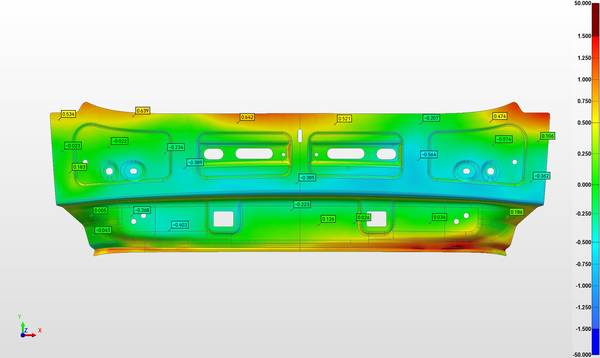
This article examines how industrial-grade 3D scanning changes the cost structure of dimensional inspection. The focus is not on replacing every coordinate measuring machine or turning metrology into a software-only process. The practical question is simpler: where can a shop-floor-ready scanning workflow remove delays, reduce avoidable rework, and create reusable digital data for lean manufacturing and Industry 4.0 programs?
Cost Pain Points in Traditional Measurement and Rework
In many high-mix manufacturing environments, measurement cost is hidden across several disconnected activities. A first-article inspection may wait in a CMM queue. A legacy component may lack CAD data. A polished mold insert may require surface preparation before optical inspection. A nonconforming part may move through production before a form deviation is fully understood.
Contact-based CMMs remain essential for many precision tasks, but they can become bottlenecks when complex freeform surfaces, legacy brackets, turbine blades, mold cavities, or low-volume service parts need rapid evaluation. A single complex part can consume hours of programming, fixturing, probing, reporting, and review. During that time, production release decisions are delayed and work-in-progress continues to accumulate.
Manual surface plate inspection and dedicated gauges create another cost layer. Results may depend on operator technique, while documentation often lives in paper records or disconnected spreadsheets. When a customer complaint or audit question appears weeks later, reconstructing the measurement context can be slow.
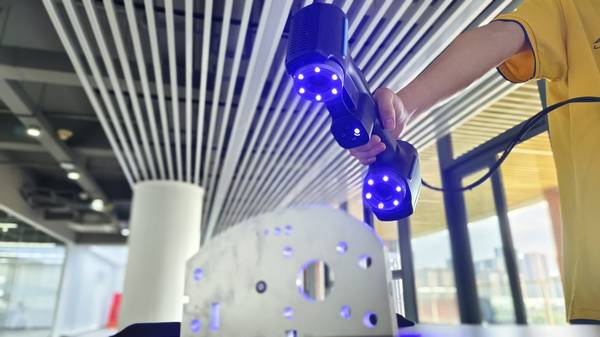
Rework and scrap amplify the issue. Sparse point measurements can confirm that selected GD&T callouts are acceptable, yet still miss broader surface distortion, warpage, or tool wear patterns. When these deviations are found late, the cost is no longer only inspection time; it becomes machine time, operator time, delivery risk, and customer confidence.
Inspection Efficiency and Measurement Cycle Time
Pain point: First-article inspection and in-process checks often compete for limited CMM time.
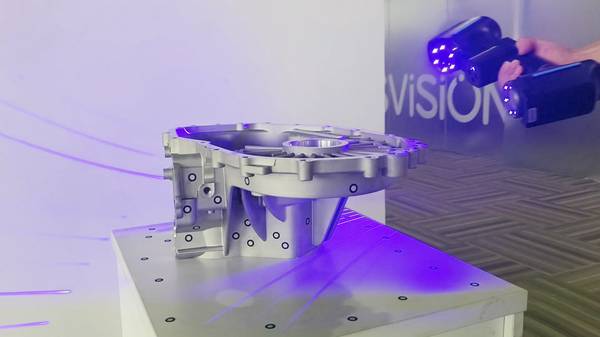
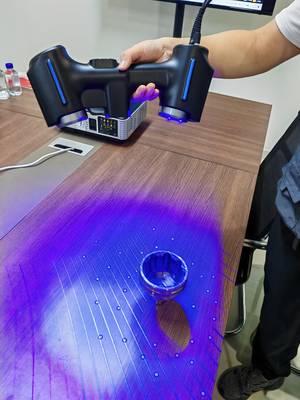
Improvement path: A metrology-grade handheld scanner can capture full-part geometry quickly and bring inspection closer to the production line. In the case of INSVISION AlphaScan, full-part scan capture on complex components can be completed in roughly three minutes, with accuracy at the 0.02 mm level under supported conditions.
Observable value: 3D scan art allows routine dimensional verification to move away from the slowest queue. CMM capacity can be reserved for tasks that truly require contact probing, while scanning supports faster release decisions, shorter inspection loops, and better alignment with lean production cadence.
Rework and Scrap Control
Pain point: Teams often make rework decisions based on limited measurement points or subjective surface assessment.
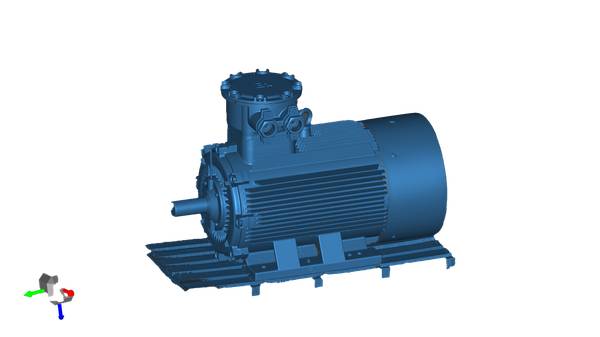
Improvement path: Full-field scanning produces dense point cloud and mesh data that can be compared with CAD. Color deviation maps show where material is high, low, twisted, warped, or inconsistent with design intent.
Observable value: Engineers can identify tool wear, die shift, draft issues, and form deviations earlier. When rework is needed, 3D scan art provides as-built geometry for CAD/CAM workflows, reducing manual guesswork and improving the consistency of repair decisions.
Labor Allocation and Skills Dependency
Pain point: Experienced CMM programmers and senior metrology specialists are scarce, and many facilities rely heavily on a small number of people for routine measurement work.
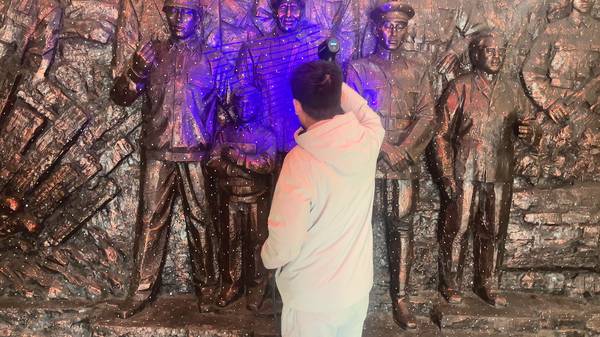
Improvement path: A well-designed handheld scanning process can be operated by trained quality technicians for routine inspections. INSVISION AlphaScan is designed for practical shop-floor use, including AI-driven filtering for ambient light and surface reflectivity challenges.
Observable value: 3D scan art does not remove the need for metrology expertise. It redirects that expertise. Senior specialists can focus on programming strategy, tolerance interpretation, root-cause analysis, and customer-facing quality review, while routine scan capture can be distributed across the team.
Delivery Cadence and Order Responsiveness
Pain point: Legacy parts without CAD data slow quotation, repair, reverse engineering, and service-part reproduction.
Improvement path: Scanning creates a digital mesh that can feed CAD reconstruction and validation workflows. Instead of starting from manual measurements and sketches, engineers begin with a complete digital representation of the physical part.
Observable value: 3D scan art supports shorter quotation cycles, faster spare-part development, and more responsive customer service. For mold shops, Tier-1 suppliers, MRO teams, and precision job shops, this can improve delivery cadence without requiring exaggerated ROI claims.
Quality Traceability and Long-Term Data Assets
Pain point: Measurement records are often created for immediate release, then become difficult to reuse for later process improvement.
Improvement path: Each scan can become part of a digital thread: as-built geometry, inspection report, deviation map, and process history.
Observable value: Over time, 3D scan art supports tool wear trending, supplier quality tracking, engineering change validation, and audit readiness. For organizations working under ISO quality systems or ASME GD&T requirements, digital inspection records reduce the burden of manual documentation and improve customer communication.
Operational Value Calculation Framework
The value of 3D scanning should be evaluated with plant-specific data rather than generic savings claims. The framework below helps operations, quality, and finance teams identify where the business case is strongest.
| Operational Lever | Current State Indicators | Improvement Path with 3D Scan Art | Observable Value |
|---|---|---|---|
| First-article inspection | CMM queue delays, long report turnaround, delayed production release | Full-field scan capture, CAD comparison, faster report preparation | Shorter release cycles, reduced WIP pressure |
| Rework control | Repeated manual blending, unclear deviation source, inconsistent repair decisions | Deviation maps and scan-to-CAM rework support | More consistent rework |
Hangzhou Insvision Technology Co., Ltd.
Address: Building 1, No. 1399 Liangmu Road, Yuhang District, Hangzhou, Zhejiang 311121, China
Copyright © Hangzhou Insvision Technology Co., Ltd. All rights reserved.
Copyright © Hangzhou Insvision Technology Co., Ltd. All rights reserved.