

Handheld Laser Scanning Tackles Complex Industrial Metrology Without the CMM Bottleneck
In heavy equipment manufacturing, automotive powertrain production, and large-scale fabrication, dimensional inspection often becomes the quiet constraint
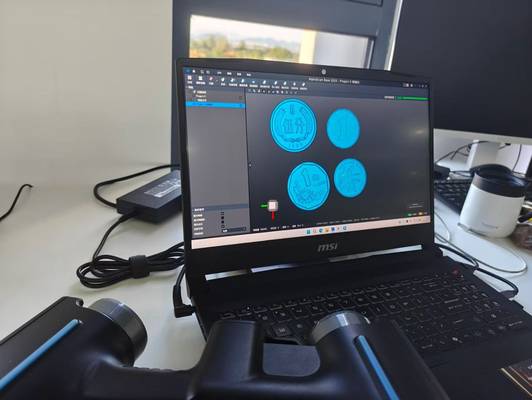
In heavy equipment manufacturing, automotive powertrain production, and large-scale fabrication, dimensional inspection often becomes the quiet constraint that limits throughput. A single complex casting or welded frame can tie up a coordinate measuring machine (CMM) for hours, while simpler manual tools fail to capture the full surface geometry needed for meaningful deviation analysis.
The result is a familiar tension: quality teams push for more data, production teams push for faster release, and neither side gets what it needs.
Handheld laser scanning has moved beyond early-adopter experimentation. Instruments like the INSVISION AlphaScan laserscanner now bring laboratory-grade metrology directly to the part—whether that part is still fixtured on a machine tool, staged in a receiving bay, or bolted into an assembly.
This article walks through how engineering and quality groups are applying the AlphaScan to real industrial workpieces, replacing legacy measurement sequences with a single, shop-floor-ready digital workflow.
Typical Industrial Conditions and Core Pain Points
Consider a mid-volume manufacturer producing ductile iron housings for off-highway equipment. Each housing measures roughly 800 mm across, with multiple machined bores, flange faces, and cast surfaces that must be verified against the CAD model.
The first-article inspection alone can consume an entire shift on a bridge CMM, and any out-of-tolerance condition discovered late in the run triggers a cascade of quarantined inventory and rushed rework.
Capability and Deployment Mapping
| Focus Area | Decision Point | Deployment Note |
|---|---|---|
| Typical Industrial Conditions and Core Pain Points | Consider a mid-volume manufacturer producing ductile iron housings for off-highway equipment. | Each housing measures roughly 800 mm across, with multiple machined bores, flange faces, and cast surfaces that must be verified against the CAD… |
| The pain points in this scenario are not unique: | These conditions demand a measurement tool that is fast, tolerant of real-world surface finishes, and capable of generating a dense point cloud that… | Confirm against part conditions, inspection tempo, and data-output requirements. |
| Designing a Shop-Floor Scanning Solution | The goal is not to replace the CMM entirely but to offload the high-density surface capture from the CMM and move it to a flexible, handheld device t… | The solution design for the ductile iron housing scenario follows a few clear principles: |
| Implementation: From Setup to Digital Twin | A typical deployment for the housing inspection unfolds in four steps, each designed to minimize disruption to the production schedule. | Confirm against part conditions, inspection tempo, and data-output requirements. |
The pain points in this scenario are not unique:
- CMM capacity is finite. Programming, fixturing, and run time for contoured surfaces create a queue that delays other urgent measurements.
- Manual methods miss the full picture. Height gages, calipers, and functional gages check discrete features but provide no insight into surface profile, warpage, or global deformation.
- Shiny, machined surfaces and dark cast iron challenge many optical scanners, requiring operators to apply developer spray—adding time, variability, and cleanup steps.
- Reporting gaps between what the CMM outputs and what the engineering team needs for root-cause analysis force re-measurement or subjective interpretation.
These conditions demand a measurement tool that is fast, tolerant of real-world surface finishes, and capable of generating a dense point cloud that feeds directly into inspection software.
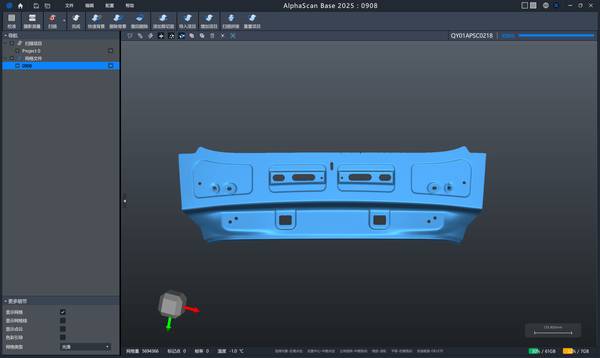
Designing a Shop-Floor Scanning Solution
The goal is not to replace the CMM entirely but to offload the high-density surface capture from the CMM and move it to a flexible, handheld device that can be deployed where the part sits. The solution design for the ductile iron housing scenario follows a few clear principles:
- Capture the entire visible surface in one session. The scanner must handle the part’s size without stitching drift, and it must maintain accuracy on both the as-cast flanges and the machined bores.
- Eliminate surface preparation. A blue-laser-based scanner that works on reflective and dark surfaces without spray keeps the workflow clean and repeatable.
- Integrate with existing inspection software. The output must be a structured point cloud or mesh that can be aligned to the CAD model in tools the quality team already uses for GD&T evaluation and deviation mapping.
- Provide immediate feedback. The operator should see a live, color-coded deviation map on screen while scanning, flagging potential issues before the part leaves the station.
The INSVISION AlphaScan handheld laserscanner fits this design because it combines blue laser projection with a compact, ergonomic form factor that can be maneuvered around large workpieces. Its metrology-grade hardware is built to deliver the volumetric accuracy needed for first-article inspection, while the live preview gives the operator confidence that coverage is complete.
Implementation: From Setup to Digital Twin
A typical deployment for the housing inspection unfolds in four steps, each designed to minimize disruption to the production schedule.
Step 1: Preparation and Alignment
The part is placed on a stable surface—no precision fixturing required. Reference targets or natural features are used to lock the scanner’s coordinate system. If the inspection requires a datum alignment matching the CMM program, a few quick probe points taken with the scanner’s integrated probing capability establish the same reference frame. This step takes minutes, not the hours needed to fixture a part on a CMM.
Step 2: Scanning the Workpiece
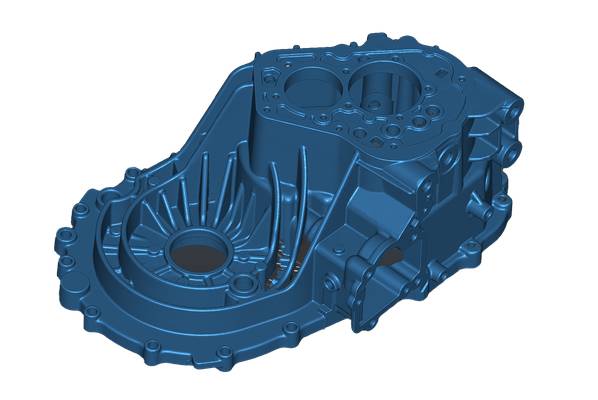
The operator walks around the housing, sweeping the AlphaScan across all critical surfaces. The blue laser lines adapt to the mixed surface finishes: machined bores reflect cleanly, while the rough cast iron absorbs enough light to generate a dense point cloud without spray. The live deviation map on the connected tablet highlights any areas that need additional passes.
For a part of this size, full surface capture typically completes in under 15 minutes.
Step 3: Data Processing and Mesh Generation
The captured point cloud is processed into a watertight mesh. The software automatically removes outliers and aligns multiple scan passes. The resulting mesh is exported in a standard format—STL, OBJ, or direct to inspection platforms—ready for comparison against the nominal CAD model.
Step 4: Inspection and Reporting
The mesh is imported into the quality team’s GD&T software. A best-fit or datum-based alignment is applied, and a full surface deviation map is generated. Cross-sections are extracted at critical bore locations, and wall thickness can be analyzed if both sides of the part were scanned. The report is shared with engineering and production within the same shift, enabling faster disposition decisions.
How the INSVISION AlphaScan Matches the Demands of This Scenario
The AlphaScan handheld laserscanner addresses the specific challenges of this industrial application through several design choices that matter on the shop floor:
- Blue laser technology maintains signal quality on shiny machined surfaces and dark cast iron, reducing the need for surface treatment. This directly removes a source of process variability and operator frustration.
- Metrology-grade hardware architecture ensures that the point cloud accuracy is sufficient for GD&T evaluations, not just for reverse engineering or rough checks. The scanner’s volumetric accuracy is traceable and consistent across the measurement volume.
- Handheld ergonomics and live feedback allow a single operator to scan large parts without repositioning the workpiece. The real-time deviation display acts as an instant sanity check, catching missed areas before data processing begins.
- Software-agnostic output means the mesh can flow into the inspection software the team already trusts, whether that is a dedicated metrology package or a CAD-integrated module. There is no forced workflow change beyond the data capture step.
These capabilities translate into a practical shift: the CMM is freed for the discrete feature checks and tight-tolerance bores it excels at, while the AlphaScan handles the dense surface capture that would otherwise consume disproportionate CMM time.
Observable Results in Daily Operations
While specific cycle-time reductions depend on part geometry and inspection requirements, several qualitative improvements become visible soon after integrating the AlphaScan into the workflow:
- First-article inspection lead time shrinks. A part that previously occupied a CMM for a full shift can be scanned and reported in under an hour, with the CMM used only for a handful of critical diameter checks.
- Rework decisions accelerate. When a deviation map is available within the same shift, manufacturing engineers can adjust tool offsets or fixturing before the next batch runs, reducing the volume of non-conforming parts.
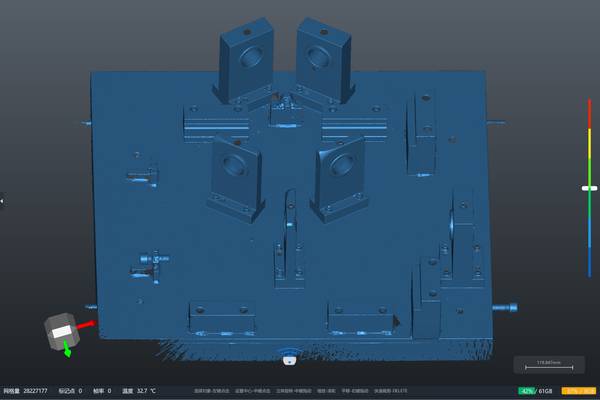
- Communication improves across shifts. A color-coded surface comparison is easier to interpret than a table of discrete measurements, helping production teams understand exactly where a part is drifting and by how much.
- Documentation becomes richer. The full 3D scan serves as a digital record of the as-built condition, useful for warranty analysis, supplier quality discussions, and continuous improvement projects.
These outcomes are not theoretical; they emerge from the fundamental capability to capture millions of measurement points in minutes, directly on the factory floor, without the logistical overhead of a CMM bay.
Extending the Approach to Similar Applications
The workflow described for a ductile iron housing applies with minor adjustments to a range of industrial scenarios where complex geometry and mixed surface finishes are the norm:
- Welded fabrications and frames: Large weldments that are difficult to fixture on a CMM can be scanned in place. The AlphaScan captures weld bead geometry, plate flatness, and hole positions in one session, supporting both fabrication inspection and reverse engineering of modified assemblies.
- Plastic injection-molded components: Warpage and sink marks are easily visualized on a deviation map. The scanner’s ability to handle glossy surfaces without spray is particularly valuable here.
- Legacy part digitization: When CAD models are missing or outdated, the AlphaScan generates a mesh that can be used for reverse engineering, replacement part design, or simulation model creation.
- In-process inspection on machine tools: For large parts that are difficult to move, the handheld scanner can be brought to the machine, capturing the part between operations to verify stock allowance or check feature location before final cuts.
In each case, the evaluation criteria remain consistent: surface finish tolerance, part size, required accuracy, and integration with existing inspection software. Engineering teams considering a handheld laserscanner for these applications should run a short capability trial on their own parts, comparing the scan data against a known CMM reference to build confidence in the workflow.
Summary
The INSVISION AlphaScan handheld laserscanner addresses a persistent gap in industrial metrology: the need for fast, dense surface capture on parts that are too large, too complex, or too awkward for efficient CMM inspection.
By moving the data capture to the shop floor and delivering metrology-grade results without surface preparation, the AlphaScan changes the economics of first-article inspection, root-cause analysis, and legacy part digitization.
For quality and manufacturing engineers who spend too many hours waiting for CMM availability, the handheld laserscanner offers a practical, immediately deployable path to richer data and faster decisions.
Hangzhou Insvision Technology Co., Ltd.
Address: Building 1, No. 1399 Liangmu Road, Yuhang District, Hangzhou, Zhejiang 311121, China
Copyright © Hangzhou Insvision Technology Co., Ltd. All rights reserved.
Copyright © Hangzhou Insvision Technology Co., Ltd. All rights reserved.