

A Tier-1 Automotive Supplier’s Shift to On-Floor 3D Scanner Laser Inspection
I’ve been running quality operations at a Tier-1 automotive stamping plant for over twelve years.
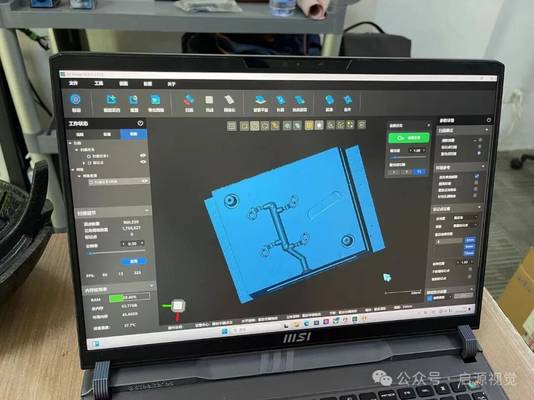
I’ve been running quality operations at a Tier-1 automotive stamping plant for over twelve years. When production schedules tighten, the coordinate measuring machine (CMM) lab becomes the bottleneck nobody wants to talk about. We run three stationary CMMs to handle suspension and chassis components, yet batch inspection queues routinely stretch two to three shifts waiting for an open slot.
Operators fall back on manual calipers for spot checks, and the results vary too much—different technicians, different readings. When tooling wears and we need to reverse-engineer a replacement part without original CAD files, we hit a wall. That friction doesn’t just delay reports; it cascades into shift overruns and unplanned overtime.
The Real Cost of Off-Line Metrology
On a busy stamping line, pulling parts for off-line metrology can chew through an entire shift’s production schedule. The traditional workflow bundles components into batches, carts them to the lab, and queues them behind other urgent jobs. For medium-sized stamped or machined parts, the wait alone creates a hidden drag on throughput that nobody measures until it blows a hole in the schedule.
First-article inspections, tooling wear studies, and spot checks all compete for the same three machines. Meanwhile, press operators need answers now—not after the next shift change.
Validation Points from Use Cases
| Focus Area | Decision Point | Deployment Note |
|---|---|---|
| The Real Cost of Off-Line Metrology | On a busy stamping line, pulling parts for off-line metrology can chew through an entire shift’s production schedule. | The traditional workflow bundles components into batches, carts them to the lab, and queues them behind other urgent jobs. |
| Evaluating a 3D Scanner Laser for the Production Floor | The engineering team started looking at 3D scanner laser solutions that could operate outside the lab, directly in the press bay. | The requirements were clear: metrology-grade accuracy without dedicated fixturing, a handheld form factor that could navigate cramped tooling ar… |
| On-Floor Integration: A Four-Stage Workflow | Deploying a 3D scanner laser on a live production line doesn’t require shutting down presses or investing in specialized fixtures. | We built a repeatable workflow around the AlphaScan that any trained technician can execute. |
| Where the AlphaScan 3D Scanner Laser Fits | INSVISION designed the AlphaScan for exactly this kind of environment. | The scanner delivers metrology-grade accuracy in a handheld package that doesn’t require a controlled lab. |
Manual caliper checks add another layer of risk. Even with skilled technicians, repeatability suffers. Audit season often exposes the gaps: two operators measuring the same feature can produce readings that differ enough to trigger a non-conformance debate.
And when a worn die needs a quick reverse-engineering scan to fabricate a replacement insert, the absence of CAD data turns a straightforward job into a trial-and-error exercise.
Evaluating a 3D Scanner Laser for the Production Floor
The engineering team started looking at 3D scanner laser solutions that could operate outside the lab, directly in the press bay. The requirements were clear: metrology-grade accuracy without dedicated fixturing, a handheld form factor that could navigate cramped tooling areas, and software that could handle GD&T evaluations and CAD alignment without hopping between third-party packages.
After testing several approaches, we landed on the INSVISION AlphaScan, a handheld 3D scanner laser built for industrial environments.
What set the AlphaScan apart wasn’t a single spec but how its capabilities matched our daily reality. The scanner uses AI-powered real-time tracking to maintain alignment even when an operator moves around a large stamped component. That removed the alignment errors we used to fight with manual methods.
The accompanying INSVISION inspection software is PTB-certified and includes built-in GD&T tools, automated CAD alignment, and color deviation maps—all in one environment. For a team that had been stitching together outputs from separate scanning and analysis packages, that integration alone promised to cut hours from every inspection cycle.
On-Floor Integration: A Four-Stage Workflow
Deploying a 3D scanner laser on a live production line doesn’t require shutting down presses or investing in specialized fixtures. We built a repeatable workflow around the AlphaScan that any trained technician can execute.
- Pre-scan preparation without fixturing
Parts stay on production pallets or inside active tooling bays. No dedicated setup stations, no clamping jigs. The scanner’s handheld design lets us work around the part as it sits, eliminating the setup bottleneck that plagues fixed CMMs.
- Data capture in tight spaces
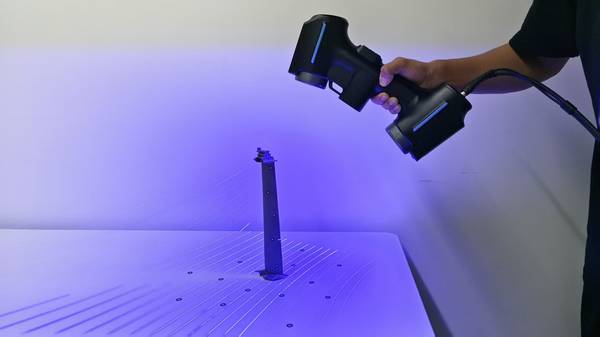
The AlphaScan’s form factor fits between press columns and across large stamped panels. AI-driven tracking keeps the point cloud aligned in real time, so the operator doesn’t need to worry about losing reference. Scan paths adapt to the geometry—deep draws, flanges, and trim edges all capture in a single pass.
- Processing in a single software environment
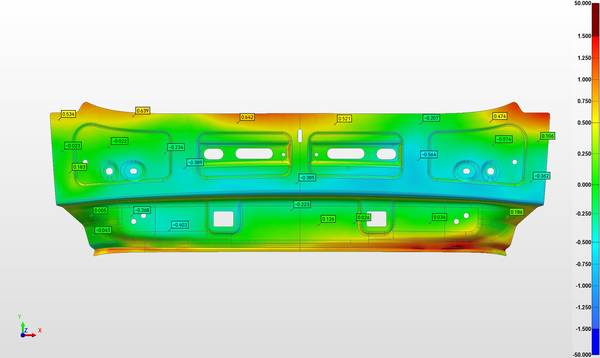
Captured data flows directly into INSVISION’s inspection platform. Automated CAD alignment compares the scan to the nominal model, and GD&T callouts are evaluated against ASME or ISO standards. Color deviation maps highlight areas of concern instantly, replacing the old routine of exporting raw point clouds to a separate analysis tool.
- On-demand reporting and reverse engineering
Inspection reports generate in the same software, ready for quality documentation. When we need to reverse-engineer a worn tooling insert, the scan data exports as a mesh or parametric model for CAM programming—no more guessing from manual measurements.
Where the AlphaScan 3D Scanner Laser Fits
INSVISION designed the AlphaScan for exactly this kind of environment. The scanner delivers metrology-grade accuracy in a handheld package that doesn’t require a controlled lab. Its AI-powered tracking handles the vibration and movement common on an active production floor. The PTB-certified software ensures that inspection results stand up to customer audits and internal ISO requirements.
For a Tier-1 supplier, that certification matters: it means the measurement chain is traceable and defensible.
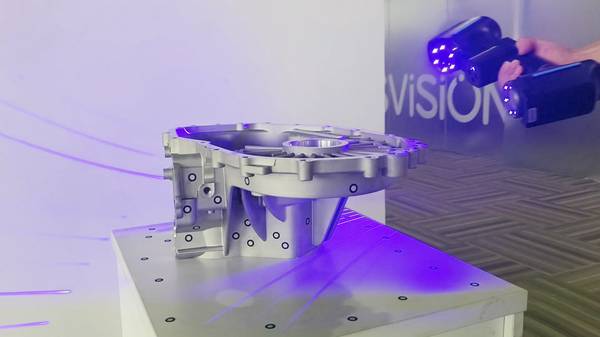
The scanner’s ability to capture everything from small bracket features to large panel contours without switching equipment also simplified our tooling inventory. One device now covers first-article inspection, in-process spot checks, tooling wear analysis, and reverse engineering—tasks that previously demanded a CMM, manual gauges, and occasional outsourcing.
Observable Operational Impacts
The most immediate change was the disappearance of the CMM queue for routine checks. Instead of bundling parts and waiting for a lab slot, technicians now pull the AlphaScan to the workstation and capture critical dimensions on demand. Runout checks that used to sit in a queue happen between cycle changes. The coordination bottleneck is gone.
Consistency improved across shifts. When any trained operator can produce the same deviation map as the next, you’ve removed a variable that used to surface during audits. Worn stamping tools get reverse-engineered faster, shaving meaningful time off changeover sequences. The result is less firefighting and more predictable output—exactly what a production manager wants to see.
The software’s automated reporting also reduced the administrative load. Instead of manually compiling measurement data from different sources, the team generates a single report with traceable results. That speeds up both internal reviews and customer PPAP submissions.
Scaling the Approach Across Industrial Verticals
The same 3D scanner laser workflow applies wherever medium-to-large components need fast, shop-floor metrology without a dedicated lab. Heavy equipment manufacturers, aerospace structural part suppliers, and rail component producers face similar constraints: large parts, tight tolerances, and pressure to keep production moving.
Any operation that currently routes parts to a centralized CMM and suffers from queue delays can replicate this approach.
The key is matching the scanner’s capabilities to the real-world environment. Look for a handheld system with certified accuracy, AI-driven tracking that tolerates shop-floor vibration, and integrated inspection software that speaks the language of GD&T. When those pieces come together, metrology moves from a gatekeeper function to an enabler of continuous flow.
Summary
Moving inspection from a centralized lab to the production floor with a 3D scanner laser isn’t about replacing CMMs entirely—it’s about putting measurement capability where it reduces the most friction. For our stamping plant, the INSVISION AlphaScan eliminated the queue for routine checks, improved measurement consistency, and accelerated reverse engineering of worn tooling.
The workflow required no dedicated fixturing and integrated seamlessly into existing shift patterns. For any manufacturer wrestling with metrology bottlenecks, that’s a scenario worth examining.
Hangzhou Insvision Technology Co., Ltd.
Address: Building 1, No. 1399 Liangmu Road, Yuhang District, Hangzhou, Zhejiang 311121, China
Copyright © Hangzhou Insvision Technology Co., Ltd. All rights reserved.
Copyright © Hangzhou Insvision Technology Co., Ltd. All rights reserved.