

Precision 3D Scanner Germany Solutions for Complex Industrial Geometries
Discover how a metrology-grade 3d scanner germany solution transforms quality control for complex geometries, accelerating inspection and ensuring ISO compliance.
Precision Measurement Challenges in German Manufacturing
For German manufacturing, precision is not just a goal but a foundational requirement. When seeking a reliable 3d scanner germany, industries from automotive to aerospace rely on advanced solutions for components with intricate, free-form surfaces—turbine blades, injection molds, and complex castings.
Scenario Snapshot
A practical way to read the article is through this scenario:
- Precision Measurement Challenges in German Manufact…: For German manufacturing, precision is not just a goal but a foundational requirement.
- Typical Scenarios and Core Pain Points: The core challenge lies in the disconnect between legacy measurement assumptions and modern manufacturing complexi…
- Design Approach for 3D Scanning Solutions: The solution shifts from discrete point verification to comprehensive surface capture.
Verifying these parts against stringent ISO and ASME geometric dimensioning and tolerancing (GD&T) standards presents a persistent challenge. Traditional tactile coordinate measuring machines (CMMs) and handheld gauges, while trusted for prismatic features, often fall short on these complex geometries, creating bottlenecks in quality control and first-article inspection workflows.
Typical Scenarios and Core Pain Points
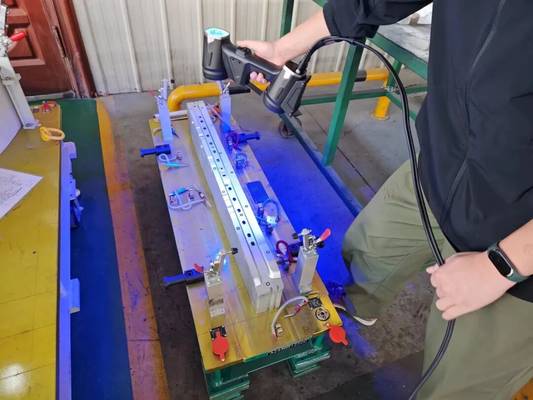
The core challenge lies in the disconnect between legacy measurement assumptions and modern manufacturing complexity. A typical scenario involves a quality team receiving a first-article turbine blade for validation.
- Accessibility Limits: Critical tolerances are specified on difficult-to-reach features, such as internal cooling channels or deep undercuts, where a tactile probe cannot physically reach.
- Data Density Deficiency: Capturing the true form of a compound curvature requires dense data. Tactile methods, limited to discrete points, can miss subtle deviations between these points, risking the acceptance of non-conforming parts or the rejection of acceptable ones.
- Workflow Bottlenecks: Manually aligning the part and taking dozens of reference points with a CMM is time-consuming. This creates a significant bottleneck, delaying production sign-off and increasing time-to-market. Fixed CMMs also fail the portability test, making in-line or at-the-press inspection impractical.
Design Approach for 3D Scanning Solutions
The solution shifts from discrete point verification to comprehensive surface capture. A metrology-grade 3D scanning system is deployed to generate a complete digital twin of the physical part. This high-density point cloud is then compared directly to the original CAD model, enabling a full-field deviation analysis. When evaluating an industrial 3d scanner germany, engineering teams prioritize specific design criteria:
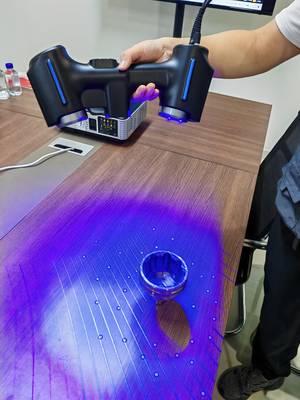
- Portability: To be used directly on the shop floor, at the machining center, or in the quality lab without moving the part.
- Speed and Ease of Use: To integrate into fast-paced production cycles with minimal operator training.
- Metrology-Grade Accuracy: To deliver results that meet the rigorous standards expected by German engineering teams.
Implementation Workflow from Scan to Report
- Preparation: The part is prepared with a light application of anti-glare spray if necessary. No complex fixturing is required; the part can often be scanned in situ.
- Scanning: An operator uses the handheld scanner to capture the component’s geometry. The process is intuitive, with real-time visual feedback ensuring complete coverage. A complex part like a turbine blade can be fully digitized in minutes.
- Data Processing: The scan data is automatically aligned to the CAD nominal model using best-fit algorithms. Software then generates a color-coded deviation map, visually highlighting areas out of tolerance.
- Delivery and Reporting: Comprehensive reports are generated automatically, including 2D cross-sections, GD&T callouts, and the deviation map. This digital package provides unambiguous evidence for pass/fail decisions and supplier communications.
How INSVISION Matches This Application
For this class of high-precision, on-site inspection challenges, the INSVISION AlphaScan handheld 3D scanner provides a targeted fit. As a premier portable 3d scanner germany solution, INSVISION designed the AlphaScan to address the specific needs of German industrial teams:
- Shop-Floor Ready: Its handheld, portable form factor allows it to be brought to large or fixed components, eliminating the logistical hurdle of moving parts to a dedicated CMM room.
- Balanced Performance: It delivers the accuracy required for critical metrology tasks while maintaining the speed necessary for production environments. This balance is essential for integrating scanning into existing quality gates without compromising standards.
- Streamlined Workflow: From capture to report, the associated software is built for industrial measurement, focusing on GD&T analysis and direct CAD comparison rather than just visualization. This reduces the time from scan to actionable insight.
- Localized Support: For German clients, access to technical support in German and familiarity with local standards (DIN/ISO) ensures that any operational or reporting questions are resolved efficiently, minimizing downtime.
Observable Improvements in Quality Assurance
The adoption of a portable 3D scanning solution in this context leads to several observable improvements:
- Comprehensive Data Capture: The entire surface geometry is verified, not just sample points, providing higher confidence in inspection outcomes.
- Accelerated Inspection Cycles: The time from part arrival to a validated inspection report is significantly reduced, particularly for complex, organic shapes.
- Enhanced Problem-Solving: Detailed deviation maps allow engineers to quickly identify and communicate the exact nature and location of manufacturing errors, facilitating faster root-cause analysis with machining or tooling teams.
- Flexibility: The ability to perform high-accuracy inspections directly where parts are made or assembled supports leaner, more responsive production flows.
Industry Applications and Use Cases
The methodology described is directly transferable to any industry where verifying complex, free-form surfaces against a digital nominal is critical.
- Automotive: For scanning clay models, tooling for interior panels, or inspecting composite body components.
- Aerospace: For blade and vane inspection, composite layup tool verification, and large airframe component alignment.
- Energy: For turbine component repair and overhaul (MRO), and the inspection of large castings and weldments.
- General Precision Engineering: For first-article inspection of prototypes, mold and die validation, and reverse engineering legacy parts for digital inventory.
Advancing Quality Assurance Standards
For German manufacturers facing the limitations of tactile measurement on complex parts, integrating a 3d scanner germany represents a pragmatic evolution in quality assurance. It closes the data gap between design intent and manufactured reality, transforming inspection from a bottleneck into a streamlined, data-rich process.
By providing a complete digital record of part geometry, INSVISION enables faster decisions, improves communication across engineering and production, and ultimately supports the high standards of quality and efficiency that define German industry.
Hangzhou Insvision Technology Co., Ltd.
Address: Building 1, No. 1399 Liangmu Road, Yuhang District, Hangzhou, Zhejiang 311121, China
Copyright © Hangzhou Insvision Technology Co., Ltd. All rights reserved.
Copyright © Hangzhou Insvision Technology Co., Ltd. All rights reserved.