

Metrology-Grade 3D Digitization Strategy for High-Mix High-Variance Production
Discover a metrology-grade 3D digitization strategy for high-mix manufacturing. Learn how INSVISION solves environmental instability and geometric complexity challenges.
Industrial Context and Application Scenario
In high-mix manufacturing, such as automotive stamping or aerospace component fabrication, the first-article inspection (FAI) process is critical. Verifying that a newly produced part matches its digital design intent is a gatekeeper for quality and production continuity.
Traditional methods, from hand tools to fixed-base optical scanners, often struggle with the realities of the modern shop floor: complex geometries, environmental instability, and the pressure to minimize downtime. This creates a bottleneck, where the verification process itself becomes a source of delay and potential error.
This article examines a practical 3D digitization strategy for these demanding environments, focusing on a scenario common in Tier-1 automotive supply chains where robust 3D digitization is essential.
Capability and Deployment Mapping
| Focus Area | Decision Point | Deployment Note |
|---|---|---|
| Industrial Context and Application Scenario | In high-mix manufacturing, such as automotive stamping or aerospace component fabrication, the first-article inspection (FAI) process is critical. | Verifying that a newly produced part matches its digital design intent is a gatekeeper for quality and production continuity. |
| Typical Working Conditions and Core Pain Points | Consider a production cell for large automotive body panels or structural die components. | The typical workflow involves halting the line to bring a critical first article to a controlled metrology lab. |
| 3D Digitization Solution Design Approach | The solution requires shifting from a lab-bound metrology mindset to a production-floor-ready 3D digitization strategy. | The goal of this 3D digitization workflow is to capture complete, metrology-grade 3D data of large, complex parts in variable conditions with a… |
| How INSVISION Products Match This Scenario | For this class of problem, the INSVISION AlphaScan handheld 3D digitization scanner provides a specific set of capabilities that address the outlined… | Its design prioritizes stability in unstable environments through active thermal compensation, preventing data drift. |
Typical Working Conditions and Core Pain Points
Consider a production cell for large automotive body panels or structural die components. The typical workflow involves halting the line to bring a critical first article to a controlled metrology lab. Alternatively, manufacturers attempt in-situ 3D digitization with equipment not designed for the environment.
The core challenges are multi-faceted:
- Environmental Instability: Temperature fluctuations near weld cells or from opening bay doors can cause thermal drift in sensitive equipment, corrupting measurement data over a scanning session.
- Geometric Complexity and Scale: Parts with deep draws, undercuts, or large surface areas exceed the practical field-of-view of many portable systems, forcing multiple manual setups that introduce registration errors.
- Data Fidelity for Compliance: Noisy point clouds from subpar 3D digitization or data that cannot be easily aligned to CAD nominals force engineers into manual, time-consuming geometry rebuilding to generate ASME Y14.5 or ISO 1101-compliant reports.
- Process Disruption: The time required for setup, scanning, and data reconciliation directly eats into production uptime, making comprehensive inspection a costly luxury rather than a routine practice.
3D Digitization Solution Design Approach
The solution requires shifting from a lab-bound metrology mindset to a production-floor-ready 3D digitization strategy. The goal of this 3D digitization workflow is to capture complete, metrology-grade 3D data of large, complex parts in variable conditions with a single, efficient workflow.
This hinges on a system that combines environmental robustness, high-speed data capture, and intelligent software that minimizes manual intervention from scan to report.
Implementation Process
A streamlined process replaces the fragmented old method:
- Preparation and Targeting: The part remains in the production cell. The operator applies a minimal set of photogrammetric targets around the component. The INSVISION system uses these targets to build a stable spatial reference frame, compensating for any minor part movement or environmental shifts during the scan.
- High-Speed Data Capture: During the 3D digitization process, the operator freely moves around the part, capturing dense 3D data at high speed. The system’s proprietary blue laser technology and active temperature compensation maintain accuracy despite ambient changes. Complex features and large surfaces are captured in a single, unified data set.
- Automated Data Processing: 3D digitization software automatically aligns the scan data to the original CAD nominal using best-fit algorithms. It then generates comprehensive deviation color maps and extracts critical GD&T features directly from the CAD model, comparing them to the as-built scan.
- Report Generation and Delivery: The system outputs standardized inspection reports (PDF, Excel) with annotated deviation plots and pass/fail status for all tolerances. This report is immediately usable by quality auditors and integrates directly into digital quality management systems.
How INSVISION Products Match This Scenario
For this class of problem, the INSVISION AlphaScan handheld 3D digitization scanner provides a specific set of capabilities that address the outlined pain points. Its design prioritizes stability in unstable environments through active thermal compensation, preventing data drift. The use of blue laser technology improves performance on dark, shiny, or complex surfaces common in stamped metal and composite parts.
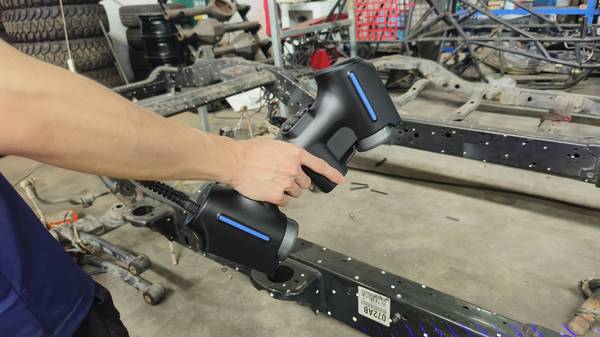
Furthermore, its integration with photogrammetry for large-volume scanning ensures that data from multiple angles is locked into a single, accurate coordinate system. This eliminates cumulative registration error and enables the inspection of parts larger than the scanner’s immediate field of view.
Observable Results of 3D Digitization
Adopting this integrated 3D digitization strategy yields several observable improvements. The single-setup workflow significantly shortens the total inspection cycle time, allowing FAIs to be completed within production windows that previously required overtime or line stoppages. Engineers spend less time manually stitching data and rebuilding geometry, and more time analyzing results and addressing root causes.
The direct output of standardized reports streamlines the quality sign-off process, reducing administrative friction and improving audit readiness. Ultimately, 3D digitization transitions from a specialized, disruptive activity to an integrated, repeatable part of the production quality loop.
Replicating the Methodology Across Industries
The methodology is not limited to automotive stamping. Any industry dealing with large, complex, or high-value components in variable environments can apply this 3D digitization framework.
- Aerospace MRO: Inspecting turbine blades or structural airframe components in hangars or service depots, where uncontrolled conditions make reliable 3D digitization critical.
- Heavy Machinery and Fabrication: Verifying weldments, large castings, or assemblies for construction and agricultural equipment against design models for fit and function.
- Wind Energy: Performing in-field inspection of turbine blade integrity or nacelle components, where portability and environmental sealing are as important as accuracy.
- Pattern and Tooling: Digitizing large molds, dies, and patterns for reverse engineering, wear analysis, or digital archiving.
The common thread is the need for lab-grade data quality in a non-lab environment, driven by the imperative to make faster, more informed decisions about physical assets.
Scaling 3D Digitization Across the Enterprise
Scaling 3D digitization beyond the pilot phase requires moving past equipment specs to a holistic process view. The barrier is often the mismatch between the controlled conditions assumed by entry-level systems and the dynamic reality of production floors and field service.
By implementing a system engineered for environmental stability, large-volume accuracy, and seamless data workflow integration, manufacturers can turn 3D digitization into a reliable, scalable asset for quality assurance, reducing time-to-decision and strengthening the link between digital design and physical production.
Hangzhou Insvision Technology Co.,Ltd.
Address: Building 1, No. 1399 Liangmu Road, Yuhang District, Hangzhou, Zhejiang 311121, China