

How 3D Scanning Technology Transforms Industrial Quality Control and Reverse Engineering
The demand for precision measurement in modern manufacturing has pushed traditional inspection methods to their limits. When components require sub-millimeter a
Understanding the Core Principles of Structured Light Scanning
Structured light 3D scanning operates on a triangulation principle. A projector casts a known pattern—typically a grid or series of parallel lines—onto the surface of an object. One or more cameras positioned at an angle capture the deformation of this pattern as it conforms to the object’s topology.
Software then analyzes the distortion to calculate depth information for each point, constructing a dense point cloud that represents the object’s three-dimensional geometry.
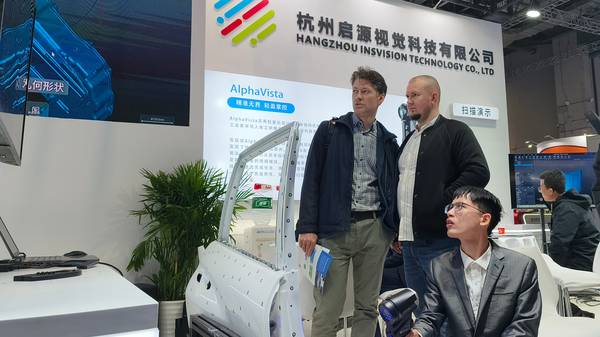
INSVISION‘s AlphaScan system employs blue laser technology rather than white light alternatives. Blue laser wavelengths offer advantages in surface penetration and ambient light rejection, particularly when scanning reflective or dark-surfaced industrial components.
The 50 cross laser line configuration increases coverage density, allowing the scanner to capture fine details across curved surfaces, corners, and transitional geometries in a single pass.
The distinction between point capture rate and effective resolution matters significantly for users evaluating scanning equipment. The AlphaScan achieves measurement-grade accuracy of 0.020mm, meaning the reported coordinates fall within twenty microns of the true physical dimensions. This level of precision suits applications ranging from precision assembly verification to tooling wear assessment.
Practical Capabilities for Industrial Environments
Field deployment introduces variables that controlled laboratory settings eliminate. Temperature fluctuations, vibration from nearby machinery, and operator movement all influence measurement outcomes. The AlphaScan operates across a temperature range from -10°C to 40°C, accommodating environments from cold storage facilities to warm production floors without requiring thermal equilibration periods that delay operations.
Weighing approximately 1070 grams, the handheld form factor allows operators to maneuver around large components without repositioning the workpiece. INSVISION documents scan completion of a complete vehicle frame assembly in ten minutes—an example that illustrates the efficiency advantage over stationary CMM systems that require either multiple probe positions or component disassembly.
The integration of artificial intelligence into the scanning workflow addresses a persistent challenge in point cloud processing: distinguishing meaningful surface features from noise introduced by dust, oil residue, or variable surface finishes.
AI-assisted alignment and feature recognition reduce the operator expertise required to achieve consistent results, though skilled technicians still play a crucial role in fixturing challenging geometries and validating questionable data regions.
Application Fit Across Manufacturing Verticals
Reverse engineering workflows benefit substantially from scanner portability. When legacy tooling requires modification or replacement, engineers traditionally relied on physical molds or extensive manual measurement. Portable 3D scanning captures the existing component geometry directly, enabling rapid generation of CAD models suitable for modification and manufacturing.
Quality control scenarios present different requirements. Rather than capturing geometry for downstream design work, inspectors need accurate comparison between manufactured parts and nominal specifications. The AlphaScan supports deviation visualization, highlighting areas where material removal, deformation, or assembly errors have introduced dimensional variance beyond acceptable tolerances.
Automated report generation streamlines documentation for production batches, reducing the clerical burden that often delays quality feedback loops.
Smaller components below 10 centimeters present scanning challenges regardless of equipment sophistication. At that scale, surface preparation, mounting stability, and scanner resolution limitations interact in ways that compromise measurement confidence.
Users evaluating scanning solutions for small batch production should consider whether their requirements genuinely demand 3D scanning or whether traditional measurement tools might offer more reliable results at lower cost.
Selecting the Appropriate Scanning Approach
Equipment selection depends on balancing multiple factors: required accuracy, part size, surface characteristics, throughput demands, and operator availability. Measurement-grade accuracy of 0.020mm exceeds the requirements of many applications and carries associated costs in equipment price and operational sensitivity.
Understanding the actual tolerance requirements of your inspection process prevents overspecification that inflates both capital expenditure and cycle time.
For operations scanning large assemblies where absolute accuracy remains important but throughput dominates, the AlphaVista series offers larger scan fields up to 2200 by 2200 millimeters with volume accuracy specifications around 0.1mm plus 0.015mm per meter.
This trade-off between point-level precision and area coverage suits initial assessment scans and reverse engineering workflows where subsequent localized high-accuracy scans can address critical features.
Organizations beginning their digital inspection journey should establish clear success criteria before equipment evaluation. Determining whether the primary goal involves dimensional verification, surface deviation analysis, geometric comparison, or reverse engineering geometry capture clarifies which system capabilities deserve emphasis during demonstration and validation activities.
Hangzhou Insvision Technology Co.,Ltd.
Address: Building 1, No. 1399 Liangmu Road, Yuhang District, Hangzhou, Zhejiang 311121, China