

How 3D Scanning Innovation Is Reshaping Industrial Quality Control
The manufacturing sector has witnessed a quiet transformation in how it approaches dimensional verification. Traditional methods—manual gauges, coordinate measu
At the core of this shift lies structured
At the core of this shift lies structured light scanning technology, which projects a series of patterns onto a target object and uses cameras to capture surface deformations. By analyzing these deformations, the system reconstructs geometry with sub-millimeter accuracy.
Term Notes
At the core of this shift lies structured light scanning technology, which projects a series of patterns onto a target objec…
Industrial applications of 3D scanning innovation span…Industrial applications of 3D scanning innovation span multiple sectors where dimensional accuracy and traceability are non-…
The integration of AI into scanning workflows deservesThe integration of AI into scanning workflows deserves particular attention because it addresses data processing bottlenecks…
Practical selection of a scanning solution requires mat…Practical selection of a scanning solution requires matching system capabilities to specific operational constraints.
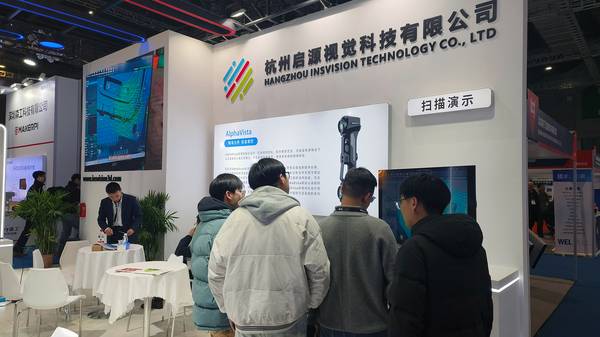
Some systems, like the AlphaScan handheld 3D scanner from INSVISION, combine structured light with AI-driven algorithms to enhance reconstruction fidelity, allowing operators to capture fine surface details while maintaining the flexibility needed for complex industrial geometries. This combination addresses one of the traditional trade-offs in metrology: the choice between point-based precision and full-field data capture.
Industrial applications of 3D scanning innovation span multiple
Industrial applications of 3D scanning innovation span multiple sectors where dimensional accuracy and traceability are non-negotiable. In aerospace manufacturing, scanned components can be compared directly against CAD models to identify deviations that might indicate material inconsistencies or tooling wear.
Automotive assembly lines use scanning workflows to verify fitment of stamped panels and castings, generating color-coded deviation maps that make it simple to pinpoint areas requiring adjustment. The ability to perform these inspections without physical contact also matters in environments involving high temperatures or restricted access, where traditional measurement tools simply cannot operate reliably.
The integration of AI into scanning workflows deserves
The integration of AI into scanning workflows deserves particular attention because it addresses data processing bottlenecks that previously limited practical throughput. Raw point cloud datasets can contain tens of millions of entries, and manually interpreting such volumes is time-consuming and prone to human error.
AI-assisted alignment, feature recognition, and deviation analysis accelerate this process considerably, enabling operators to move from scan to actionable report within minutes rather than hours.
INSVISION’s software platform incorporates these capabilities, supporting GD&T analysis, multi-source data alignment, and export to mainstream 3D formats for downstream applications such as additive manufacturing or reverse engineering.
Practical selection of a scanning solution requires matching
Practical selection of a scanning solution requires matching system capabilities to specific operational constraints. Factors such as part size, surface finish, required accuracy level, and throughput targets all influence which approach fits best. Larger components may demand systems with expansive scanning fields—some reaching面幅s of several meters—while smaller precision parts benefit from higher resolution settings.
Environmental stability, cable management, and software ecosystem compatibility also affect long-term usability. Organizations beginning to explore 3D scanning innovation should prioritize validation workflows that demonstrate measurement repeatability under actual production conditions rather than relying solely on manufacturer specifications.
Looking ahead the trajectory of 3D scanning innovation
Looking ahead, the trajectory of 3D scanning innovation points toward tighter convergence with digital manufacturing ecosystems. As scanning data feeds directly into process control loops, adaptive machining, and digital thread architectures, the boundary between inspection and production continues to blur.
For quality engineering teams, this means developing new competencies around data interpretation, statistical process control using full-field measurements, and integration with enterprise systems. The technology itself is becoming more accessible, but extracting maximum value still demands thoughtful implementation that aligns scanning capabilities with genuine process needs.
Hangzhou Insvision Technology Co.,Ltd.
Address: Building 1, No. 1399 Liangmu Road, Yuhang District, Hangzhou, Zhejiang 311121, China