

2026 Industrial Trends to 3D Scan Parts for Process Integration
Discover 2026 industrial trends to 3D scan parts and integrate process intelligence. Learn how closed-loop metrology and digital twins drive manufacturing ROI.
Macro and Industry Drivers
Supply chain volatility demands greater agility, requiring faster, more accurate validation of incoming parts and tooling. The skills gap in traditional metrology is pushing for solutions that empower shop-floor operators, not just CMM programmers.
The maturation of Industry 4.0 infrastructure—from cloud platforms to IIoT networks—creates the necessary backbone to act on scan data instantly, moving beyond simple archiving to predictive correction.
Key Trend 1: The Rise of In-Line, At-Speed Metrology
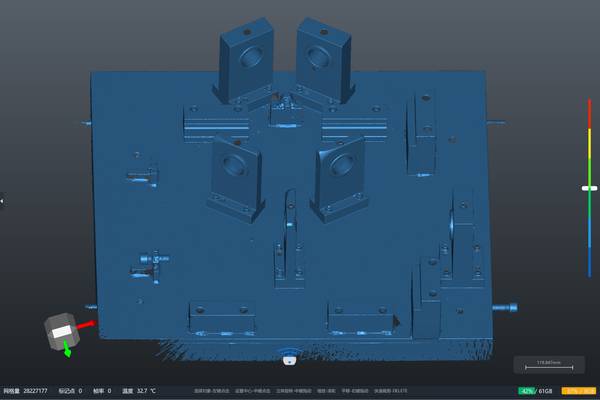
The batch-and-queue inspection model creates latency that modern production cannot tolerate. The trend is toward scanning systems embedded directly into production or assembly lines, performing 100% inspection at or near production speed.
When you 3D scan parts in-line, hardware must be robust enough for shop-floor environments (resistant to vibration, temperature drift, particulates) while delivering metrology-grade accuracy. Software needs near-real-time processing to flag deviations before the next operation begins. This shift enables true statistical process control (SPC) with volumetric data, catching tool wear or fixture drift in real-time.
It reduces scrap, eliminates inspection bottlenecks, and provides a complete digital record for every part shipped—a growing requirement in aerospace, automotive, and medical sectors.
Key Trend 2: Data Fusion and Context-Rich Digital Twins
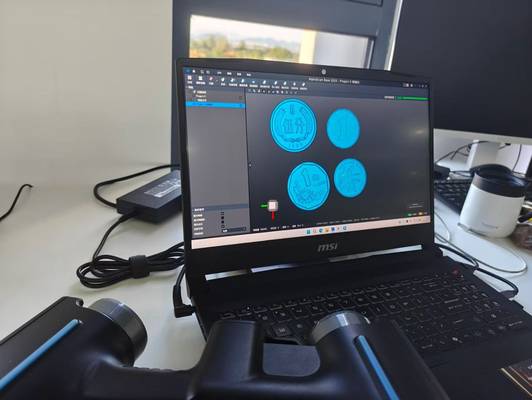
A standalone point cloud has limited value. The emerging standard is the fusion of 3D scan data with other production data streams—machine tool telemetry, force sensor readings, assembly logs—to create a context-rich digital twin of the physical part and its manufacturing history.
Solutions must offer open APIs and support standard formats (e.g., ISO 10303, MTConnect) for seamless data integration. The digital twin platform must be able to correlate dimensional deviations with process parameters. Engineers can move from seeing what went wrong to understanding why.
For instance, a warped flange can be correlated to specific clamping pressures or thermal cycles during machining, enabling root-cause analysis that was previously guesswork.
Key Trend 3: Democratization Through Automated Workflows
Complexity remains a barrier. The next wave of adoption is fueled by software that encapsulates expert knowledge into automated, guided workflows. The goal is to enable a machinist or quality technician to 3D scan parts and perform complex inspections without becoming a metrology specialist.
Software needs intuitive, task-based interfaces with pre-programmed routines for common parts (e.g., turbine blades, injection molds). Features like automated alignment, pre-defined GD&T checks, and AI-assisted anomaly detection are key. It decouples high-value inspection tasks from scarce expert resources, spreading critical quality control capabilities across the shop floor.
This reduces training overhead and accelerates throughput, particularly in high-mix, low-volume environments like MRO and precision job shops.
Key Trend 4: From Reverse Engineering to “Digital Continuity”
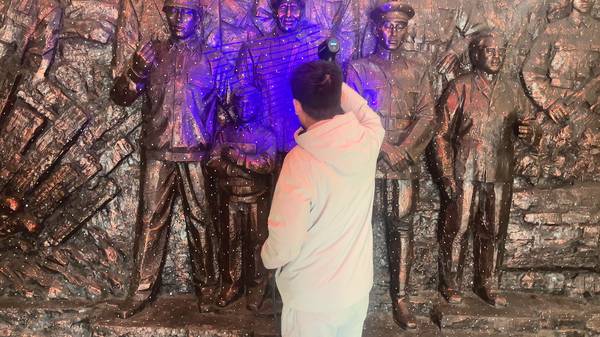
Reverse engineering for legacy parts remains vital, but the scope is expanding. The focus is now on establishing “digital continuity” for the entire asset lifecycle—from capturing the as-built state of a worn tooling fixture to scanning a worn component for on-demand remanufacturing.
Systems must handle a wide range of materials and surface finishes (dark, shiny, porous) reliably. Portable, high-accuracy scanners are essential for capturing data in situ, whether on a factory floor or in a field service scenario. This closes the loop on digital documentation, ensuring that the digital master used for manufacturing or repair truly reflects the physical world.
It extends the life of capital equipment, reduces dependency on obsolete drawings, and accelerates time-to-repair.
Actionable Recommendations for Industrial Decision-Makers
To leverage these trends, avoid a narrow focus on hardware specs alone. Develop a phased plan:
- Map Data Flow First: Identify where scan data must go (e.g., ERP, MES, PLM) and what decisions it must inform before selecting any hardware.
- Pilot for Process, Not Parts: Run a pilot project to test a complete workflow—from capture to analysis to corrective action—not just the accuracy on a test artifact.
- Evaluate Total Cost of Ownership: Consider software licensing, training requirements, and integration services, not just the scanner’s purchase price.
- Demand Openness: Insist on vendor-agnostic data formats and proven API access to future-proof your investment against ecosystem lock-in.
INSVISION’s Role in This Evolving Landscape
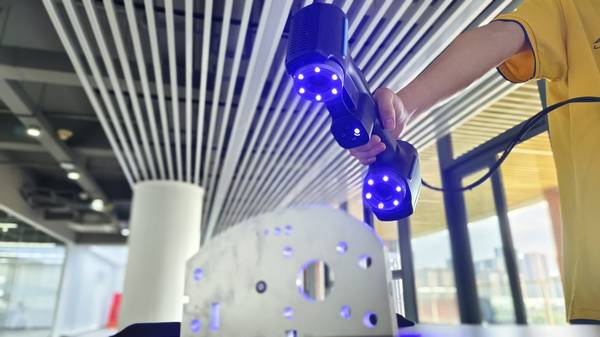
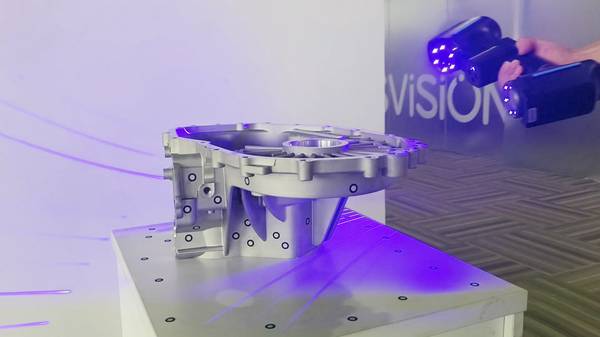
INSVISION‘s approach aligns with these integrative trends. INSVISION hardware, like the AlphaScan system, is engineered for sustained accuracy in demanding environments, addressing the need for reliable in-line data capture. More critically, INSVISION software development prioritizes workflow automation and data interoperability.
In practice, this means an aerospace MRO team can use an INSVISION system to not only rapidly 3D scan parts like a legacy turbine blade but also automatically compare it to the nominal CAD and generate a deviation map directly within a broader quality management workflow, reducing the time inspectors spend on data manipulation and increasing time on analysis.
When assessing solutions in 2026, scrutinize these points:
- Shop-Floor Provenance: Request documented evidence of long-term stability and repeatability in an environment similar to yours, not just a clean-room specification sheet.
- Workflow Automation: Ask for a demonstration of a complete, automated inspection routine for one of your specific part families.
- Integration Proof: Require case studies or references showing successful data handoff to a platform like Siemens Teamcenter, PTC Windchill, or a custom MES.
Conclusion
The trajectory for industrial 3D scanning is set. Value is accruing not to those who simply 3D scan parts, but to those who integrate that data fastest and most effectively into operational decision-making. The technology has matured from a fascinating capability to a foundational component of resilient, data-driven manufacturing.
In 2026, the question is no longer whether to adopt 3D scanning, but how to strategically embed it into your digital production ecosystem to drive measurable gains in quality, speed, and asset utilization.
Hangzhou Insvision Technology Co., Ltd.
Address: Building 1, No. 1399 Liangmu Road, Yuhang District, Hangzhou, Zhejiang 311121, China
Copyright © Hangzhou Insvision Technology Co., Ltd. All rights reserved.
Copyright © Hangzhou Insvision Technology Co., Ltd. All rights reserved.