

What Is Reverse Engineering? The Role of 3D Scanning in Reverse Modeling
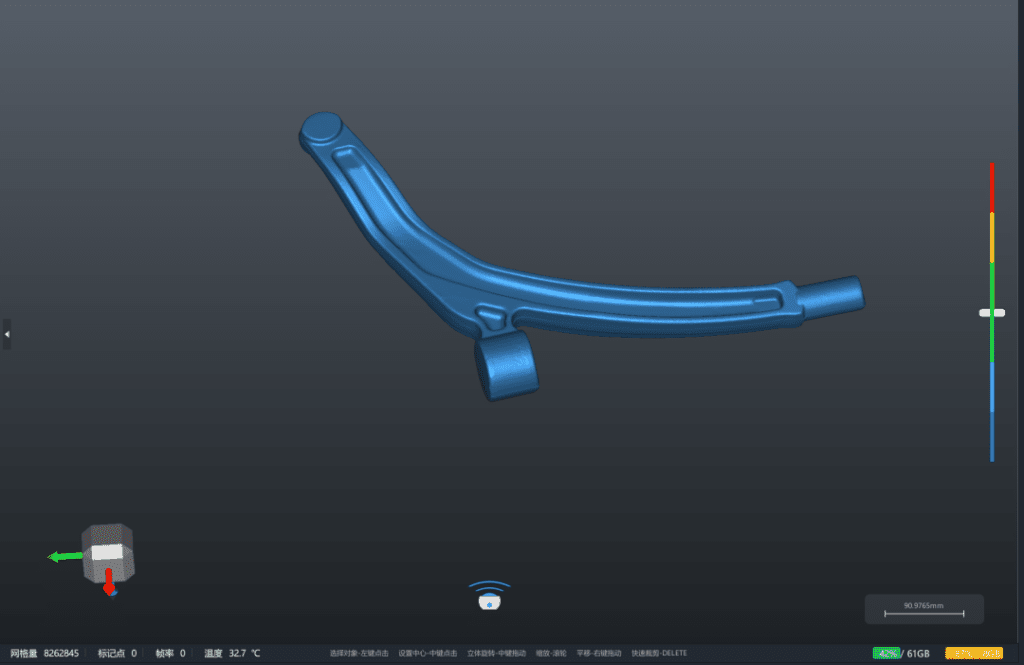
Reverse engineering rebuilds usable digital models from physical parts. 3D scanning is often used to capture complex surface data quickly.
Reverse engineering is the process of obtaining data from an existing physical object and rebuilding a usable digital model.
What Is Reverse Engineering?
Reverse engineering starts from a real part, sample, or legacy component. It rebuilds digital data that can be used for analysis, modification, repair, or manufacturing.
The Role of 3D Scanning
3D scanning converts the physical surface into point clouds or mesh data. It improves the efficiency of capturing complex surfaces.
Basic Workflow
- Scan the part and obtain complete surface data.
- Clean the data and remove noise.
- Generate a mesh and check completeness.
- Rebuild surfaces or parametric models.
- Compare the model with scan data.
Point Cloud, Mesh, and CAD
| Stage | Data Form | Engineering Editability |
|---|---|---|
| Scan capture | Point cloud | Not suitable for direct editing |
| Surface expression | STL/OBJ mesh | Useful for visualization |
| Reverse modeling | CAD surface or solid | Suitable for design modification |
Suitable Scenarios
Reverse engineering is useful when original drawings are missing, old parts need repair, molds need optimization, or freeform surfaces must be copied.
Common Misunderstandings
- Assuming scanning automatically creates editable CAD.
- Ignoring reconstruction and verification workload.
- Judging only scanning speed instead of modeling quality.
Further Reading
- 3D scanner products: compare equipment forms and use cases.
- Industrial 3D inspection: see how scan data supports quality control.
- Reverse engineering 3D scanning: understand the workflow from point cloud to usable model.
FAQ
Does reverse engineering always require 3D scanning?
No. Simple parts may be measured with traditional tools, but complex and freeform geometry is often better suited for scanning.
Can scan data be used directly for manufacturing?
In most cases, the data needs cleaning, modeling, and verification before manufacturing use.
Summary
3D scanning is an important data entry point for reverse engineering, but reliable results also require modeling, comparison, and engineering judgment.
- What Is 3D Scanning? Principles, Workflow, and Industrial Applications 3D scanning captures the shape and surface data of real objects for inspection, reverse engineering, digital modeling, and quality traceability.
- What Is a 3D Scanner? Types, Parameters, and Selection Criteria A 3D scanner captures three-dimensional surface data. Selection depends on accuracy, part size, material, software workflow, and site efficiency.
- What Is 3D Scanning Accuracy? Accuracy, Repeatability, and Resolution Explained 3D scanning accuracy should be judged together with repeatability, resolution, alignment error, and real operating conditions.
- What Is Point Cloud Data? Point Clouds, Meshes, and CAD Models in 3D Scanning Point cloud data is the basic output of 3D scanning and can be processed into meshes, inspection data, or CAD references.
Hangzhou Insvision Technology Co.,Ltd.
Address: Building 1, No. 1399 Liangmu Road, Yuhang District, Hangzhou, Zhejiang 311121, China