

Full-size inspection
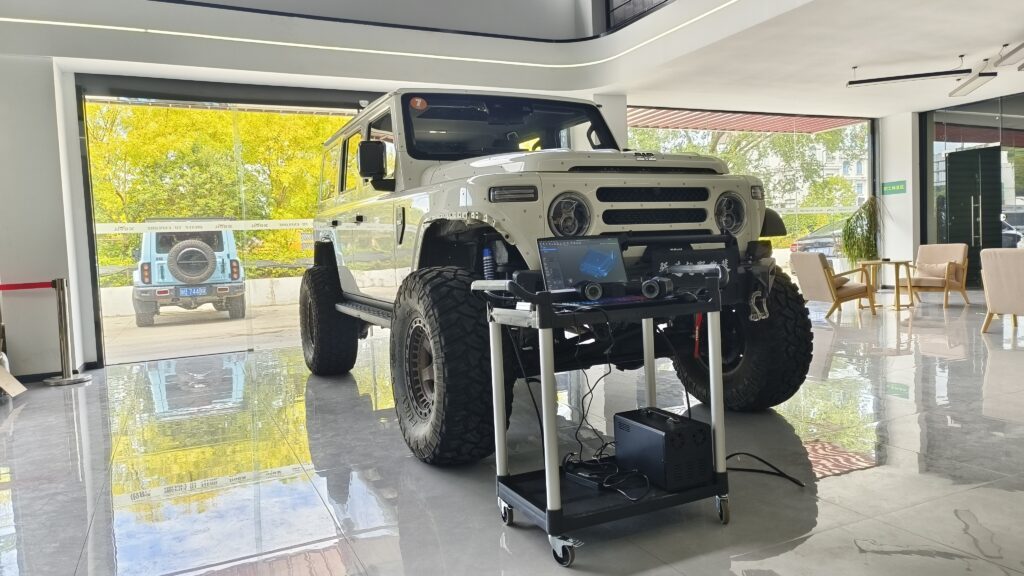
Full-size inspection is a quality control process that measures the accessible geometry of a workpiece and compares the result with CAD, drawing.
Definition
Full-size inspection is an industrial 3D metrology and quality control process that captures the accessible geometric data of an entire workpiece, then compares the as-built measurement data against nominal design specifications (such as CAD models, geometric dimensioning and tolerancing (GD&T) requirements, or master part reference data) to support dimensional verification, identify manufacturing defects, and assess wear or damage over the part’s full surface. Unlike sampling or partial inspection, which only measures a subset of features, full-size inspection eliminates gaps in coverage that could hide unobserved defects, making it suitable for safety-critical and high-value industrial components and assemblies.
How It Works
Full-size inspection follows a standardized metrology workflow, adapted to workpiece size, environment, and accuracy requirements:
- Pre-inspection preparation: The workpiece is positioned for full access to all target surfaces, and reference markers or optical tracking systems are deployed as needed to maintain consistent coordinate alignment across the full scan volume. Scanning hardware is calibrated to match operating environment conditions.
- Full geometry data acquisition: The 3D scanning system captures point cloud or mesh data across all accessible surfaces of the workpiece. Specialized scanning modes may be used to capture hard-to-reach features such as deep cavities or undercuts. For large workpieces, multiple scan passes are registered to form a unified dataset.
- Data integration and optimization: Raw scan data is processed to remove noise, align overlapping scan passes, and generate a clean, complete 3D model of the as-built workpiece.
- Reference alignment and deviation analysis: The as-built 3D model is aligned to a nominal reference (typically a CAD model or master part scan) using a common coordinate system. Metrology software generates a color-coded deviation map to highlight dimensional differences between the as-built part and design specifications.
- Multidimensional quality validation: Automated checks are run to verify compliance with GD&T requirements, dimensional tolerances, and assembly fit specifications. Critical features may be cross-validated against secondary measurement methods for redundancy.
- Inspection reporting: Results are compiled into a standardized report including deviation maps, compliance status for all inspected features, and supporting metrology data for quality control documentation.
Key Parameters and Criteria
Full-size inspection performance is evaluated against standardized metrology parameters that account for workpiece size, surface material, operating environment, and required tolerance thresholds, as outlined in the table below:
| Parameter | Meaning | Judgment Method |
|---|---|---|
| Measurement Accuracy | The maximum allowable deviation between scan-derived dimensional values and the true metrological value of the workpiece | Verified using calibrated reference artifacts traceable to national metrology standards; varies based on scan distance, workpiece surface material, and operating environment |
| Scan Coverage Completeness | The percentage of the workpiece’s accessible surface geometry captured during data acquisition, excluding intentionally obscured or physically inaccessible features | Calculated by comparing total scanned surface area to the nominal surface area of the reference model; gaps exceeding project-specific tolerance thresholds require targeted re-scanning |
| GD&T Compliance Rate | The proportion of inspected geometric characteristics (e.g., position, flatness, concentricity) that fall within specified engineering tolerance limits | Assessed via automated metrology software analysis, with critical features cross-validated against tactile coordinate measuring machine (CMM) measurements for high-risk applications |
| Inspection Cycle Time | Total elapsed time from initial workpiece setup to delivery of a finalized inspection report | Measured per workpiece; varies based on part size, geometric complexity, required accuracy level, and the degree of automation in the inspection workflow |
| Environmental Stability Tolerance | The range of temperature, humidity, and vibration conditions under which inspection results remain within stated accuracy specifications | Validated via repeated measurement of a calibrated reference artifact across variable operating conditions, per standardized industrial performance testing protocols |
Suitable and Unsuitable Scenarios
Suitable Scenarios
- On-site full dimensional validation of large industrial assemblies (e.g., aerospace fuselages, automotive chassis, energy infrastructure) in production, field, or maintenance environments
- Batch inspection of mid-to-large sized industrial components for incoming, in-process, or outgoing quality control
- Post-repair or operational wear assessment for heavy equipment, industrial tooling, and installed infrastructure
- Dimensional validation of 3D printed or custom-manufactured parts with complex freeform geometries
- In-line quality control for advanced manufacturing production lines requiring 100% part compliance verification
Unsuitable Scenarios
- Inspection of workpieces with a maximum outer dimension of less than 10cm
- Human body or facial scanning for non-industrial applications
- Medical imaging or diagnostic use cases
- Inspection of fully internal features with access apertures smaller than 5mm
Common Misconceptions
- Misconception: Full-size inspection requires capture of 100% of a workpiece’s features, including internal and physically inaccessible areas.
Fact: Full-size inspection refers to complete capture of all line-of-sight accessible surface features. Fully enclosed internal features or areas with no external access require complementary inspection methods such as industrial computed tomography (CT) scanning.
- Misconception: Higher scan resolution always improves full-size inspection result reliability.
Fact: Excessively high scan resolution increases data processing time and storage requirements without improving accuracy for workpieces with loose tolerance requirements. Resolution should be matched to the part’s specified tolerance thresholds to balance speed and measurement reliability.
- Misconception: Full-size inspection replaces all other quality control methods.
Fact: Full-size 3D scanning inspection complements, rather than replaces, tactile coordinate measuring machine (CMM) testing, functional performance testing, and destructive testing for safety-critical applications where redundant validation is required.
- Misconception: Full-size inspection can only be performed in controlled laboratory or cleanroom environments.
Fact: Modern industrial 3D scanning systems support full-size inspection in harsh operating conditions, including wide temperature ranges, high vibration, and outdoor field settings, provided the system’s environmental performance ratings match the operating conditions.
Related Concepts
- 3D Metrology: The broader field of measuring the geometric properties of physical objects using 3D capture technology, of which full-size inspection is a specialized use case focused on end-to-end workpiece compliance validation.
- Geometric Dimensioning and Tolerancing (GD&T): A standardized symbolic language used on engineering drawings to define allowable deviations in part geometry, which serves as the primary reference framework for most industrial full-size inspection workflows.
- Point Cloud Deviation Analysis: A core processing step in full-size inspection that compares the as-built scan point cloud to the nominal reference model to generate color-coded maps of dimensional differences across the part surface.
- Automated Dimensional Inspection: A subset of full-size inspection that uses robotic or fixed-position scanning systems to perform end-to-end inspection without manual operator input, typically integrated into high-volume production lines for 100% part validation.
- Optical Tracking: A technology used to maintain consistent coordinate alignment across very large workpieces during full-size inspection, reducing the need for fixed reference markers across extended scan volumes.
FAQ
What is the core difference between full-size inspection and sampling inspection?
Full-size inspection captures all accessible surface geometry of an entire workpiece to identify defects or deviations anywhere on the part, while sampling inspection only measures a preselected subset of features or locations to estimate overall part conformance. Full-size inspection is standard for high-value or safety-critical components where unobserved defects could lead to operational failure.
Can full-size inspection be performed in outdoor or non-climate-controlled industrial environments?
Yes, provided the 3D scanning system used is rated for the specific operating temperature, humidity, and vibration conditions of the environment. Many industrial-grade 3D scanning systems are designed to operate reliably across wide temperature ranges without loss of measurement accuracy.
How does full-size inspection address hard-to-reach features such as deep holes or undercuts?
Specialized scanning modes (such as narrow-beam laser scanning for deep cavities) are used to capture line-of-sight accessible hard-to-reach features. If a feature is completely blocked or inaccessible via line-of-sight scanning, complementary inspection methods may be used to validate those features separately from the full-size surface scan.
Is full-size inspection cost-effective for high-volume batch production?
Yes, automated full-size inspection systems can be integrated into production lines to scan and validate every part in a batch at cycle times aligned with production throughput. Manual full-size inspection workflows are typically reserved for low-volume, high-value parts, or on-site field inspection of installed assemblies.
Summary
Full-size inspection is a 3D metrology process that delivers complete surface coverage validation for industrial workpieces, enabling accurate assessment of dimensional compliance, manufacturing defects, and operational wear. It is distinguished from partial or sampling inspection by its full accessible surface capture, making it suitable for mid-to-large components and assemblies across aerospace, automotive, energy, and advanced manufacturing sectors. Performance is evaluated against standardized metrology parameters including measurement accuracy, scan coverage completeness, and inspection cycle time, and the process complements rather than replaces other quality control methods for critical applications.
- What Is 3D Scanning? Principles, Workflow, and Industrial Applications 3D scanning is a digital measurement technology that converts the surface geometry of physical objects into 3D data. This entry covers its working principles, core parameters, industrial use cases, common misconceptions, and related technical…
- What Is a 3D Scanner? Types, Parameters, and Selection Criteria A 3D scanner captures three-dimensional surface data from physical objects and converts geometry, dimensions, and features into digital data for inspection, reverse engineering, and modeling.
- What Is 3D Scanning Accuracy? Accuracy, Repeatability, and Resolution Explained 3D scanning accuracy describes how closely scan data matches an object's actual geometry and dimensions. It is assessed through local accuracy, volumetric accuracy, stitching accuracy, repeatability, and resolution.
- What Is Point Cloud Data? Point Clouds, Meshes, and CAD Models in 3D Scanning Point cloud data is an important raw data format in 3D scanning. It consists of discrete 3D coordinate points that describe object surface geometry and support inspection, reverse engineering, modeling, and archiving.
Hangzhou Insvision Technology Co., Ltd.
Address: Building 1, No. 1399 Liangmu Road, Yuhang District, Hangzhou, Zhejiang 311121, China
Copyright © Hangzhou Insvision Technology Co., Ltd. All rights reserved.
Copyright © Hangzhou Insvision Technology Co., Ltd. All rights reserved.