

Blue Light 3D Scanning
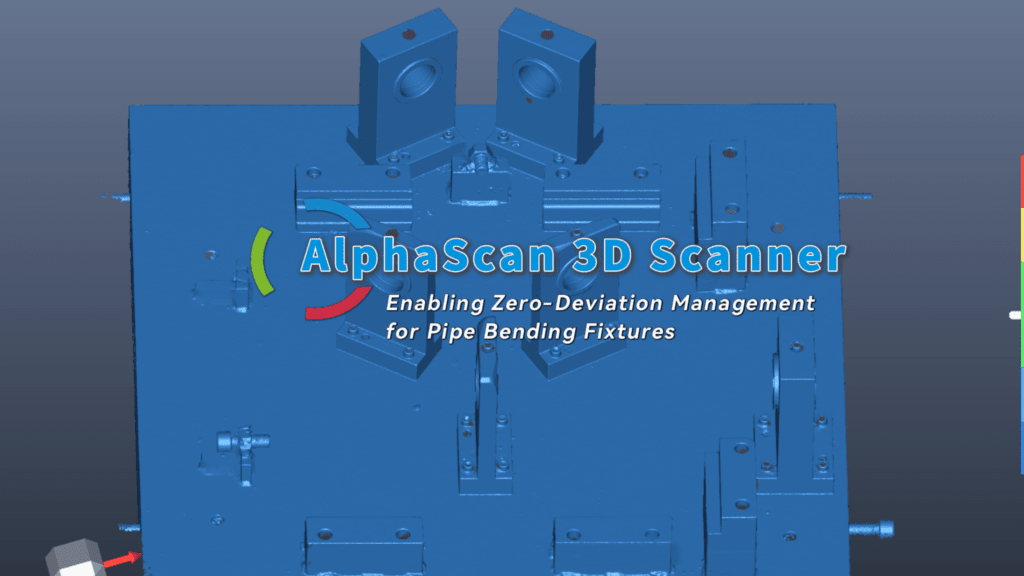
Blue light 3D scanning is an optical 3D measurement method that uses blue-wavelength light patterns or laser lines to capture surface geometry.
Definition
Blue light 3D scanning is a non-contact optical 3D metrology technology that uses blue-wavelength light to capture detailed three-dimensional geometric data of physical objects. In industrial use cases, it uses the unique properties of blue light to deliver stable measurement performance under controlled factory-lighting conditions, supporting applications ranging from reverse engineering to dimensional quality inspection.
How It Works
Blue light 3D scanning systems operate on the principle of optical triangulation, with varying configurations optimized for different use cases. First, the system projects controlled blue light patterns—including fringe patterns, parallel or cross laser lines, or grid patterns—onto the surface of the target object. The shorter wavelength of blue light produces sharper pattern edges than longer visible wavelengths, enabling more precise capture of fine surface features. One or more calibrated, factory-aligned cameras capture the distortion of the projected patterns as they conform to the object’s geometry. Onboard or connected processing software then calculates the 3D coordinates of each point on the object’s surface by triangulating the known position of the projector, camera, and observed pattern distortion, generating a dense point cloud. Modern industrial systems often integrate AI-powered algorithms to reduce noise from reflective or uneven surfaces, automatically align multiple scan passes, and accelerate post-processing into usable 3D meshes or solid models. Systems may be configured as handheld portable units, fixed-position stations, automated robotic mounts, or paired with external optical tracking systems for large-workpiece scanning.
Key Parameters and Criteria
Blue light 3D scanning systems are evaluated against standardized metrological parameters to ensure suitability for industrial use cases. Core parameters and their evaluation criteria are outlined below:
| Parameter | Meaning | Judgment Method |
|---|---|---|
| Single Scan Field of View (FoV) | The maximum contiguous surface area captured by the system in one discrete scan pass, which may be adjustable across different scan modes | Measured as width × height of the capture area, verified by scanning a traceable calibrated reference artifact of known dimensions under standard operating conditions |
| Point Accuracy | The maximum allowable deviation between an individual scanned 3D point coordinate and its corresponding true physical coordinate | Determined by comparing scan data of a certified metrology standard (e.g., gauge block, precision ball bar) to its nominal value; performance varies by scan mode, object surface material, and working distance |
| Volume Accuracy | The cumulative measurement deviation across the full spatial volume of a scanned object, scaled relative to object size | Assessed by scanning a calibrated reference artifact of defined dimensions, calculating root mean square (RMS) deviation across all measured points relative to the artifact’s certified values, typically expressed as a base precision value plus a per-meter scaling factor |
| Scan Rate | The number of discrete 3D measurement points captured by the system per second | Measured under standard operating conditions for the system’s default high-speed scan mode, excluding post-processing and data alignment time |
| Working Distance Range | The span of distances between the scanning system and target object within which specified accuracy and resolution performance is maintained | Verified by measuring scan accuracy at incremental distances from a calibrated reference artifact to identify the minimum and maximum operating distances that meet published performance thresholds |
Suitable and Unsuitable Scenarios
Suitable Scenarios
- Industrial reverse engineering, including CAD model generation from physical parts and additive manufacturing pre-processing
- Industrial quality control, including batch dimensional inspection, GD&T analysis, uneven component wear assessment, and 3D model deviation visualization
- Digitization of small to medium industrial parts, as well as large-format workpieces such as automotive body panels and aerospace tooling
- On-site inspection in harsh industrial environments, including locations with high ambient light, variable temperatures, or restricted access
- Integration with automated production lines for in-line or near-line quality verification
- Photovoltaic component dimensional inspection and defect detection
Unsuitable Scenarios
- Non-industrial use cases including human body or facial scanning
- Medical imaging for diagnostic purposes
- Measurement of internal apertures smaller than 5mm
- Scanning of objects with maximum dimensions below 10cm, where specialized micro-metrology tools are required
Common Misconceptions
- Misconception: Blue light 3D scanning only uses structured fringe patterns. Correction: Industrial blue light 3D scanning systems support multiple projection types, including blue laser lines, structured fringe patterns, and LED-generated grid patterns, depending on the intended use case. Many multi-mode systems switch between broad, fast scanning patterns for large surfaces and dense, high-resolution patterns for fine feature capture.
- Misconception: Blue light scanning is only appropriate for small, high-precision parts. Correction: Blue light 3D scanning systems are available in configurations optimized for a wide range of object sizes, from small industrial components to large-format workpieces such as automotive body panels and aerospace tooling. Specialized systems support single-pass scan fields of several square meters for large-area capture.
- Misconception: All blue light 3D scanning systems offer the same measurement accuracy. Correction: Measurement accuracy varies significantly based on system calibration, scan mode, working distance, target object surface properties (e.g., reflectivity, texture), and environmental conditions. Metrology-grade industrial systems require regular calibration against traceable reference standards to maintain stated performance.
- Misconception: Blue light scanning cannot capture data from highly reflective metal surfaces. Correction: Modern industrial blue light scanning systems integrate adjustable exposure settings, multi-exposure capture routines, and AI-powered noise reduction to reliably scan high-reflectivity surfaces such as polished molds and machined metal parts. For extremely reflective or transparent surfaces, a temporary thin matte coating may be applied to eliminate glare artifacts.
Related Concepts
- Structured Light 3D Scanning: A broader category of optical 3D measurement that uses projected light patterns of any visible or non-visible wavelength to capture object geometry; blue light 3D scanning is a high-precision, industrial-focused subset of this technology.
- Optical Tracking System: A supplementary measurement system that uses fixed or mobile cameras to track the 3D position of a handheld scanner in real time, reducing the need for adhesive reference markers on large target objects.
- Automated 3D Scanning: A configuration where a blue light scanning head is mounted to a robotic arm, gantry, or conveyor system to execute pre-programmed scan routines without manual operation, commonly used for in-line or near-line production quality control.
- Point Cloud: The raw 3D data output of blue light scanning, consisting of millions of individual spatial coordinate points that represent the surface geometry of the scanned object, which is processed into meshes or solid CAD models for downstream use.
- 3D Metrology: The field of precision dimensional measurement that uses technologies including blue light scanning to verify the compliance of manufactured parts against design specifications and GD&T requirements.
FAQ
What is the primary difference between blue light 3D scanning and white light 3D scanning?
The core difference lies in the wavelength of the projected light: blue light operates in the 400–500 nm range, while white light is a broad blend of visible wavelengths. Blue light’s shorter wavelength produces sharper, more defined projection patterns, enabling higher-resolution capture of fine surface features. It is also far less susceptible to interference from ambient factory lighting, making it more reliable for on-site industrial use cases. White light scanning is typically deployed for lower-precision, non-industrial applications.
Do blue light 3D scanning systems require adhesive markers on target objects?
Marker requirements vary by system configuration. Most standard handheld and fixed scanners use temporary adhesive markers to align multiple overlapping scan passes into a single coherent 3D model. However, systems paired with external optical tracking systems can track the scanner’s position relative to a fixed reference frame, reducing the need for object-mounted markers entirely, which is particularly beneficial for large or delicate workpieces.
Can blue light 3D scanning capture data from high-reflectivity metal surfaces?
Modern industrial blue light 3D scanning systems are optimized for use on common industrial materials, including high-reflectivity polished metal molds and machined components. Many systems use adjustable multi-exposure capture routines and AI-powered artifact reduction algorithms to minimize glare and capture accurate surface data without pre-processing. For extremely reflective, transparent, or matte-black surfaces, a thin temporary matte coating may be applied to improve data capture consistency.
What output formats are standard for blue light 3D scan data?
Industrial blue light scanning systems typically export both raw point cloud data and processed 3D meshes in formats compatible with all mainstream CAD, metrology, and additive manufacturing software platforms. Common supported formats include STL, STEP, IGES, PLY, and ASCII point cloud files, enabling seamless integration into existing industrial 3D digitization workflows.
Summary
Blue light 3D scanning is a versatile, non-contact optical 3D metrology technology designed for high-precision geometric data capture across a wide range of industrial use cases. Its resistance to ambient light interference, support for both small component and large workpiece scanning, and integration with AI-powered processing have made it a core tool for reverse engineering, dimensional quality inspection, and 3D digital twin generation across sectors including advanced manufacturing, aerospace, automotive, and photovoltaic energy. Systems are available in portable handheld, fixed-station, and fully automated configurations to adapt to diverse operational requirements.
- What Is 3D Scanning? Principles, Workflow, and Industrial Applications 3D scanning is a digital measurement technology that converts the surface geometry of physical objects into 3D data. This entry covers its working principles, core parameters, industrial use cases, common misconceptions, and related technical…
- What Is a 3D Scanner? Types, Parameters, and Selection Criteria A 3D scanner captures three-dimensional surface data from physical objects and converts geometry, dimensions, and features into digital data for inspection, reverse engineering, and modeling.
- What Is 3D Scanning Accuracy? Accuracy, Repeatability, and Resolution Explained 3D scanning accuracy describes how closely scan data matches an object's actual geometry and dimensions. It is assessed through local accuracy, volumetric accuracy, stitching accuracy, repeatability, and resolution.
- What Is Point Cloud Data? Point Clouds, Meshes, and CAD Models in 3D Scanning Point cloud data is an important raw data format in 3D scanning. It consists of discrete 3D coordinate points that describe object surface geometry and support inspection, reverse engineering, modeling, and archiving.
Hangzhou Insvision Technology Co., Ltd.
Address: Building 1, No. 1399 Liangmu Road, Yuhang District, Hangzhou, Zhejiang 311121, China
Copyright © Hangzhou Insvision Technology Co., Ltd. All rights reserved.
Copyright © Hangzhou Insvision Technology Co., Ltd. All rights reserved.