

3D Scanning Field of View
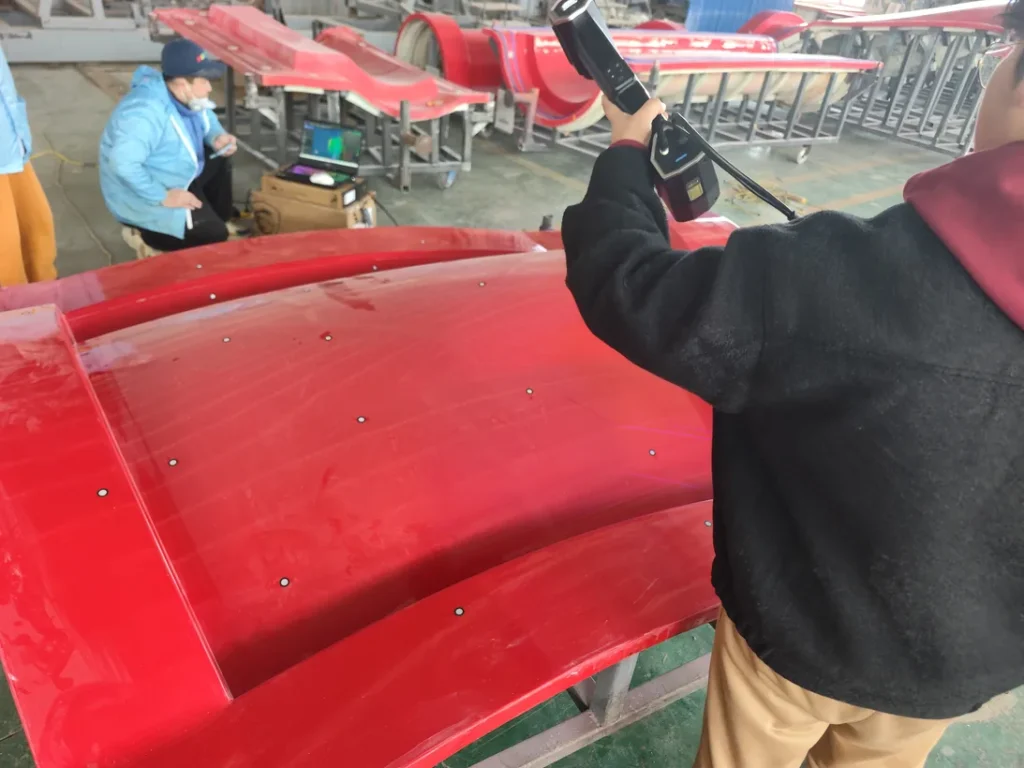
3D Scanning Field of View (often abbreviated as FoV) is the calibrated measurable two-dimensional area or three-dimensional volume that a 3D scanning system can capture in a single stationary scan position, without repositioning the scanner, target object, or supporting tracking hardware.
Definition
3D Scanning Field of View (often abbreviated as FoV) is the calibrated measurable two-dimensional area or three-dimensional volume that a 3D scanning system can capture in a single stationary scan position, without repositioning the scanner, target object, or supporting tracking hardware. It is a core functional attribute that directly impacts scan workflow efficiency, total capture time, and data quality across all 3D scanning use cases.
How It Works
For optical 3D scanning systems (including structured light, laser, and photogrammetric configurations), FoV is defined by the combined calibration of imaging sensors, projection components (such as pattern projectors or laser emitters), and onboard processing algorithms. For structured light and blue light scanning systems, the usable FoV corresponds to the overlapping view shared by all imaging sensors and projection hardware, where projected patterns or laser lines are visible to all sensors and can be processed into accurate 3D data. For handheld 3D scanners, FoV describes the capture area within which the system can maintain tracking lock, either via natural surface features on the target object or affixed reference markers. For optical tracking systems, FoV refers to the 3D volume within which tracked targets (such as markers, scanners, or assembly tools) can be reliably localized. For most systems, effective FoV changes with working distance (the distance between the scanner’s optical aperture and the target surface): increasing working distance expands FoV, while decreasing working distance narrows it, with corresponding tradeoffs in point density and measurement accuracy as defined by the system’s calibration.
Key Parameters and Criteria
FoV performance is evaluated via standardized, measurable parameters, all of which are dependent on system calibration, operating environment, and target object characteristics:
| Parameter | Meaning | Judgment Method |
|---|---|---|
| Rated Static FoV | The maximum 2D area or 3D volume specified for a system at a defined calibrated working distance, measured under controlled laboratory conditions with standard reference artifacts | Verified by capturing a calibrated reference artifact of known dimensions placed at the rated working distance, confirming the artifact’s full extent is captured within a single scan frame with published accuracy thresholds |
| Effective Working FoV | The actual usable capture area or volume in real-world operating conditions, adjusted for variables including target surface material, ambient lighting, marker placement, and object geometry | Tested using representative target objects in the intended operating environment, measuring the maximum capture area achievable without tracking loss or significant data dropout |
| FoV Uniformity | The consistency of point density, measurement accuracy, and data completeness across the full extent of the FoV, comparing central regions to edge regions | Compare measurement deviation and point count between calibrated reference targets placed at the center and four corners of the rated FoV at the specified working distance |
| FoV Aspect Ratio | The proportional relationship between the width and height of a 2D FoV, or the x, y, and z axis dimensions of a 3D tracking FoV | Calculated from measured dimensions of a calibrated grid artifact captured at the rated working distance |
FoV performance is always evaluated alongside correlated metrics including measurement accuracy and point density, as system designs typically involve intentional tradeoffs between FoV size and these other performance attributes for specific use cases.
Suitable and Unsuitable Scenarios
Suitable Scenarios
Wide FoV configurations are optimal for:
- Large-object scanning tasks, such as full vehicle bodies, large aerospace tooling, or large structural components, where minimizing the number of scan positions reduces total project time
- High-throughput batch scanning of multiple small to medium industrial parts placed within a single FoV, for quality inspection workflows
- Optical tracking of large work volumes, such as automated scanning cells or large-scale assembly alignment tasks
Narrow FoV configurations are optimal for:
- High-precision inspection of small, high-tolerance components, such as precision machined parts, electronic components, or medical implants, where high point density and edge resolution are required
- Capture of fine surface details, deep cavities, or complex geometric features that would be under-sampled in a wide FoV configuration
Unsuitable Scenarios
Wide FoV configurations are not suitable for:
- Applications requiring micron-level accuracy on sub-centimeter features, as the larger capture area reduces per-pixel resolution and point density at equivalent working distances
- Scanning of highly reflective, transparent, or low-contrast surfaces, as wider FoVs are more sensitive to surface-related data dropout
Narrow FoV configurations are not suitable for:
- Time-sensitive large-object scanning tasks, as they require a significantly higher number of scan positions and longer post-processing time for data alignment
- Batch scanning workflows for multiple medium to large parts, as the limited capture area reduces throughput
Common Misconceptions
- Misconception: A larger FoV is always a higher-performance choice for all use cases.
Correction: FoV is strictly application-specific. While a larger FoV reduces the number of required scan positions, it typically comes with lower point density and reduced measurement accuracy at the same working distance compared to a narrower FoV from the same system.
- Misconception: A system’s rated FoV is fully usable for all target objects.
Correction: Rated FoV is measured under ideal controlled conditions using high-contrast, matte calibration artifacts. Real-world usable FoV may be smaller for transparent, high-reflective, or low-contrast surfaces, or in environments with high ambient light.
- Misconception: FoV is a fixed, unchanging value for a given 3D scanner.
Correction: Most 3D scanning systems have an adjustable FoV that changes with working distance within the system’s calibrated operating range. Some specialized systems also support interchangeable lenses or configurable scan modes to switch between wide and narrow FoV profiles.
- Misconception: Multi-camera 3D scanning systems always have a larger FoV than single-camera systems.
Correction: Multi-camera configurations may be designed for wider FoV coverage, but may also be calibrated for overlapping narrow FoVs to achieve higher measurement accuracy or improved depth resolution, depending on the intended use case.
Related Concepts
- Working Distance: The distance between a 3D scanning system’s optical aperture and the target object surface, which is the primary variable determining effective FoV for most optical scanning systems.
- Point Density: The number of 3D data points captured per unit area, which typically decreases as FoV increases for a given sensor resolution and working distance.
- Scan Coverage: The total percentage of an object’s surface captured across all scan positions, which is influenced by FoV size, object geometry, number of scan positions, and overlap between adjacent scans.
- Optical Tracking Volume: The three-dimensional FoV of an optical tracking system, within which markers, scanners, or assembly tools can be reliably localized for dynamic scanning or alignment tasks.
- System Calibration: The process of mapping the optical paths of a scanning system’s sensors and projection components to define the usable overlapping FoV and verify accuracy across its full extent.
FAQ
How does 3D scanning FoV differ from standard 2D camera FoV?
A standard 2D camera FoV describes a two-dimensional angular view of a scene, with no inherent calibration for depth or measurement accuracy. 3D scanning FoV refers to a calibrated three-dimensional volume or measurable area with verified accuracy and depth resolution across its full extent, and only includes the overlapping region visible to all imaging sensors and projection components in the scanning system, rather than the full view of a single sensor.
Can I adjust the FoV of a 3D scanner for different tasks?
Most general-purpose 3D scanners support adjustable FoV via changes to working distance, with predefined calibrated working ranges published by the manufacturer. Some specialized industrial systems also support interchangeable lenses or configurable scan modes to switch between wide and narrow FoV profiles optimized for different use cases, such as large-part scanning vs. high-precision inspection.
What performance tradeoffs exist when using a wider FoV configuration?
For a given sensor resolution and working distance, a wider FoV typically results in lower per-pixel resolution, reduced point density, and slightly lower measurement accuracy across the capture area, particularly at the edges of the FoV. Wide FoV configurations may also be more sensitive to ambient light interference and surface reflectivity than narrow FoV setups.
How do I estimate the number of scan positions needed for a given object?
The number of required scan positions depends on the object’s size and geometry, the scanner’s effective FoV, and the required overlap between adjacent scans for reliable data alignment. Most 3D scanning workflows require 20-30% overlap between adjacent FoVs to ensure accurate alignment, so total positions can be estimated by dividing the total surface area to be captured by the usable FoV area, adjusted for overlap and occluded surface regions.
Summary
3D scanning field of view is a core functional parameter that defines the capture capacity of a 3D scanning system in a single stationary position. Its performance is quantified by measurable attributes including rated static FoV, effective working FoV, uniformity, and aspect ratio, with inherent tradeoffs against measurement accuracy and point density depending on system design and operating conditions. Selecting an appropriate FoV configuration for a specific use case is critical to balancing scan workflow efficiency, data quality, and measurement accuracy for industrial 3D scanning, inspection, and digitization tasks.
- What Is 3D Scanning? Principles, Workflow, and Industrial Applications 3D scanning is a digital measurement technology that converts the surface geometry of physical objects into 3D data. This entry covers its working principles, core parameters, industrial use cases, common misconceptions, and related technical…
- What Is a 3D Scanner? Types, Parameters, and Selection Criteria A 3D scanner captures three-dimensional surface data from physical objects and converts geometry, dimensions, and features into digital data for inspection, reverse engineering, and modeling.
- What Is 3D Scanning Accuracy? Accuracy, Repeatability, and Resolution Explained 3D scanning accuracy describes how closely scan data matches an object's actual geometry and dimensions. It is assessed through local accuracy, volumetric accuracy, stitching accuracy, repeatability, and resolution.
- What Is Point Cloud Data? Point Clouds, Meshes, and CAD Models in 3D Scanning Point cloud data is an important raw data format in 3D scanning. It consists of discrete 3D coordinate points that describe object surface geometry and support inspection, reverse engineering, modeling, and archiving.
Hangzhou Insvision Technology Co., Ltd.
Address: Building 1, No. 1399 Liangmu Road, Yuhang District, Hangzhou, Zhejiang 311121, China
Copyright © Hangzhou Insvision Technology Co., Ltd. All rights reserved.
Copyright © Hangzhou Insvision Technology Co., Ltd. All rights reserved.