

3D Scanner Calibration
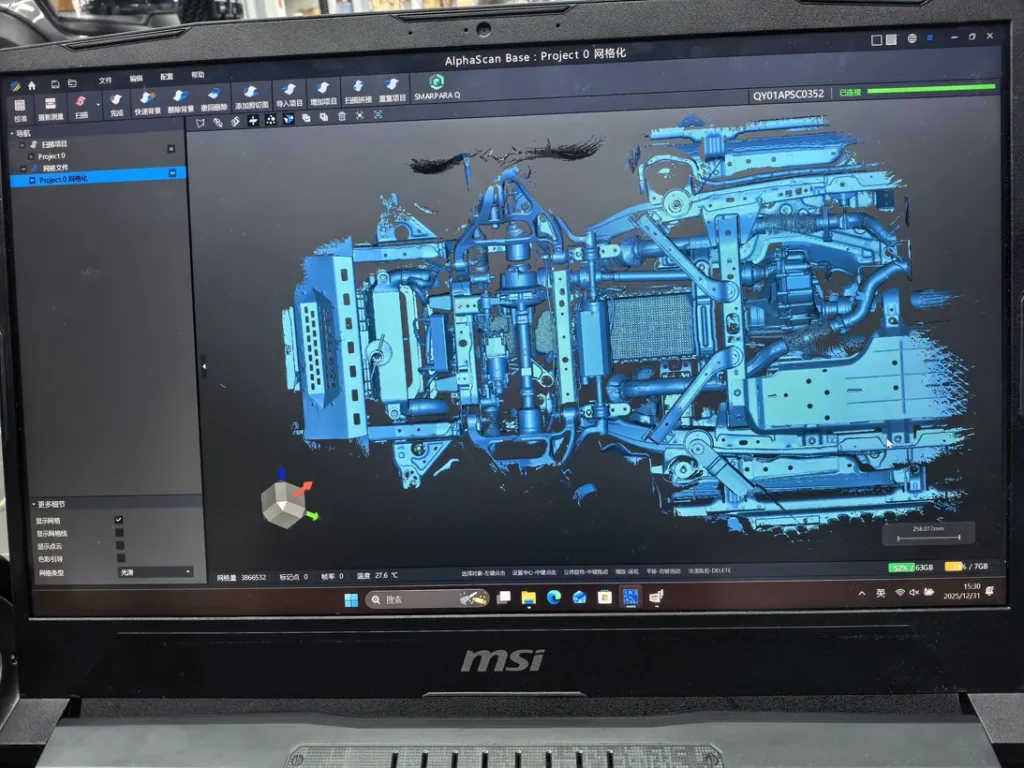
3D scanner calibration verifies and adjusts scanner measurement output against traceable references for reliable industrial inspection data.
Definition
3D scanner calibration is a systematic metrology process that adjusts, verifies, and documents the alignment of a 3D scanner’s measurement output to a traceable reference standard, ensuring consistent, accurate, and reliable dimensional measurements across scanning operations. It is a core quality control step for industrial 3D scanning workflows, addressing systematic measurement errors introduced by hardware misalignment, component aging, environmental drift, physical shock, or transport. It is distinct from post-scan point cloud alignment, a separate data processing step that registers multiple scan datasets to a common coordinate system.
How It Works
Calibration follows established metrology best practices to ensure traceability and repeatability, with four core stages:
- Reference Artifact Setup: A calibrated reference standard (such as a gauge block, step gauge, high-contrast calibration board, or ball bar) with certified, traceable dimensional values is positioned within the scanner’s working volume per manufacturer guidelines.
- Controlled Data Capture: The scanner captures multiple scans of the reference artifact across varying distances, angles, and positions within its rated working range, under stable environmental conditions (temperature, ambient light, and vibration within specified operating limits).
- Error Calculation and Adjustment: The scanner’s software compares captured measurements of the reference’s known features to its certified values to quantify systematic errors, including scale drift, lens distortion, and sensor or projector positional offset. Correction offsets are applied to the scanner's firmware or processing pipeline to reduce or compensate for these errors, followed by verification of residual error.
- Verification: A second, independent scan of the reference artifact confirms residual measurement errors fall within the scanner’s published accuracy specifications. Calibration records are logged for quality management and traceability purposes.
Some advanced systems support dynamic in-process calibration checks to flag potential drift during extended scanning operations.
Key Parameters and Criteria
Calibration performance is evaluated against standardized, measurable parameters, with acceptable thresholds dependent on scanner type, application accuracy requirements, and relevant industry standards.
| Parameter | Meaning | Judgment Method |
|---|---|---|
| Residual Measurement Error | The difference between a scanner’s measured value of a reference feature and the feature’s certified traceable value, after calibration adjustments are applied | Calculate deviation across repeated scans of the same reference feature according to the manufacturer procedure or internal metrology plan; compare results to the scanner's published accuracy specifications for the relevant working volume |
| Calibration Interval | The maximum allowable time or number of scanning operations between formal calibration cycles to maintain rated accuracy | Align with manufacturer baseline recommendations, adjusted for environmental stress (temperature fluctuation, physical shock, dust exposure) and application-specific accuracy requirements |
| Scale Error | Systematic proportional deviation in measured dimensions across the full scanning volume, caused by uncalibrated sensor or projector positioning | Measure the distance between two or more certified reference points at multiple positions within the scanner’s working volume; verify deviation remains within allowable application-specific thresholds |
| Lens Distortion Correction Accuracy | The degree to which optical distortion in the scanner's cameras or projection systems is reduced or compensated during calibration | Scan a flat, high-contrast calibration grid at multiple depths and angles relative to the scanner; verify grid lines remain straight and evenly spaced in the output point cloud |
| Traceability | The ability to link calibration reference standards to recognized metrology standards or accredited calibration documentation | Confirm reference artifacts carry valid, unexpired calibration certificates with an unbroken chain of traceability to recognized metrology standards |
Suitable and Unsuitable Scenarios
Suitable Scenarios
- Pre-deployment setup of new 3D scanners for industrial metrology or quality control use cases
- After physical shock, long-distance transport, or replacement of core hardware components (cameras, projectors, lenses)
- Periodic routine maintenance for scanners used in high-accuracy applications, including aerospace, automotive, and precision manufacturing
- Following extended exposure to extreme operating conditions (high temperature fluctuation, heavy vibration, excessive dust)
- Prior to high-volume batch scanning or critical inspection campaigns with strict dimensional tolerance requirements
Unsuitable Scenarios
- Post-scan alignment of multiple datasets of the same part, a separate data processing step that does not correct inherent scanner measurement error
- Correction of random scanning errors caused by improper part preparation (e.g., unremoved surface oil, uncoated highly reflective surfaces)
- Adjustment of user-configurable workflow settings such as scan resolution or point cloud density, which are unrelated to core measurement accuracy
- Non-industrial consumer scanning applications where traceable dimensional accuracy is not a formal requirement
Common Misconceptions
- Misconception: Calibration is identical to post-scan point cloud alignment.
Fact: Calibration adjusts the scanner’s internal measurement system to match a traceable reference standard, correcting inherent hardware-related error. Alignment registers multiple scan datasets to a common coordinate system after capture, and cannot fix systematic measurement inaccuracies from an uncalibrated scanner.
- Misconception: Factory calibration removes the need for recalibration over the scanner's lifespan.
Fact: Component aging, environmental drift, physical impact, and frequent transport can introduce new systematic errors over time. Periodic recalibration is required to maintain the scanner’s published accuracy specifications.
- Misconception: Higher scan resolution removes the need for regular calibration.
Fact: Resolution refers to the density of captured point data, not the accuracy of individual measurement points. Even high-resolution scanners will produce dense but dimensionally inaccurate data if uncalibrated.
- Misconception: Calibration can correct all types of scanning errors.
Fact: Calibration only addresses consistent, repeatable systematic errors in the scanner’s optical and hardware systems. Random errors from ambient light interference, operator error, or unsuitable surface conditions require separate workflow adjustments.
Related Concepts
- Traceable Reference Standard: A physical artifact with certified dimensional values linked to recognized metrology standards or accredited calibration documentation, used as the reference for calibration procedures.
- Systematic Error: Consistent, repeatable measurement deviation caused by hardware misalignment, optical distortion, or environmental drift, which is correctable via calibration.
- Volume Accuracy: A 3D scanner’s measurement accuracy across its entire rated working volume, verified and validated during full system calibration.
- Dynamic Tracking Compensation: A feature that adjusts measurement data in real time to account for scanner or part movement during scanning, often calibrated alongside core scanner hardware for large-volume or dynamic measurement workflows.
- GD&T (Geometric Dimensioning and Tolerancing): A standardized framework for defining and communicating manufacturing tolerances, where formal calibration of measurement tools is a prerequisite for valid, auditable inspection results.
FAQ
How often should an industrial 3D scanner be calibrated?
Calibration frequency depends on the scanner manufacturer's guidance, use intensity, environmental exposure, and required tolerance level. Some organizations use periodic checks, while high-accuracy inspection campaigns may require pre-task verification. The interval should be adjusted based on documented in-house error checks rather than a fixed universal rule.
Can I perform 3D scanner calibration in the field, or does it require a laboratory environment?
Most modern industrial 3D scanners support field calibration using portable, traceable reference artifacts, provided the work area meets basic stability requirements: minimal vibration, controlled ambient light, and temperature within the scanner’s specified operating range. Laboratory calibration is typically reserved for tightly controlled metrology applications, formal recertification, or reference artifacts that require accredited verification.
Does calibration affect scan speed or point cloud density?
No. Calibration adjusts only the dimensional accuracy of individual measurement points, not user-configurable workflow settings such as scan rate, capture resolution, or point cloud density. Calibration also does not alter post-processing workflows or data export compatibility.
What happens if I use an uncalibrated 3D scanner for industrial inspection?
An uncalibrated scanner may produce data with consistent systematic errors, such as incorrect scale, distorted geometry, or global positional offset. For inspection applications, this can lead to false pass/fail determinations, inaccurate deviation analysis, and non-compliance with industry quality standards. For reverse engineering, uncalibrated data will result in manufactured parts that do not match original design specifications.
Summary
3D scanner calibration is a foundational industrial metrology process that ensures 3D scanning systems produce accurate, consistent, and traceable dimensional data by aligning system measurement output to certified reference standards. It corrects systematic measurement errors caused by hardware drift, environmental exposure, component aging, and physical impact, and is a required step for reliable industrial 3D scanning use cases including quality inspection, reverse engineering, and large-volume metrology. Calibration requirements vary by use case, operating environment, and scanner type, with standardized, auditable workflows supported across most industrial 3D scanning hardware and software platforms.
- What Is 3D Scanning? Principles, Workflow, and Industrial Applications 3D scanning is a digital measurement technology that converts the surface geometry of physical objects into 3D data. This entry covers its working principles, core parameters, industrial use cases, common misconceptions, and related technical…
- What Is a 3D Scanner? Types, Parameters, and Selection Criteria A 3D scanner captures three-dimensional surface data from physical objects and converts geometry, dimensions, and features into digital data for inspection, reverse engineering, and modeling.
- What Is 3D Scanning Accuracy? Accuracy, Repeatability, and Resolution Explained 3D scanning accuracy describes how closely scan data matches an object's actual geometry and dimensions. It is assessed through local accuracy, volumetric accuracy, stitching accuracy, repeatability, and resolution.
- What Is Point Cloud Data? Point Clouds, Meshes, and CAD Models in 3D Scanning Point cloud data is an important raw data format in 3D scanning. It consists of discrete 3D coordinate points that describe object surface geometry and support inspection, reverse engineering, modeling, and archiving.
Hangzhou Insvision Technology Co., Ltd.
Address: Building 1, No. 1399 Liangmu Road, Yuhang District, Hangzhou, Zhejiang 311121, China
Copyright © Hangzhou Insvision Technology Co., Ltd. All rights reserved.
Copyright © Hangzhou Insvision Technology Co., Ltd. All rights reserved.