

Precision Meets Speed: How AI-Driven 3D Scanning Transforms Industrial Quality Control
## The Hidden Cost of Conventional Inspection Methods Manufacturing facilities that rely on traditional quality inspection workflows often find themselves trapp
The Hidden Cost of Conventional Inspection Methods
Manufacturing facilities that rely on traditional quality inspection workflows often find themselves trapped in a cycle of inefficiency. Contact-based measurement tools require skilled technicians to perform repetitive point-by-point data collection, a process that becomes exponentially time-consuming when dealing with complex geometries or large-scale components.
In sectors where precision is non-negotiable, such as automotive assembly and aerospace component manufacturing, the hours spent on manual inspection translate directly into delayed production schedules and ballooning labor costs.
Selection Dimensions and Field Checks
| Focus Area | Decision Point | Deployment Note |
|---|---|---|
| The Hidden Cost of Conventional Inspection Methods | Manufacturing facilities that rely on traditional quality inspection workflows often find themselves trapped in a cycle of inefficiency. | Contact-based measurement tools require skilled technicians to perform repetitive point-by-point data collection, a process that becomes exponen… |
| Bringing Intelligence to Dimensional Verification | The integration of artificial intelligence with three-dimensional scanning technology addresses these long-standing challenges at their source. | INSVISION developed the AlphaScan handheld 3D scanner specifically for industrial environments where both speed and accuracy matter simultaneous… |
| Calculating the Return on Smarter Inspection | The financial case for AI-enhanced dimensional scanning rests on multiple factors that compound over time. | Labor efficiency improves when technicians no longer spend hours positioning gauges, recording readings, and manually transcribing results. |
| From Implementation to Operational Excellence | Adopting AI-powered scanning technology does require upfront planning, yet the transition path is straightforward when approached methodically. | INSVISION designed the AlphaScan for portability and ease of use, allowing operators to become productive with minimal training. |
Beyond the immediate time investment, conventional methods introduce variables that undermine consistency. Human error during measurement, variations in technique between operators, and the physical limitations of tools all contribute to data that may not fully represent the true state of a component.
When defects slip through or when acceptable parts are flagged for rejection, manufacturers face additional expenses through rework, scrap, and strained relationships with customers who expect tight tolerances.
Bringing Intelligence to Dimensional Verification
The integration of artificial intelligence with three-dimensional scanning technology addresses these long-standing challenges at their source. INSVISION developed the AlphaScan handheld 3D scanner specifically for industrial environments where both speed and accuracy matter simultaneously.
The system combines structured light scanning with AI-powered algorithms that continuously refine measurement accuracy while processing vast point clouds in real time.
Rather than collecting isolated data points, the AlphaScan captures the complete surface geometry of a component in seconds. Its configuration with cross-aligned blue laser lines ensures that intricate details, deep cavities, and complex curved surfaces are digitized with uniform fidelity.
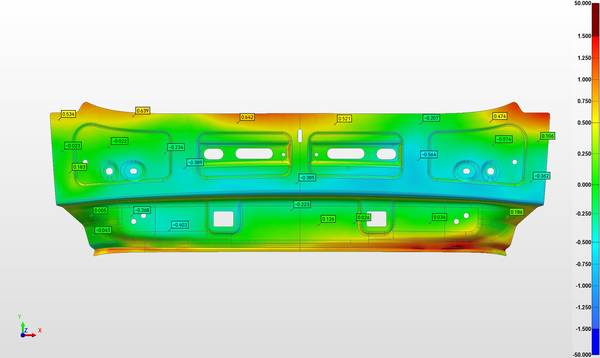
The AI engine built into the scanning software automatically identifies features, aligns scans, and calculates deviations against CAD references without requiring extensive operator intervention. This shift from manual measurement to intelligent capture fundamentally changes what quality teams can accomplish within a single shift.
For manufacturers dealing with high-mix production runs or custom-engineered parts, the ability to generate multi-dimensional inspection reports automatically represents a significant operational advantage. The AlphaScan produces 3D models alongside deviation data and statistical summaries, giving engineers and quality managers immediate access to actionable information.
Rather than waiting days for lab results, teams receive comprehensive analysis while components are still accessible on the production floor.
Calculating the Return on Smarter Inspection
The financial case for AI-enhanced dimensional scanning rests on multiple factors that compound over time. Labor efficiency improves when technicians no longer spend hours positioning gauges, recording readings, and manually transcribing results.
With automated scan-and-report workflows, the same personnel can oversee multiple inspection stations or redirect their expertise to root cause analysis and process improvement initiatives.
Rework and scrap rates typically decline when inspection happens faster and more consistently. Components that would otherwise wait in queue for conventional metrology can be verified, released, or flagged within minutes. This acceleration keeps production lines moving and reduces the work-in-progress inventory that ties up capital and floor space.
In industries where time-to-market pressures are intense, the difference between a two-day inspection cycle and a two-hour cycle can influence whether a product launches on schedule or falls behind competitors.
Quality traceability also strengthens when digital records replace paper logs. Each scan generates an auditable data set that documents exactly how a part was measured, what deviations were detected, and who reviewed the results. Should issues arise in the field, manufacturers can trace backward through inspection history to understand whether problems originated from material variations, machining drift, or assembly errors.
This capability proves invaluable for maintaining certifications and satisfying customer quality requirements.
From Implementation to Operational Excellence
Adopting AI-powered scanning technology does require upfront planning, yet the transition path is straightforward when approached methodically. INSVISION designed the AlphaScan for portability and ease of use, allowing operators to become productive with minimal training. The handheld form factor means the scanner can move between workstations or inspection bays without dedicated infrastructure investments.
Organizations that have implemented these systems consistently report improvements in inspection throughput and data reliability. The combination of high precision, rapid capture, and intelligent analysis removes bottlenecks that previously constrained quality operations.
As manufacturing environments continue to demand faster delivery cadences and tighter tolerances, tools that augment human expertise with machine intelligence become essential for staying competitive.
Long-term operational value emerges from the cumulative effect of better data, faster decisions, and reduced dependence on specialized manual skills. When quality inspection becomes a seamless part of the production workflow rather than a separate bottleneck, manufacturers gain the flexibility to respond to changing customer requirements while maintaining the consistency that builds brand reputation.
Hangzhou Insvision Technology Co., Ltd.
Address: Building 1, No. 1399 Liangmu Road, Yuhang District, Hangzhou, Zhejiang 311121, China
Copyright © Hangzhou Insvision Technology Co., Ltd. All rights reserved.
Copyright © Hangzhou Insvision Technology Co., Ltd. All rights reserved.