

3D dimensional scanner for manufacturing conveyor: Practical Criteria fo
Before evaluating any new technology, it helps to map the real cost drivers embedded in current inspection routines.
Where Conventional Inspection Erodes Margin
Before evaluating any new technology, it helps to map the real cost drivers embedded in current inspection routines. Three patterns repeat across automotive, aerospace, and medical device plants.
First, measurement cycle time rarely matches production takt. A CMM located two bays away might deliver high-accuracy results, but the logistics of transporting parts, queuing for the machine, and waiting for a report create a lag that forces quality teams to make decisions on incomplete data. The default response is often batch sampling—check one part per shift and hope the process hasn’t drifted.
When a non-conformance is eventually caught, the suspect batch is already large, and the cost of containment, rework, or scrap multiplies.
Second, manual gauging introduces dependency on operator skill and attention. Go/no-go checks confirm whether a feature passes a hard limit but provide no insight into how close it is to the edge of tolerance. A bracket flange that drifts 0.35 mm over a shift might still pass a manual gauge, only to cause assembly issues downstream.
The absence of full-field surface data means process drift remains invisible until it becomes a functional failure.
Third, fixed inline scanning systems solve the speed problem for dedicated, high-volume lines but lock capital into a single location. For contract manufacturers, multi-line factories, or maintenance teams that need to verify parts across different conveyor zones, the floor space and recalibration overhead of a gantry-mounted system rarely justify the investment.
These pain points share a common root: inspection is treated as a separate step rather than an integrated capability that moves with production.
How Portable 3D Scanning Changes the Cost Equation
A handheld 3D dimensional scanner for manufacturing conveyor lines rewires the inspection workflow at several points, each with measurable operational impact.
- In-line verification without line stoppage. Instead of pulling parts offline, an inspector can walk to the conveyor, position the scanner over a part as it moves or pauses, and capture full-field dimensional data in minutes. The conveyor keeps running. This eliminates the throughput loss associated with dedicated inspection bays and allows quality checks to happen at the frequency the process demands, not the frequency the schedule allows.
- Immediate GD&T feedback at the point of decision. When scan data is aligned to CAD nominals and color-mapped against tolerance bands on screen, an engineer can see a 0.38 mm profile deviation the moment it’s captured. That turns a potential tooling issue into an immediate adjustment rather than a shift’s worth of borderline parts. The reduction in reaction time directly limits the size of any containment action.
- Reduced reliance on dedicated metrology personnel. Portable systems with onboard AI-driven noise filtering and automated alignment lower the barrier to high-quality data capture. A quality technician can acquire inspection-grade point clouds without programming a CMM or manually cleaning up scan artifacts. This frees senior metrologists for complex first-article work while expanding the pool of staff who can perform reliable in-process checks.
- Targeted verification instead of batch quarantine. When a single part looks suspect, the team can scan that unit and a few adjacent samples on the spot. If the deviation is isolated, the line continues. If a trend emerges, corrective action starts immediately. The alternative—quarantining an entire batch until a lab backlog clears—carries carrying costs, potential delivery penalties, and the risk of scrapping conforming parts.
- Audit-ready traceability without extra paperwork. Scan data, GD&T evaluations, and deviation maps can be stored with time stamps, operator IDs, and part serial numbers, creating a digital thread that closes the loop on non-conformance documentation. For quality managers, this means audit trails are generated as a byproduct of inspection, not a separate administrative task.
A Framework for Estimating Operational Value
Rather than offering generic ROI claims, the following table provides a structure that operations and finance teams can populate with their own line data to assess where a portable 3D scanning approach shifts costs.
| Cost Driver | Traditional Baseline | With Portable 3D Scanning | What to Measure Internally |
|---|---|---|---|
| Line stoppage for inspection | Minutes per check × checks per shift | Near-zero stoppage for spot checks | Throughput gain per shift; OEE impact |
| Rework and scrap from late detection | Batch size at risk when drift is caught | Single-part or small-sample containment | Reduction in parts quarantined per event |
| Metrology labor allocation | Senior staff time on routine checks | Routine checks handled by line-side personnel | Hours reallocated to higher-value tasks |
| Tooling correction lag | Hours to days between detection and adjustment | Minutes from scan to corrective action | Reduction in non-conforming parts produced during lag |
| Audit documentation effort | Manual report generation per inspection | Automated digital records with traceability | Hours saved per audit cycle |
| Capital utilization | Fixed CMM or inline scanner dedicated to one line | One device serves multiple lines and shifts | Utilization rate of inspection asset |
This framework doesn’t require precise numbers to be useful. Even a qualitative assessment—identifying which of these cost drivers are most acute in a given plant—can clarify where a portable system would deliver the greatest operational leverage.
Where INSVISION’s AlphaScan Fits into the Picture
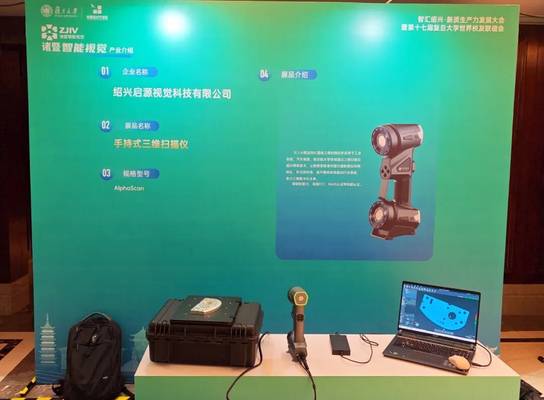
The INSVISION AlphaScan is a handheld 3D dimensional scanner for manufacturing conveyor environments, built around a blue laser engine that handles ambient factory lighting and a range of surface finishes—machined metals, cast textures, dark composites—without developer spray.
Its architecture is deliberately different from fixed gantry systems: no permanent mounting, no conveyor modification, no recalibration when moving between lines.
The scanner’s fused AI and 3D algorithm stack addresses a practical problem that undermines many portable measurement tools on the factory floor. Conveyor vibration, dust, and flickering overhead lights inject noise into point cloud data. AlphaScan’s onboard processing learns the environmental noise signature in real time, separating vibration harmonics from actual surface geometry and suppressing artifacts.
The result is inspection-ready data the moment it’s captured, without a manual cleanup step. For quality managers in automotive OEM or aerospace MRO settings, this means dimensional data flows into the digital thread without adding cycle time or headcount.
The handheld form factor enables a workflow that is difficult to replicate with fixed systems. An engineer can scan a suspension subframe on a moving stamping line, verify a door aperture on a body-in-white conveyor, or sample landing gear bushings on an overhaul line—all with the same device.
The data streams into INSVISION’s SMARPARA Q software, where scans are stitched in real time, aligned to native CAD, and evaluated against ASME Y14.5 GD&T callouts. Color deviation maps become a visual handoff to production, making it obvious where tool wear or process drift is creeping in.
From a procurement standpoint, AlphaScan carries CE, FCC, RoHS, and ISO 9001 certifications, which simplifies qualification for regulated production lines in North America and Europe. For multi-line factories or contract manufacturers with frequent changeovers, the ability to move inspection capability across conveyor zones without additional infrastructure changes the utilization math on the capital investment.
Practical First Steps for Implementation
Operations teams that want to test the operational impact of portable 3D scanning can start with two or three focused scenarios that generate visible results quickly.
- Spot-check high-risk features on moving conveyors. Identify one or two part numbers where dimensional drift has historically caused downstream assembly issues or customer returns. Deploy the scanner for in-line spot checks at the conveyor, capturing data on critical GD&T callouts without stopping the line. Track the time from detection to corrective action and the number of non-conforming parts produced during that window. This single application often reveals the gap between current sampling frequency and the process’s actual stability.
- Replace batch quarantine with targeted verification. When a suspect part is flagged—whether by a manual gauge, a visual check, or a downstream fit issue—use the scanner to verify that unit and a small sample of adjacent parts directly on the line. Measure how often the issue is isolated versus indicative of a broader trend. Compare the cost of this targeted approach to the historical cost of full-batch quarantine and lab backlog delays.
- Extend the device to reverse engineering and maintenance. Many plants carry legacy parts for which CAD data is missing or outdated. Use the same scanner to capture a worn conveyor drive bracket or a discontinued component, generate a manufacturable CAD file, and produce a replacement. This dual-use capability—dimensional inspection plus reverse engineering—increases the utilization of the asset and provides value to maintenance teams that often operate on separate budgets.
These starting points don’t require a plant-wide overhaul. They allow quality and operations leaders to observe the impact on throughput, rework, and labor allocation in a controlled way, building the internal case for broader deployment.
Summary
The pressure to improve margin in discrete manufacturing rarely comes from a single breakthrough. It accumulates through dozens of small decisions about how time, labor, and equipment are used. Inspection is one of those areas where legacy workflows quietly consume capacity—not because the measurement technology is inaccurate, but because the process of accessing it is slow and rigid.
A portable 3D dimensional scanner for manufacturing conveyor lines changes that equation by making dimensional verification a capability that moves with production, not a gate that stops it. For plants where conveyor uptime, fast tooling corrections, and audit-ready traceability are operational priorities, that shift in workflow is worth a close look.
Hangzhou Insvision Technology Co., Ltd.
Address: Building 1, No. 1399 Liangmu Road, Yuhang District, Hangzhou, Zhejiang 311121, China
Copyright © Hangzhou Insvision Technology Co., Ltd. All rights reserved.
Copyright © Hangzhou Insvision Technology Co., Ltd. All rights reserved.