

From Scan to Parametric Solid: A Tier 1 Automotive Supplier’s 3D Scan Mesh to Solid Workflow for Legacy Parts
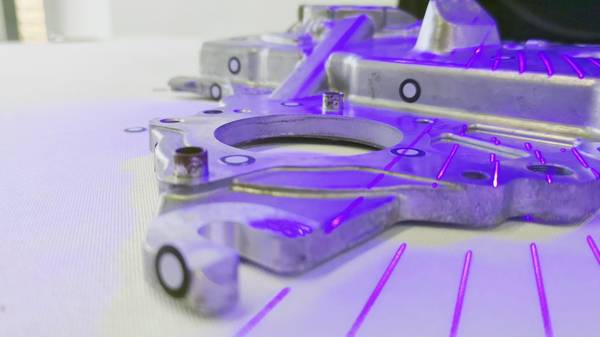
The bracket in question was a legacy cast aluminum component. Without a solid CAD file, the plant relied on a CMM to probe flat datums, but the complex cur
The Real Cost of Missing CAD Data
The bracket in question was a legacy cast aluminum component. Without a solid CAD file, the plant relied on a CMM to probe flat datums, but the complex curved surfaces remained guesswork. The resulting mesh, built from incomplete point data, refused to convert into a closed solid model. Three attempts produced three failures.
Each rework cycle pulled a metrology tech off current production inspection, directly hitting takt time and on-time delivery metrics. Traceability requirements meant every undocumented dimension became a potential audit risk. The plant manager needed a workflow that could capture the as-built condition in one session and generate a parametric solid with editable features—without sending the part out or shutting down the line.
Deployment Validation Checklist
| Focus Area | Decision Point | Deployment Note |
|---|---|---|
| Target part | Check size, surface condition, and key tolerances against the scan task | Run a full trial scan on a representative part |
| Data workflow | Verify point cloud, deviation map, and quality-report handoff | Confirm export formats and review ownership in advance |
| Shop-floor use | Review training, calibration, lighting, and working space | Keep the validation record as a repeatable inspection reference |
Practical Workflow
- The Real Cost of Missing CAD Data — The bracket in question was a legacy cast aluminum component.
- What a Production-Grade Mesh-to-Solid Pipeline Demands — A production-grade 3D scan mesh to solid pipeline is not defined by scan resolution alone.
- Deploying the INSVISION AlphaScan on the Shop Floor — On a stamping line at a Tier 1 supplier, a cast engine bracket needed reverse engineering.
- How INSVISION’s Technology Matches the Production Challen… — INSVISION’s approach addresses the specific failure points that derail legacy part re-engineering.
What a Production-Grade Mesh-to-Solid Pipeline Demands
A production-grade 3D scan mesh to solid pipeline is not defined by scan resolution alone. It is measured by how quickly a part moves from fixture to validated solid model in CATIA or SolidWorks. Six criteria separate a workable process from one that adds cost and cycle time:
- Direct scanning of high-reflectivity surfaces. Cast metal parts with shiny as-cast finishes must be captured without spraying developer. A blue laser system that handles reflective surfaces eliminates that step.
- Watertight, gap-free mesh output. Any hole in the mesh cascades into hours of surfacing work. The mesh must convert to solid CAD with minimal manual cleanup, preserving feature intent.
- Native CAD compatibility. Intermediate file translations introduce errors and rework. The mesh must import cleanly into CATIA and SolidWorks without format conversion.
- Portability and robustness. The same scanner must operate on the production floor and in the quality lab, with an IP54 rating and no recalibration between moves.
- Minimal training overhead. Technicians should be able to run measurement plan templates after a half-day orientation, not a week-long certification course.
- MES integration. Every scan result and solid model must be tagged with serial number, timestamp, and machine ID for full dimensional traceability.
A pipeline that meets these criteria turns reverse engineering from a firefighting exercise into a repeatable, auditable process.
Deploying the INSVISION AlphaScan on the Shop Floor
On a stamping line at a Tier 1 supplier, a cast engine bracket needed reverse engineering. No CAD model existed. The plant manager did not want to disrupt production or send the part to an external lab. INSVISION’s AlphaScan deployed without facility changes. Technicians trained during regular shifts—no special certification required.
The part was high-reflectivity cast metal. No coating, no masking. The quality tech picked up the scanner and used cross blue lasers for the main body, switched to a single blue laser for deep bolt holes, then engaged fine-detail mode for tight-tolerance features. One session, no repositioning. The integrated software cleaned the point cloud, closed small gaps, and output a watertight mesh.
Within the same toolchain, the mesh converted directly to a parametric solid CAD model. No exporting to another package. The entire 3D scan mesh to solid workflow happened on the floor, in hours, not days.
How INSVISION’s Technology Matches the Production Challenge
INSVISION’s approach addresses the specific failure points that derail legacy part re-engineering. The blue laser technology captures shiny as-cast surfaces without developer, eliminating a time-consuming preparation step and the risk of coating residue.
The software generates closed, watertight meshes that import cleanly into CATIA and SolidWorks, preserving feature intent and avoiding the surfacing rework that used to consume engineering hours. Native CAD compatibility means no intermediate file translation, reducing the chance of geometry corruption.
The scanner’s IP54 rating and portability allow it to move between the production floor and the quality lab without recalibration, so parts stay where they are. Measurement plan templates let technicians run repeatable scans after a short orientation, and the system tags every result with serial number, timestamp, and machine ID for full MES integration.
These capabilities directly answer the six criteria that define a production-grade pipeline.
Operational Gains That Production Teams Notice
The shift from manual CMM workflows to the INSVISION 3D scan mesh to solid process cut reverse engineering project timelines significantly, but the more meaningful gain was freeing engineers from endless data correction loops. Instead of cleaning up point clouds, they now spend time on design optimization.
Scan accuracy is consistent and repeatable, holding ISO/TS 16949 dimensional tolerances without the mesh conversion errors that previously caused fit issues in first prototype runs. Rework from that source stopped.
The portable form factor eliminated the need to move heavy or fragile parts to a dedicated CMM lab. Material handling time dropped, and the risk of part damage during transport disappeared. The integrated end-to-end workflow also reduced reliance on specialized CAD cleanup labor. For legacy part re-engineering, overall project costs came down because the team was no longer paying for hours of manual surface reconstruction.
These are the kinds of improvements a plant manager notices: less firefighting, fewer schedule slips, and a team that can focus on value-added work.
Extending the Workflow to Other Industrial Sectors
The same pattern holds across aerospace MRO, medical device reverse engineering, and energy sector redesign. When scanning legacy turbine components on the shop floor, the real test is not the scan itself—it is getting from a noisy mesh to a parametric solid model without sending files to three different departments.
If the scanner does not output a clean, closed mesh natively, teams burn hours fixing topology before they can extrude a solid. For additive manufacturing pre-processing on small-batch industrial parts, that delay erases any time savings the technology promised.
INSVISION’s full-stack approach—scanning, inspection, and model generation in one environment—removes the toolchain fragmentation that usually derails these projects. No exporting to a separate meshing tool, no reformatting for the MES.
Teams evaluating a 3D scan mesh to solid workflow should prioritize scanners that integrate directly with existing CAD and production systems and that can operate where the work actually happens, not just in a metrology lab. That is the practical difference between a pilot that gathers dust and a process that becomes standard operating procedure.
Conclusion
When a legacy part with no CAD data threatens production continuity, the cost of an unreliable mesh-to-solid conversion is measured in line downtime, audit risk, and engineering hours lost to manual surfacing. A production-grade 3D scan mesh to solid workflow that captures full geometry in one session, outputs a watertight mesh, and converts directly to a parametric solid changes the equation.
INSVISION’s integrated scanning and model generation workflow gives Tier 1 automotive suppliers—and any manufacturer facing similar legacy part challenges—a repeatable, auditable process that keeps production moving and engineers focused on design, not data cleanup.
References
- Automotive Component Redesign Brief (2024)
- High-Reflectivity Mold Scanning Brief (2024)
- Industrial 3D Digitalization Solution Brief (2024)
Hangzhou Insvision Technology Co., Ltd.
Address: Building 1, No. 1399 Liangmu Road, Yuhang District, Hangzhou, Zhejiang 311121, China
Copyright © Hangzhou Insvision Technology Co., Ltd. All rights reserved.
Copyright © Hangzhou Insvision Technology Co., Ltd. All rights reserved.