

Industrial Scanning Arm Metrology for Shop-Floor First-Article Inspection
INSVISION AlphaScan scanning arm delivers 0.020 mm shop-floor measurement with blue laser scanning and AI processing for inspection and reverse engineering.
Introduction: Shop-Floor Metrology for Real Production Conditions
In discrete manufacturing, the gap between the quality lab and the production floor still shapes inspection speed. CMMs remain trusted for dimensional verification, but large castings, machined housings, welded assemblies, and composite parts often lose time waiting for lab access, temperature stabilization, and dedicated fixturing.
A scanning arm brings 3D measurement closer to the process, especially when first-article inspection, reverse engineering, or in-process deviation checks must happen near the machine.
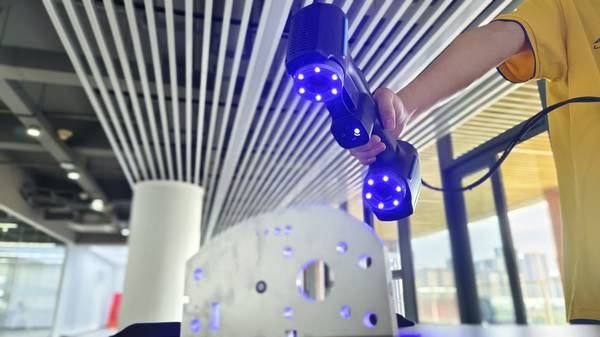
The INSVISION AlphaScan scanning arm is designed for this environment, combining a 50-line crossed blue laser array, on-board AI processing, and 0.020 mm volumetric accuracy for measurement tasks affected by vibration, dust, surface variation, and changing light.
Typical Working Conditions and Core Pain Points
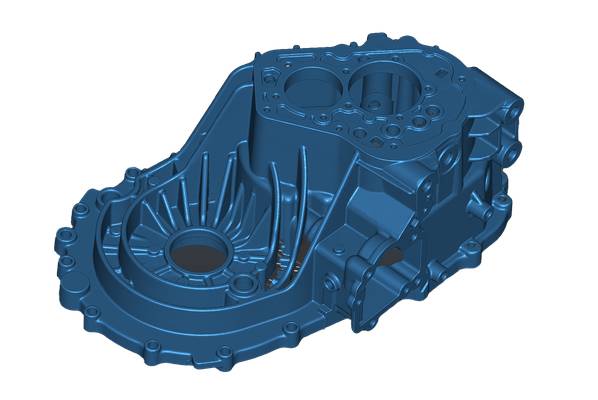
A common example is a die-casting cell producing aluminum gearbox housings. Before production continues, quality teams must verify flatness on sealing faces, position of bearing bores, and profile tolerances on internal ribs against CAD data and ISO GPS or ASME Y14.5-style GD&T requirements.
The part may still be warm, with as-cast texture, semi-gloss machined pads, oxidized areas, and narrow internal pockets that are difficult to probe.
In this setting, a scanning arm must do more than capture visible surfaces. It has to maintain point-cloud density while nearby trim presses, conveyors, CNC spindles, or pallet systems create vibration. Airborne particles can create outliers, and skylights or bay lighting can shift during a shift.
A conventional scanning arm workflow may require repeated passes, surface preparation, or a move back to the metrology room, weakening the feedback loop that lean manufacturing and Industry 4.0 quality systems depend on.
| Shop-floor condition | Measurement risk | Practical impact |
|---|---|---|
| Vibration from nearby equipment | Noisy point clouds and unstable edges | More cleanup before inspection |
| Dark, oxidized, or semi-gloss surfaces | Sparse or inconsistent scan data | Missed features or repeated passes |
| Deep ribs, pockets, and flange geometry | Shadowing and occlusion | Multiple setups and longer cycle time |
| Variable lighting and dust | Outliers and inconsistent capture | Reduced operator confidence |
Solution Design for a Shop-Floor Scanning Arm
The right scanning arm setup for this type of work should be selected around application fit, not only specification sheets. The measurement system needs optical performance for mixed surfaces, enough geometry access for internal features, and processing capability to reduce the effect of factory noise before the data reaches inspection software.
INSVISION AlphaScan uses a 50-line crossed blue laser projector operating near 450 nm. Blue laser scanning is well suited to dark alloys, titanium, carbon-fiber composites, coated surfaces, and semi-gloss machined zones. The crossed-line pattern helps fill geometry around ribs, pockets, and internal corners that a single-direction pattern can miss.
For process engineers, this means the scanning arm can collect more usable surface data in fewer operator movements.
The on-board AI inference pipeline is also central to the solution design. Instead of relying only on downstream software cleanup, AlphaScan processes scan data locally to filter vibration-induced noise, adapt to ambient light changes, and preserve usable geometry. This supports shop-floor dimensional checks without isolating the part from its normal production environment.
1. Preparation and Referencing
The part is placed on a stable surface or measured in its existing fixture when access allows. For larger parts or multi-position scans, operators can apply photogrammetric targets or magnetic reference nests to maintain alignment. The scanning arm is prepared for use with a warm-up time under two minutes, and routine work does not require an external calibration artifact.
2. Scanning the Part
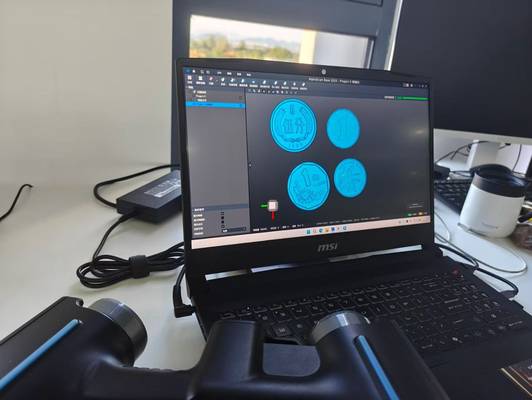
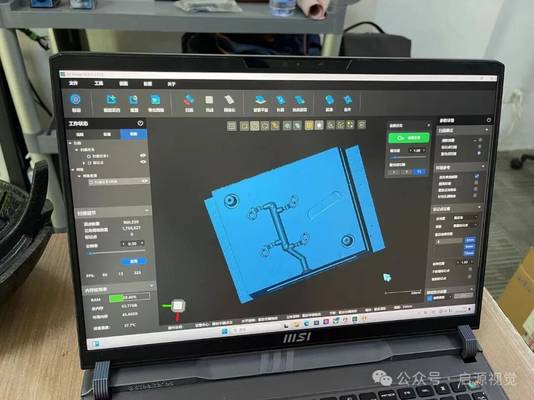
The operator moves the scanning arm across the accessible surfaces while monitoring the real-time point cloud on a connected workstation, tablet, or laptop. The crossed blue laser lines cover broad areas and help capture recessed geometry by changing the angle of approach. On a gearbox housing, this can include sealing faces, bore regions, ribs, datum pads, and flange transitions in one coordinated workflow.
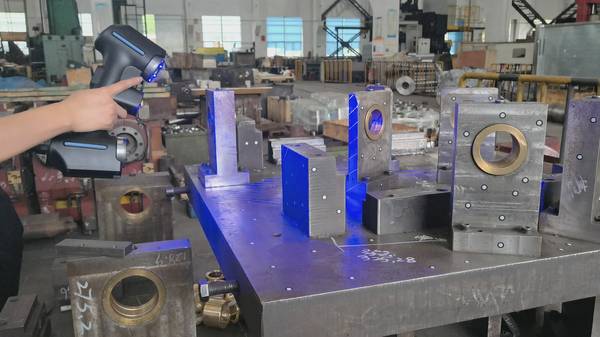
The AI processing pipeline maintains point density and suppresses outliers caused by dust particles or brief vibration spikes. When the operator sees a low-density region, moving the scanning arm from a different angle usually fills the missing geometry without moving the part to a lab.
3. Data Processing and Inspection
The captured point cloud can be meshed or kept as scan data for direct comparison with CAD. In inspection software, the operator aligns the dataset using datum features, then generates color deviation maps and evaluates GD&T requirements such as profile, position, and flatness. Clean, dense scanning arm data supports more reliable edge and feature extraction, reducing manual cleanup before reporting.
4. Report Delivery and Process Feedback
Inspection outputs are typically exported as PDF or CSV reports for quality records, manufacturing engineering, and production teams. For first-article inspection, this shortens the path from measurement to corrective action. Tool wear, fixture shift, machining offsets, casting drift, or weld distortion can be identified early enough for the team to adjust the process before non-conforming parts accumulate.
How INSVISION AlphaScan Matches the Scanning Arm Application
INSVISION AlphaScan fits this application because its core capabilities correspond directly to the main failure points of shop-floor metrology.
- Surface versatility: The blue laser array helps the scanning arm capture cast, machined, coated, oxidized, and composite surfaces without routine developer spray or extensive surface preparation.
- Environmental resilience: On-board AI processing allows the scanning arm to handle vibration artifacts, changing lighting, and short-term dust-related outliers more effectively than workflows that depend only on post-processing.
- Geometry access: Crossed-line projection and portable operation help the scanning arm capture internal cavities, ribs, flanges, and occluded transitions that are inefficient to measure with a CMM alone.
- Production fit: The system supports first-article inspection, reverse engineering, tooling validation, and in-process checks where moving the part to a lab would delay feedback.
For Western manufacturers operating under lean production, digital quality documentation, and Industry 4.0 data requirements, this type of scanning arm deployment supports measurement at the point of production while preserving traceable inspection outputs.
Observable Effects on Quality and Throughput
For a reliable selection, manufacturers should validate the scanner with real parts, existing inspection workflows, and reporting requirements before making a decision. INSVISION can support this process with application demos, sample data verification, and practical recommendations for integrating 3D scanning into quality control and production improvement.
Hangzhou Insvision Technology Co., Ltd.
Address: Building 1, No. 1399 Liangmu Road, Yuhang District, Hangzhou, Zhejiang 311121, China
Copyright © Hangzhou Insvision Technology Co., Ltd. All rights reserved.
Copyright © Hangzhou Insvision Technology Co., Ltd. All rights reserved.