

When Measurement Bottlenecks Erode ROI: The Case for 3D Scanning Structured Light in Industrial Workflows
Manufacturing operations today face a quiet but persistent drain on margins: measurement workflows that haven’t kept pace with machining speed, additive ma
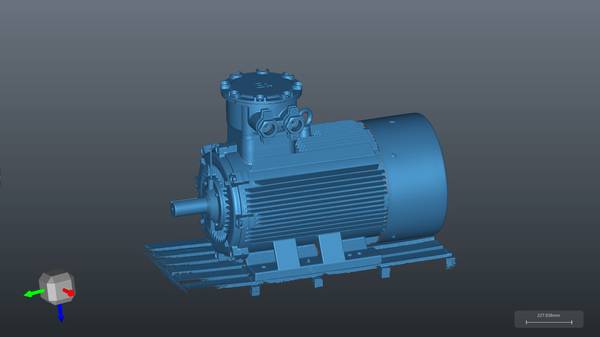
Manufacturing operations today face a quiet but persistent drain on margins: measurement workflows that haven’t kept pace with machining speed, additive manufacturing flexibility, or customer expectations for faster turnaround. While a CNC mill can finish a complex part in hours, verifying that part against design intent often takes days—or weeks, if the job is sent to an external metrology lab.
The result is a bottleneck that inflates carrying costs, delays downstream assembly, and turns what should be a competitive advantage in speed into a liability.
This article examines those hidden cost drivers from an operational perspective. It maps where conventional measurement and inspection create rework, tie up skilled labor, and slow delivery cadence. Then it outlines how structured light 3D scanning—specifically, high-speed, metrology-grade systems—can relieve those pressure points.
The goal is not to sell a scanner, but to give plant managers, quality directors, and operations leaders a clear framework for evaluating whether bringing 3D scanning structured light in-house makes financial sense for their specific mix of parts and workflows.
Hidden Cost Drivers in Conventional Industrial Measurement Workflows
Most factories still rely on a patchwork of hand tools, CMMs, and outsourced metrology services to qualify parts. Each method carries its own cost signature, but three patterns show up repeatedly in plants that haven’t modernized their measurement stack.
First, turnaround time acts as a multiplier on inventory and working capital. When a first-article inspection report takes two weeks to come back from an external lab, production either idles or proceeds at risk. If a non-conformance is found later, the cost of rework compounds across every unit produced in the interim.
Second, sparse data creates blind spots. A CMM might capture a few dozen discrete points on a critical surface. That’s enough to check a handful of GD&T callouts, but it misses the full topography. Warpage, subtle draft issues, or blend inconsistencies between surfaces go undetected until assembly or field use, when the cost of correction is highest.
Third, the process is labor-intensive and skill-dependent. Programming a CMM, setting up fixtures, and interpreting point-based reports require experienced metrology technicians. When those people are overloaded, measurement becomes a queue—and the queue dictates the pace of the entire quality loop.
Why Structured Light 3D Scanning Technology Fit Determines Long-Term Returns
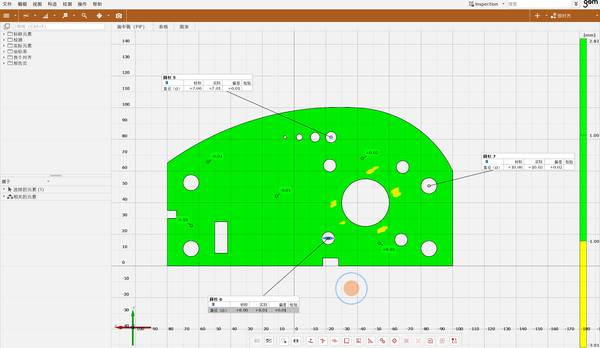
Structured light 3D scanning changes the economics by capturing millions of points in seconds, producing a dense point cloud that represents the full surface geometry. Instead of sampling a few locations, the system generates a deviation map comparing the as-built part to the CAD model across every square millimeter.
This shift from sparse sampling to full-field data has operational consequences that go far beyond the inspection lab.
The technology’s return, however, depends heavily on fit. A scanner that excels at digitizing small, intricate medical device components may struggle with large castings. A system optimized for reverse engineering legacy parts without CAD may not be the right tool for in-line production checks.
Getting the fit right—sensor field of view, accuracy class, software workflow, and environmental robustness—determines whether the investment becomes a daily workhorse or a shelf asset.
Aligning INSVISION Structured Light 3D Scanners to High-Impact Operational Use Cases
INSVISION designs its handheld structured light 3D scanning lineup to address distinct operational scenarios rather than offering a one-size-fits-all device. The INSVISION AlphaScan, for example, targets industrial reverse engineering and tooling replication workflows.
It captures up to 5,400,000 measurements per second with accuracy up to 0.020 mm, making it suitable for teams that need to digitize legacy components, prepare files for additive manufacturing, or recreate tooling where the original CAD no longer exists.
Before structured light scanning, a procurement team chasing a reverse engineering quote from an external metrology service was looking at a 3 to 6 week turnaround and a four-figure line item per part. After bringing the work in-house with a handheld structured light 3D scanner, the same part is digitized in a single shift. That is the operational delta most buyers are actually trying to quantify.
The direct effect on the cost line is immediate: outsourcing fees drop, engineering teams iterate faster, and production planning no longer hinges on an external lab’s schedule.
A Procurement-Focused Framework for Calculating Structured Light 3D Scanning TCO
Rather than rely on generic ROI promises, operations teams can build their own total cost of ownership model using the categories below. The table provides a structure for comparing the current state against a proposed in-house 3D scanning structured light workflow. Where hard numbers aren’t available, qualitative indicators still reveal whether the investment is likely to pay back within an acceptable window.
| Cost Factor | Traditional Workflow | With 3D Scanning Structured Light | Observable Impact |
|---|---|---|---|
| Outsourced measurement spend | Recurring per-part fees, expediting charges | Near-zero variable cost per scan after equipment acquisition | Direct reduction in external service invoices |
| Rework and scrap | Errors found late, entire batches affected | Full-field deviation maps catch form errors at first article | Fewer non-conformances escaping to production; lower scrap cost |
| Skilled labor allocation | CMM programmers and metrology techs as bottleneck | Operator-level data capture; specialists focus on analysis | Higher throughput per metrology headcount |
| Delivery lead time | Days to weeks for external reports | Same-day digital results | Faster order-to-ship cycles; improved on-time delivery |
| Engineering change iteration | Slow feedback loop between measurement and design | Rapid scan-compare-modify cycles | Shorter development timelines for new products and tooling |
| Data traceability and digital twin | Isolated inspection reports, paper-based records | Archivable 3D datasets linked to serial numbers | Long-term quality traceability; easier supplier qualification |
This framework doesn’t require perfect data to be useful. Even rough estimates of current outsourcing spend, average rework hours per month, and the cost of a delayed shipment can indicate whether the payback period aligns with the company’s capital expenditure thresholds.
Low-Risk Pilot Steps to Validate Structured Light 3D Scanning ROI Pre-Purchase
Before committing to a capital purchase, a focused pilot can generate the evidence needed to build an internal business case. The following steps keep the evaluation grounded in operational reality.
- Select a high-pain-point part family. Choose components that currently require external measurement, generate frequent rework, or have long inspection lead times. The pilot should target a workflow where the gap between current cost and potential improvement is widest.
- Benchmark the current process. Document the exact steps, time, labor hours, and external costs involved in measuring a representative sample of parts. Capture not just the inspection time but the waiting time, transportation, and any rework triggered by late findings.
- Run a parallel trial with a structured light 3D scanning system. Work with an INSVISION application engineer or a local partner to scan the same parts using a system that matches the accuracy and speed requirements. Compare the time from part receipt to actionable deviation map, the completeness of the data, and the number of issues identified that the conventional method missed.
- Calculate the operational delta. Translate the time savings, rework avoidance, and outsourcing reduction into cost terms using the TCO framework. If the pilot shows that a single shift can replace a multi-week external loop, the financial logic is usually clear enough to move forward.
Scaling Structured Light 3D Scanning Investments to Support Long-Term Industry 4.0 Goals
Once a structured light 3D scanning system proves its value in one workflow, the natural next step is to extend its use across the production chain. The same point cloud data that speeds up reverse engineering can feed into in-line quality checks, supplier part approvals, and digital twin archives.
Over time, the accumulated 3D datasets become a manufacturing asset in their own right—enabling trend analysis on tool wear, faster root cause investigation when defects appear, and a traceable quality record that strengthens customer confidence.
INSVISION’s handheld lineup supports this scaling because the systems are portable and can move between the metrology lab, the shop floor, and even supplier sites. The data output is compatible with common inspection software and CAD platforms, so the information flows into existing quality management systems rather than creating a new data silo.
For operations leaders building a roadmap toward Industry 4.0, structured light 3D scanning provides a practical entry point: it solves an immediate cost problem while laying the foundation for closed-loop digital quality management.
Summary
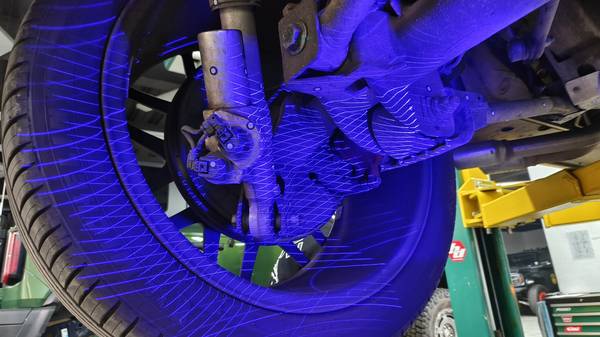
Measurement bottlenecks are not just a quality department concern—they are a direct drag on delivery performance, working capital, and engineering throughput. Structured light 3D scanning offers a way to break those bottlenecks by replacing sparse, slow, and outsourced measurement with fast, full-field, in-house data capture.
The operational value shows up in reduced rework, shorter lead times, lower reliance on scarce metrology specialists, and a digital thread that connects design intent to as-built reality.
By applying a structured TCO evaluation and starting with a low-risk pilot on a high-impact part family, manufacturers can make an informed decision about where 3D scanning structured light fits into their cost-efficiency strategy—and where it can deliver the greatest long-term return.
Hangzhou Insvision Technology Co., Ltd.
Address: Building 1, No. 1399 Liangmu Road, Yuhang District, Hangzhou, Zhejiang 311121, China
Copyright © Hangzhou Insvision Technology Co., Ltd. All rights reserved.
Copyright © Hangzhou Insvision Technology Co., Ltd. All rights reserved.