

3D Scanning Resolution
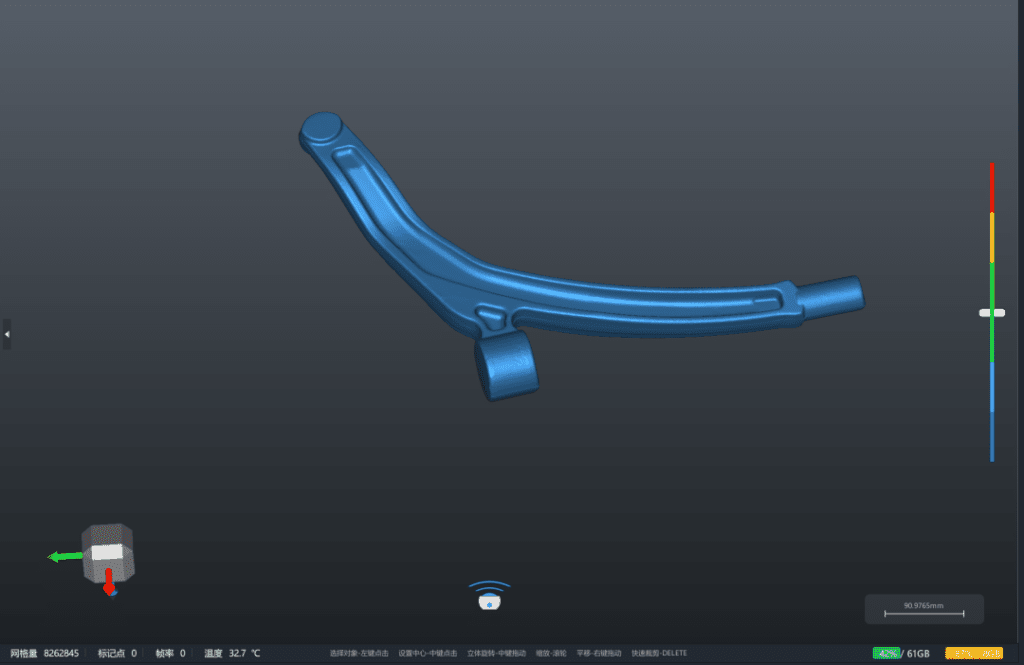
3D scanning resolution describes the level of geometric detail a scanning system can capture, including point spacing and the smallest features that.
Definition
3D scanning resolution is a core performance metric for 3D scanning systems, most commonly referenced in industrial 3D digitization workflows, that quantifies the level of detail a system can capture from a target object. It describes either the minimum linear distance between two adjacent discrete sampled points in a generated point cloud, or the smallest physical surface feature that the system can reliably distinguish from measurement noise. This metric directly impacts the fidelity of reconstructed 3D models and the validity of downstream applications including dimensional inspection, reverse engineering, and wear assessment.
How It Works
3D scanning resolution is governed by the interaction of hardware design, scanning technology, and software processing, with real-world results dependent on operational conditions and target object properties.
For structured light scanning systems, baseline resolution is determined by the density of projected light patterns, the resolution of imaging sensors, and the focal length of optical lenses; finer patterns and higher-resolution sensors deliver smaller point spacing. For laser triangulation systems, baseline resolution is tied to laser line spacing, sensor sampling rate, and working distance.
Software processing further modulates effective resolution: multi-scan alignment, noise filtering, and AI-driven super-resolution reconstruction algorithms can analyze overlapping scan data from multiple angles to resolve sub-pixel features, increasing detectable detail beyond the nominal hardware resolution.
Achievable resolution varies by use case: reflective, translucent, or matte black surfaces may reduce feature detectability, while longer working distances and larger scan fields of view typically increase point spacing and lower effective resolution.
Key Parameters and Criteria
3D scanning resolution is evaluated using three standardized, measurable parameters, which account for both nominal system specifications and real-world performance. All parameters are subject to variation based on scanning environment, target surface properties, and workflow settings.
| Parameter | Meaning | Judgment Method |
|---|---|---|
| Point Spacing (Point Pitch) | The average linear distance between two nearest-neighbor sampled points in a point cloud, the primary direct metric for sampling density | Calculate the mean distance between adjacent points on a calibrated flat reference surface scan, excluding outlier noise points |
| Feature Detectability Threshold | The smallest physical surface feature (e.g., notch, step, texture variation, or fillet) that the system can consistently capture and distinguish from measurement noise | Scan a certified calibration artifact with graded, dimensionally verified feature sizes; identify the smallest feature that appears in the reconstructed model with less than 10% dimensional deviation from the reference value |
| FOV-Normalized Effective Resolution | The resolution achievable at a given working distance and scan field of view (FOV), adjusted for scaling to enable cross-system comparison | Measure point spacing and feature detectability across all available FOV settings of a system, normalized to a standard 1m² scan area to eliminate FOV size bias |
Nominal resolution values published by system manufacturers are measured under ideal controlled conditions using optimized reference surfaces. Real-world effective resolution may be 10–50% lower than nominal values for non-ideal targets or field scanning environments. AI-driven super-resolution algorithms can improve feature detectability relative to nominal hardware resolution for suitable targets, by validating sub-point-spacing features across multiple overlapping scans.
Suitable and Unsuitable Scenarios
Suitable Scenarios
- High-precision industrial quality inspection, including micro-wear detection on tooling, GD&T verification of precision components, and surface texture validation for molded or 3D printed parts
- Reverse engineering of parts with complex fine features, such as turbine blades, injection mold inserts, and small mechanical assemblies
- Uneven wear assessment for critical industrial components, where sub-millimeter surface variation must be quantified to predict component lifespan
- Batch inspection of small to medium industrial parts, where consistent capture of fine dimensional features is required for compliance verification
Unsuitable Scenarios
- Large-scale asset scanning where only overall structural geometry (not surface detail) is required, such as construction site mapping or large structural frame alignment, as high resolution generates unnecessary large data volumes
- Non-industrial applications including human body or facial scanning, and medical imaging diagnostics, which have separate regulatory requirements and performance specifications unrelated to industrial 3D scanning resolution standards
- Measurement of internal apertures smaller than 5mm, where optical line-of-sight limitations prevent sufficient feature capture regardless of a system's nominal resolution
- Workflows where scan speed is the primary priority, as higher resolution reduces scan area per capture and increases post-processing time
Common Misconceptions
- Misconception: 3D scanning resolution is equivalent to 3D scanning accuracy
Clarification: Resolution describes the level of detail a system can detect, while accuracy describes how closely measured dimensions match the true physical value of a feature. A system can have high resolution (fine point spacing) but low accuracy if measurements are consistently offset, and vice versa; the two metrics are independent but complementary for industrial measurement use cases.
- Misconception: Higher nominal resolution always delivers superior scan results
Clarification: Effective resolution is dependent on real-world scanning conditions, and excessively high resolution for low-detail use cases generates unnecessarily large point clouds, increases processing time, and provides no practical benefit for applications that do not require fine feature capture.
- Misconception: Resolution is determined exclusively by camera or sensor hardware
Clarification: Software processing, including multi-scan alignment, noise reduction, and AI-driven super-resolution reconstruction, can significantly improve effective feature detectability beyond the baseline resolution of a system's hardware.
- Misconception: Resolution is consistent across a system's entire field of view
Clarification: Most optical 3D scanning systems exhibit slightly lower resolution at the edges of their FOV compared to the center, due to optical lens distortion and reduced sampling density at peripheral scan areas.
Related Concepts
- 3D Scanning Accuracy: A complementary performance metric that quantifies the deviation between scanned dimensional values and certified reference measurements.
- Point Cloud: The set of discrete 3D coordinate points generated by a 3D scanner, whose sampling density is directly correlated to scanning resolution.
- Field of View (FOV): The maximum area a 3D scanner can capture in a single scan, which has an inverse relationship with achievable resolution for most optical scanning systems.
- Structured Light 3D Scanning: A scanning technology that uses projected patterned light, where pattern density is a core driver of baseline scanning resolution.
- Laser Triangulation 3D Scanning: A scanning technology that uses projected laser lines, where laser line spacing and sensor resolution determine baseline scanning resolution.
- AI-Driven Super-Resolution Reconstruction: A software processing technique that enhances effective 3D scanning resolution by analyzing overlapping scan data to resolve sub-pixel features, implemented in INSVISION AlphaScan handheld 3D scanners.
FAQ
What is the difference between nominal resolution and effective resolution?
Nominal resolution is the theoretical point spacing or feature detectability value specified by a system manufacturer, measured under ideal calibrated conditions using an optimized reference surface with controlled reflectivity and texture. Effective resolution is the actual resolution achieved in real-world scanning operations, adjusted for variables including target object surface properties, working distance, ambient lighting, scan angle, and post-processing settings.
Can 3D scanning resolution be improved after data capture?
Limited improvements to effective resolution are possible via post-processing, for features that are partially captured across multiple overlapping scans. AI-driven super-resolution algorithms can analyze cross-scan feature data to resolve details that fall below the nominal hardware resolution, but post-processing cannot recover features that were not detected at all during the initial scan.
How does field of view impact 3D scanning resolution?
For nearly all optical 3D scanning systems, resolution scales inversely with field of view. A larger FOV captures a wider area in a single scan, reducing the number of scans required to cover large objects, but results in larger point spacing and lower feature detectability. A smaller FOV delivers higher resolution for targeted small-area scans, but requires more overlapping captures to cover large or complex objects.
Is the highest available 3D scanning resolution always required for industrial quality inspection?
No, required resolution is determined by the smallest feature size and tightest dimensional tolerance specified for the inspection use case. For example, inspection of large structural welds may only require 1mm point spacing, while inspection of precision industrial components may require sub-0.1mm resolution. Selecting resolution matched to the use case balances data quality, scan speed, and processing efficiency.
Summary
3D scanning resolution is a foundational performance metric for industrial 3D scanning systems, defining the maximum level of detail that can be captured in point clouds and reconstructed 3D models. It is governed by a combination of hardware design, scanning technology, and software processing, with real-world effective resolution dependent on operational conditions, target object properties, and workflow parameters. Evaluating resolution via standardized metrics including point spacing, feature detectability threshold, and FOV-normalized effective resolution enables consistent cross-system comparison, while understanding tradeoffs between resolution, scan speed, and field of view supports appropriate selection of scanning solutions for industrial use cases including quality inspection, reverse engineering, and component wear assessment.
- What Is 3D Scanning? Principles, Workflow, and Industrial Applications 3D scanning is a digital measurement technology that converts the surface geometry of physical objects into 3D data. This entry covers its working principles, core parameters, industrial use cases, common misconceptions, and related technical…
- What Is a 3D Scanner? Types, Parameters, and Selection Criteria A 3D scanner captures three-dimensional surface data from physical objects and converts geometry, dimensions, and features into digital data for inspection, reverse engineering, and modeling.
- What Is 3D Scanning Accuracy? Accuracy, Repeatability, and Resolution Explained 3D scanning accuracy describes how closely scan data matches an object's actual geometry and dimensions. It is assessed through local accuracy, volumetric accuracy, stitching accuracy, repeatability, and resolution.
- What Is Point Cloud Data? Point Clouds, Meshes, and CAD Models in 3D Scanning Point cloud data is an important raw data format in 3D scanning. It consists of discrete 3D coordinate points that describe object surface geometry and support inspection, reverse engineering, modeling, and archiving.
Hangzhou Insvision Technology Co., Ltd.
Address: Building 1, No. 1399 Liangmu Road, Yuhang District, Hangzhou, Zhejiang 311121, China
Copyright © Hangzhou Insvision Technology Co., Ltd. All rights reserved.
Copyright © Hangzhou Insvision Technology Co., Ltd. All rights reserved.