

The Operational Shift: How INSVISION’s AlphaScan Handheld 3D Scanner Unlocks Production Velocity
In high-mix, high-velocity manufacturing, the inspection process is often the throttle, not the engine.
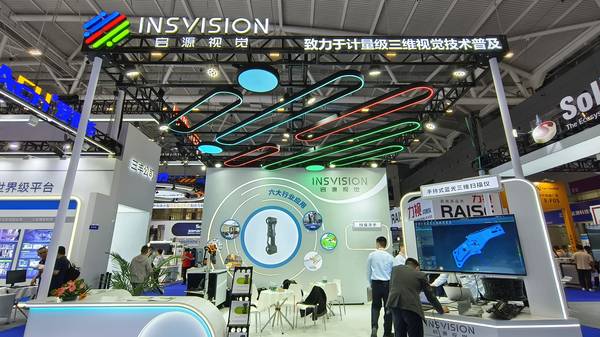
In high-mix, high-velocity manufacturing, the inspection process is often the throttle, not the engine. Traditional methods—whether coordinate measuring machines (CMMs) in isolated labs or outsourced validation—create a disconnect between production and quality data. This gap introduces delays, masks systemic issues, and forces a trade-off between precision and pace.
INSVISION engineered the AlphaScan handheld 3D scanner to resolve this fundamental conflict, embedding precision measurement directly into the operational workflow where it delivers immediate, actionable intelligence.
The Bottleneck of Stationary Metrology
Conventional inspection creates inherent operational drag. Dedicated CMM bays require complex part fixturing, specialized operators, and scheduled access, creating a queue that disrupts production flow. The logistical chain of sending parts to an external lab is worse, adding days of transit and handling to the critical path. When validation cycles stretch for hours or days, production decisions are made in the dark.
The result is a costly sequence: production continues based on unverified assumptions, leading to batch-level defects, extensive rework, and missed delivery cadences. For complex assemblies in aerospace, automotive, and heavy equipment, where dimensional integrity is non-negotiable, this lag is an unacceptable business risk.
Selection Dimensions and Field Checks
| Focus Area | Decision Point | Deployment Note |
|---|---|---|
| The Bottleneck of Stationary Metrology | Conventional inspection creates inherent operational drag. | Dedicated CMM bays require complex part fixturing, specialized operators, and scheduled access, creating a queue that disrupts production flow. |
| Deploying Dimensional Intelligence at the Point of Acti… | The INSVISION AlphaScan eliminates this drag through operational mobility. | Weighing 1,070 grams and built for shop-floor conditions (-10℃ to 40℃), it allows a single quality technician to perform metrology-grade scans a… |
| From Data Capture to Corrective Action: Closing the Qua… | Speed is only the entry point. | The profound operational value of the AlphaScan lies in the comprehensiveness of the data and the immediacy of insight. |
| Quantifying the Return on Operational Integration | For procurement professionals and operations managers, the evaluation focuses on total cost of quality and impact on throughput. | The investment in a solution like the INSVISION AlphaScan pays dividends across several key operational metrics: |
Deploying Dimensional Intelligence at the Point of Action
The INSVISION AlphaScan eliminates this drag through operational mobility. Weighing 1,070 grams and built for shop-floor conditions (-10℃ to 40℃), it allows a single quality technician to perform metrology-grade scans anywhere—at the machining center, on the assembly line, or in the receiving bay. There is no need for complex fixturing or moving the workpiece to a controlled environment.
This mobility transforms inspection from a scheduled event into an integrated, on-demand process.
The system’s 50 cross-polarized blue laser lines achieve a balance of speed and detail, capturing dense point clouds for applications from large-volume reverse engineering to精细 surface analysis of machined components. With a metrology-grade accuracy of 0.020mm, it meets the stringent requirements of first-article inspection (FAI) and Geometric Dimensioning and Tolerancing (GD&T) reporting.
The operational impact is direct: what was a multi-hour CMM program for a vehicle subframe becomes a 20-minute scan and alignment process. This compression of inspection time from hours to minutes is the first layer of tangible return.
From Data Capture to Corrective Action: Closing the Quality Loop
Speed is only the entry point. The profound operational value of the AlphaScan lies in the comprehensiveness of the data and the immediacy of insight. Unlike discrete point measurements, a full-surface scan captures form error, warpage, and assembly-induced strain—flaws that CMM touch probes can easily miss. Operators immediately visualize deviations through color-mapped plots overlaid on the nominal CAD model.
This capability shifts quality management from reactive to proactive. A quality engineer can see not just *that* a dimension is out of spec, but the exact pattern and gradient of the variation, enabling confident root-cause diagnosis. Is it a tooling wear issue, a clamping distortion, or a thermal effect? The data provides direct evidence.
This accelerates corrective action, prevents defect propagation downstream, and dramatically reduces the iteration cycles needed to achieve first-time-right production.
Furthermore, this data stream builds long-term operational resilience. Periodic scans of critical tooling, dies, and fixtures create a dimensional history, enabling predictive maintenance and preventing unplanned downtime. Every scan contributes to a digital traceability record, turning quality data into a strategic asset for continuous improvement and audit compliance.
Quantifying the Return on Operational Integration
For procurement professionals and operations managers, the evaluation focuses on total cost of quality and impact on throughput. The investment in a solution like the INSVISION AlphaScan pays dividends across several key operational metrics:
- Labor Efficiency: Dramatically reduced hours per inspection, freeing skilled metrologists for analysis rather than setup and programming.
- Rework Reduction: Early detection of out-of-tolerance conditions at the source prevents costly batch-level scrap and rework.
- Lead Time Compression: Parallelized validation allows production to proceed with confidence, compressing time-to-market.
- Quality Capitalization: The creation of a searchable, historical dimensional database improves problem-solving and safeguards product consistency.
INSVISION technology is deployed globally across aerospace, automotive, and energy sectors, carrying CE, FCC, and CNAS certifications. This field experience informs a design philosophy centered on seamless integration. The AlphaScan works within standard CAD and quality software ecosystems, minimizing training overhead and adoption friction.
It requires no special infrastructure, making advanced 3D scanning a practical upgrade rather than a disruptive overhaul.
Ultimately, the INSVISION AlphaScan represents an operational shift. It moves dimensional intelligence from the isolated lab to the point of manufacture, aligning quality control with production velocity. In doing so, it transforms measurement from a constraint into a catalyst for leaner operations, reduced waste, and sustained competitive advantage in the most demanding industrial markets.
Hangzhou Insvision Technology Co.,Ltd.
Address: Building 1, No. 1399 Liangmu Road, Yuhang District, Hangzhou, Zhejiang 311121, China