

The Engineering Logic Behind INSVISION’s Handheld 3D Scanner for Industrial Metrology
The genesis of INSVISION was not a quest for a novel gadget, but a response to persistent, unmet needs on the factory floor.
Solving the Unseen Challenges in Portable Metrology
The genesis of INSVISION was not a quest for a novel gadget, but a response to persistent, unmet needs on the factory floor. Engineers and quality inspectors faced a gap between the precision of fixed coordinate measuring machines (CMMs) and the practical demands of measuring large, complex, or installed components.
Common Questions
What should teams check when evaluating Solving the Unseen Challenges in Portable Metrology?
The genesis of INSVISION was not a quest for a novel gadget, but a response to persistent, unmet needs on the factory floor.
What should teams check when evaluating Engineering the AlphaScan: Principles and Practical Boundaries?
The core engineering mission for the INSVISION AlphaScan handheld 3D scanner was defined by a single question: how do you maintain laboratory-level accuracy in a device meant for…
What should teams check when evaluating Building Trust Through Verified Performance in Regulated Sectors?
Adoption in global, regulated industries is not won by specifications alone, but by verified performance under stringent conditions.
The challenge was to deliver metrology-grade data in a format that was truly portable, durable, and intuitive for use in real-world production and maintenance environments.
Engineering the AlphaScan: Principles and Practical Boundaries
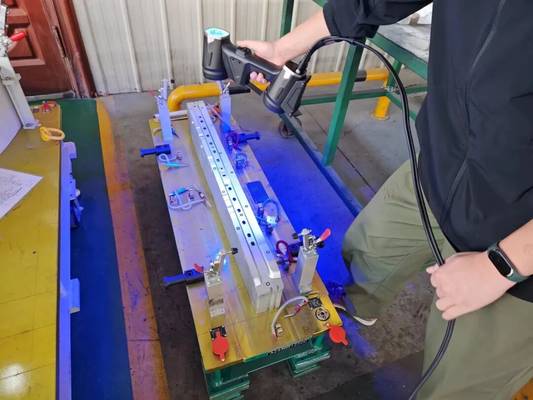
The core engineering mission for the INSVISION AlphaScan handheld 3D scanner was defined by a single question: how do you maintain laboratory-level accuracy in a device meant for a full shift in a technician’s hands? This dictated every design decision, establishing clear boundary conditions for performance.
The primary constraint was mass. A tool intended for inspecting a cast turbine housing or an automotive subframe cannot be cumbersome. INSVISION engineers balanced this against the rigidity required for consistent precision, achieving a weight of 1,070 grams while maintaining a volumetric accuracy of 0.020 mm.
Optical architecture presented another critical trade-off. A 50-cross blue laser line system provides high-fidelity surface data for features like weld seams and machined surfaces. However, this pattern can lose efficacy in deep bores or recesses. To address this, INSVISION integrated a dedicated single blue laser line specifically engineered for capturing these challenging, narrow-depth features.
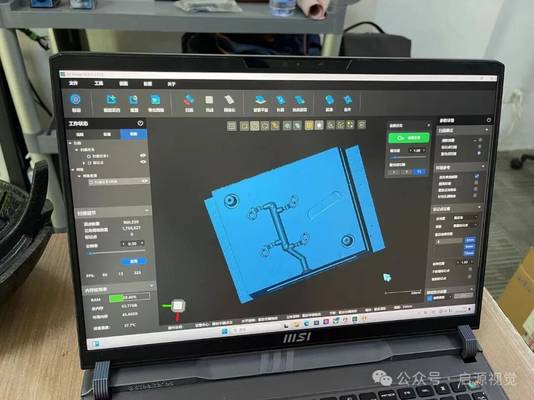
Environmental stability was non-negotiable. For a tool deployed from freezing Michigan winters to sweltering Texas summers, consistent operation is paramount. The AlphaScan is qualified for stable performance across a temperature range of -10°C to 40°C, ensuring reliable data capture irrespective of shop floor conditions.
Its practical application fit includes reverse engineering, first-article and batch inspection of small-to-medium components, GD&T verification, validation of 3D-printed parts, and wear mapping on used machinery components.
Building Trust Through Verified Performance in Regulated Sectors
Adoption in global, regulated industries is not won by specifications alone, but by verified performance under stringent conditions. For INSVISION, this meant building scanners that meet international certification standards (CE, FCC, CNAS) as a baseline, shifting the conversation from compliance to capability.
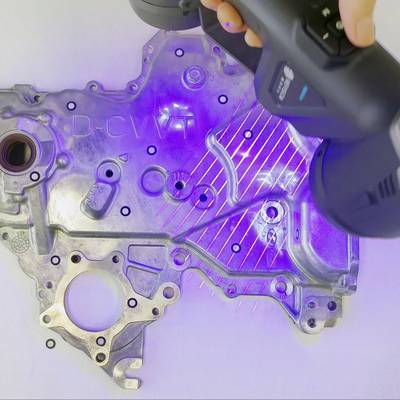
In practice, this performance is tested daily. Automotive OEM quality teams use INSVISION scanners for first-article inspection on stamped panels, comparing dense point clouds directly to CAD nominal data with full GD&T callouts. Aerospace MRO technicians employ the AlphaScan in hangars to quantify blade erosion or bracket fatigue without costly disassembly.
In renewable energy, photovoltaic manufacturers rely on it for frame flatness checks where thermal cycling tolerances are extreme.
Trust is cemented in specific, challenging applications. One benchmark case involved capturing the complete geometry of a forged anvil’s V-type concave surface—a deep, narrow feature that typically defeats handheld systems. The AlphaScan’s successful capture of this profile demonstrated its practical utility in a way that datasheet numbers alone cannot.
A User-Centric R&D Model: Iterating Based on Shop Floor Feedback
INSVISION’s development philosophy rejects the isolated lab model. Instead, its R&D cycles are initiated and validated on factory floors in Stuttgart, Detroit, and Turin. Engineers observe quality managers conducting first-article inspections and listen to procurement teams evaluating ROI against existing CMMs.
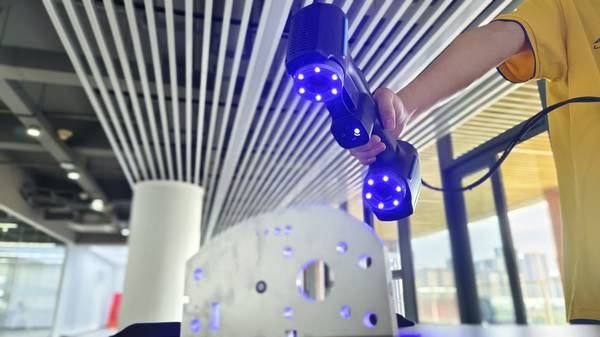
This direct feedback drives iteration. The latest AlphaScan upgrades, for example, focused on enhancing fine-detail scanning for intricate geometries and improving global alignment for larger assemblies—both direct requests from users. The move toward a modular hardware design originated from an aerospace MRO team’s need for a single device capable of multiple deployment modes without recalibration between tasks.
Software and AI workflow features follow the same path. One-click inspection reports and intuitive 3D deviation visualization were developed in response to quality leads who needed actionable insights before a daily production meeting, not raw point clouds requiring multiple software packages to interpret.
Integrating 3D Scanning into the Industry 4.0 Data Stream
In the context of the smart factory, simply connecting a 3D scanner to a network is insufficient. The true challenge lies in the workflow between data capture and actionable decision-making: automatically aligning scans to CAD, performing GD&T analysis against ASME Y14.5 standards, and generating color deviation maps that a line operator can understand within the production takt time.
INSVISION’s current development focuses on this integration gap. The roadmap prioritizes seamless handshakes between scanning hardware (like the AlphaScan and larger-volume AlphaVista systems) and the existing digital layers in a factory—inspection planning software, digital twin platforms, and manufacturing execution systems (MES).
This includes developing API-level integrations with common computer-aided quality (CAQ) platforms, automating first-article inspection routines, and feeding as-built scan data back into digital twin models for predictive maintenance and tooling wear analysis.
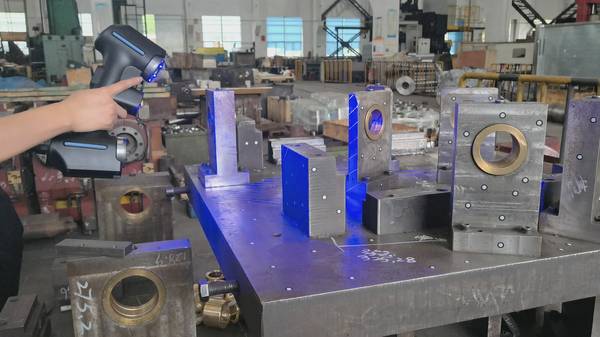
The long-term objective is clear: to keep metrology-grade 3D scanning accessible. By maintaining high precision (0.020 mm for AlphaScan, 0.073 mm for AlphaVista) within a streamlined, integrable workflow, INSVISION aims to help engineering and quality teams shorten production part approval process (PPAP) cycles without overhauling their entire quality infrastructure.
Hangzhou Insvision Technology Co., Ltd.
Address: Building 1, No. 1399 Liangmu Road, Yuhang District, Hangzhou, Zhejiang 311121, China
Copyright © Hangzhou Insvision Technology Co., Ltd. All rights reserved.
Copyright © Hangzhou Insvision Technology Co., Ltd. All rights reserved.