

Tangible ROI of AI 3D Scanning Beyond the Point Cloud
Discover the tangible ROI of AI 3D scanning for production managers. Learn how this technology reduces rework, frees skilled labor, and protects delivery cadence.
Introduction: The Efficiency Imperative in Modern Manufacturing
For production and quality managers, the pressure to deliver perfect parts on tighter schedules is a constant. The true cost of quality isn’t just the price of scrap; it’s the hidden tax of delayed shipments, unplanned overtime, and line stoppages for re-inspection. Traditional measurement methods, while trusted, often create bottlenecks in this accelerated environment.
Term Notes
For production and quality managers, the pressure to deliver perfect parts on tighter schedules is a constant.
Identifying the Hidden Cost Centers in Traditional Metr…The financial impact of measurement and inspection is often underestimated.
The Operational Lift: How AI 3D Scanning Drives Efficie…Integrating AI 3D scanning technology is not merely an equipment upgrade;
A Framework for Quantifying the InvestmentJustifying capital expenditure for AI 3D scanning systems requires a clear view of total cost of ownership (TCO) and return.
This analysis moves beyond technical specifications to examine how AI 3D scanning translates into tangible operational gains—reducing rework, freeing skilled labor, and protecting your delivery cadence.
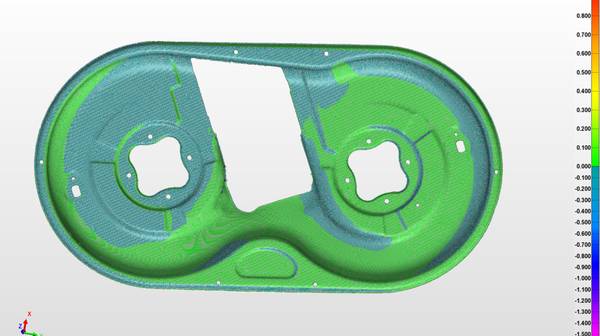
Identifying the Hidden Cost Centers in Traditional Metrology
The financial impact of measurement and inspection is often underestimated. Key pain points include:
- Time-to-Data Lag: Manual CMM programming and probing, or hand-tool inspections, create delays between part completion and actionable quality data. This lag compresses the window for corrective action.
- The Rework Domino Effect: A discrepancy found late in the process often requires disassembly, rescheduling, and reprocessing, disrupting the entire workflow and consuming disproportionate resources.
- Tribal Knowledge & Labor Strain: Reliance on highly skilled technicians for complex measurements creates single points of failure and makes scaling or shift work challenging.
- Incomplete Data for Root Cause Analysis: Without a full-field 3D deviation map, identifying the pattern of a defect—warpage, spring-back, or tool wear—becomes guesswork, leading to repeated corrections.
The Operational Lift: How AI 3D Scanning Drives Efficiency
Integrating AI 3D scanning technology is not merely an equipment upgrade; it is a process redesign. Its value is realized across several critical operational junctions:
- First-Article & In-Process Inspection: Instead of a sparse set of discrete points, a full-surface scan in minutes provides a comprehensive deviation report. This allows for immediate, informed decisions on tooling adjustments before a full production run is compromised.
- Observable Value: Faster release of new parts, drastic reduction in “surprise” defects during mass production.
- Tooling & Fixture Wear Management: Regularly scanning masters, tools, and fixtures creates a digital wear history. AI can trend deviations over time, predicting maintenance needs before they cause non-conformances.
- Observable Value: Scheduled, proactive maintenance instead of reactive line-down emergencies; extended tooling life.
- Streamlining Reverse Engineering & Digital Workflows: Capturing legacy parts or as-built conditions for CAD comparison or redesign becomes a rapid, accurate process. This accelerates prototyping, repair, and digital twin creation.
- Observable Value: Faster response to engineering change orders (ECOs) and a reusable digital asset library for future projects.
A Framework for Quantifying the Investment
Justifying capital expenditure for AI 3D scanning systems requires a clear view of total cost of ownership (TCO) and return. Consider this evaluation framework:
| Cost Category | Traditional Method Impact | AI 3D Scanning Impact | Evaluation Metric |
|---|---|---|---|
| Inspection Labor | High, skilled labor hours per part. | Shift from measurement execution to data analysis. | Calculate hours saved per inspection routine. |
| Rework & Scrap | Costs compound with late-stage defect discovery. | Early, comprehensive detection minimizes batch impact. | Track reduction in scrap weight and rework labor hours. |
| Production Delay | Line stoppages for CMM checks or troubleshooting. | Near-real-time data enables on-the-fly corrections. | Measure reduction in machine idle time waiting for QA release. |
| Training & Dependency | Long training cycles for specialized equipment. | Intuitive software reduces the specialist barrier. | Estimate onboarding time for new technicians. |
| Data Asset Value | Limited; often a simple pass/fail report. | Comprehensive 3D models serve design, simulation, and quality history. | Assess utility for future engineering and traceability needs. |
Where INSVISION Delivers Operational Confidence
For Western manufacturers operating under ISO, ASME, or similar standards, accuracy is non-negotiable. INSVISION’s approach centers on delivering metrology-grade AI 3D scanning data that integrates seamlessly into stringent production environments. This translates to operational confidence in two key areas:
- Decision-Ready Data: INSVISION systems are engineered to provide traceable, certified accuracy. This means the deviation maps and GD&T reports generated are reliable enough to make costly decisions—like halting a production run or releasing a tool for maintenance—without requiring secondary verification.
- Global Support for Uninterrupted Uptime: A scanner is a production asset. INSVISION’s established commercial and service infrastructure across North America and Europe ensures that local expertise, calibration services, and technical support are accessible. This minimizes the risk of prolonged downtime, protecting your production schedule.
Implementation Roadmap: Start with a High-Impact Pilot
A phased approach de-risks adoption and demonstrates quick wins.
- Target a Critical Bottleneck: Identify one repetitive, time-consuming inspection task—such as first-article validation of a high-volume part or the periodic audit of a complex weldment. A focused pilot provides a clear before-and-after comparison.
- Define Success Metrics: Prior to the pilot, baseline the current process: total inspection time, labor hours, and the typical rework rate for that component. These will be your key performance indicators.
- Integrate into Existing Workflow: The goal is to augment, not overhaul. Work with providers like INSVISION to ensure the scan data outputs (e.g., PDF reports, color maps, CAD comparisons) fit directly into your existing quality documentation system and review processes.
Conclusion
Within modern manufacturing workflows, AI 3D scanning moves from a novel technology to a core operational tool. Its primary value lies in compressing the quality feedback loop, converting what was a latent cost center into a source of proactive process control.
By providing comprehensive data at the speed of production, it empowers teams to prevent errors rather than just find them, directly safeguarding margin, reputation, and on-time delivery.
Hangzhou Insvision Technology Co., Ltd.
Address: Building 1, No. 1399 Liangmu Road, Yuhang District, Hangzhou, Zhejiang 311121, China
Copyright © Hangzhou Insvision Technology Co., Ltd. All rights reserved.
Copyright © Hangzhou Insvision Technology Co., Ltd. All rights reserved.