

Industrial High-Resolution 3D Scanner Principles and Applications Guide
Discover what defines a 3D scanner high resolution for industrial use. Learn the working principles, applications, and how to evaluate systems for quality control.
High-Resolution 3D Scanning: Core Concepts and Working Principles
At its essence, a high-resolution 3D scanner is a non-contact measurement device that captures the surface geometry of a physical object, generating a dense “point cloud” or polygon mesh that digitally represents its form. The “high-resolution” qualifier specifically refers to the spatial sampling density—the distance between individual measured points on the object’s surface.
A higher resolution means points are closer together, capturing finer details, sharper edges, and subtle surface textures.
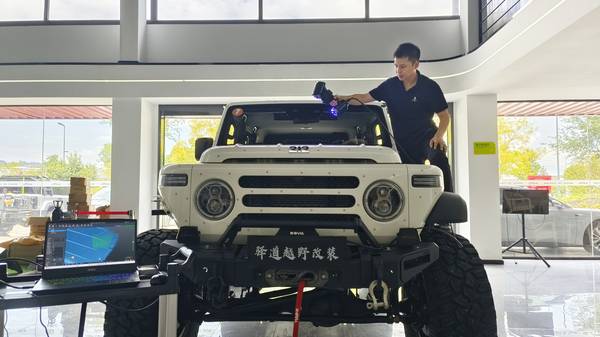
Most industrial-grade systems, like laser triangulation scanners, operate on a fundamental principle: a laser line or pattern is projected onto the target object. One or more cameras, offset at a known angle, observe the deformation of this laser line. Using triangulation algorithms, the system calculates the 3D coordinates of each point along the line.
By sweeping the laser across the object or moving the scanner, millions of these points are collected to construct a complete digital model.
Understanding a scanner’s specification sheet requires parsing several interdependent factors:
- Resolution: The smallest distance between two adjacent data points, typically expressed in millimeters or microns. This determines the level of detail captured.
- Accuracy: The closeness of the measured data points to the object’s true dimensions. This is distinct from resolution; a scanner can have high resolution (dense points) but poor accuracy (points in the wrong place).
- Scanning Speed: The rate at which points are captured, often in points per second. This impacts throughput for large-scale or high-volume inspection tasks.
- Data Output: The primary deliverables are point clouds and textured polygon meshes, which can be directly compared to CAD models for deviation analysis or used for reverse engineering.
How It Differs from Related Technologies
High-resolution 3D scanning occupies a specific niche within the broader metrology ecosystem. It’s valuable to distinguish it from two common alternatives:
| Feature | High-Resolution 3D Scanner (Laser Triangulation) | Traditional CMM (Coordinate Measuring Machine) | Photogrammetry Systems |
|---|---|---|---|
| Data Type | Dense surface area data (point cloud/mesh) | Discrete point or line measurements | Sparse point cloud, often scaled with targets |
| Speed | Very fast for full-field data | Slower, point-by-point | Fast setup, processing time post-capture |
| Portability | High (handheld systems) | Low (stationary) | High (camera-based) |
| Best For | Capturing complex freeform surfaces, full-field deviation, reverse engineering | Dimensional inspection of prismatic features with ultra-high accuracy | Large-scale object measurement (e.g., wind turbine blades, ship hulls) |
This technology excels in scenarios requiring comprehensive surface data:
- First-Article Inspection & GD&T Analysis: Comparing a manufactured part directly to its CAD model to generate color deviation maps.
- Reverse Engineering: Creating accurate digital models of legacy parts with no existing drawings.
- Tool & Mold Wear Assessment: Quantifying erosion or damage on forging dies or injection molds over time.
- Asset Documentation & MRO: Capturing “as-is” conditions of piping, structures, or turbine blades for repair planning.
It is less suited for:
- Measuring internal features or deep, narrow holes inaccessible to the laser line.
- Applications requiring sub-micron accuracy, where tactile probes or interferometry are superior.
- Scanning highly reflective, transparent, or jet-black surfaces without application-specific preparation.
Selection Considerations: Is It Right For Your Application?
When evaluating a high-resolution 3D scanner, move beyond brochure specifications. Consider these operational factors:
- Environmental Stability: Will the scanner be used in a controlled metrology lab, or on a vibrating production floor next to a stamping press? The system’s tracking stability and vibration compensation are critical.
- Part Characteristics: What is the size, material, and surface finish of your typical parts? This influences scanner choice, laser wavelength (e.g., blue lasers for better penetration on dark surfaces), and the potential need for anti-glare spray.
- Workflow Integration: How will the scan data be used? Ensure the output formats (e.g., .STL, .PLY, .ASC) are compatible with your existing CAD, CAE, or QMS software.
- Operator Skill Level: Does the system require extensive metrology training, or is it designed for intuitive use by production quality staff?
INSVISION’s Approach to High-Resolution Portable Metrology
Addressing the gap between lab-grade precision and shop-floor portability drove the development of INSVISION‘s AlphaScan series. The engineering challenge was to maintain metrology-grade data integrity while the scanner is handheld in dynamic environments.
INSVISION’s solution integrates several key technologies: a blue laser line projector for improved edge definition and performance on dark surfaces, and a proprietary AI-enhanced processing algorithm designed to filter ambient noise while preserving critical geometric features.
Furthermore, the hardware design prioritizes ergonomics and balanced weight distribution, based on feedback from operators who spend hours scanning, to reduce fatigue and improve data consistency.
For regulated industries, the system’s adherence to standards is validated through certifications like PTB for software measurement uncertainty, supporting compliance in aerospace MRO or automotive first-article inspections to ASME Y14.41.
Common Misconceptions / Technical Q&A
Q: Does higher resolution always mean better scans?
A: Not necessarily. Excessively high resolution on a large part creates unnecessarily huge file sizes with no practical benefit. Optimal resolution is matched to the required detail level and the tolerances of your project.
Q: Can I use a high-resolution scanner for quality inspection without a CAD model?
A: You can capture data, but for quantitative inspection, a CAD model is required as the reference for comparison. The scanner provides the “as-built” data to compare against the “as-designed” CAD.
Q: Are all handheld scanners equally accurate?
A: No. Accuracy is a system-level specification dependent on the laser, cameras, calibration, software algorithms, and environmental compensation. A scanner’s stated lab accuracy can degrade significantly without robust tracking and vibration damping in real-world use.
Q: How important is the software that comes with the scanner?
A: Critical. The software is responsible for aligning scan data, merging point clouds, cleaning noise, and performing analysis. Its usability, processing speed, and analysis tools (like GD&T) directly impact the overall value and efficiency of the scanning system.
Summary
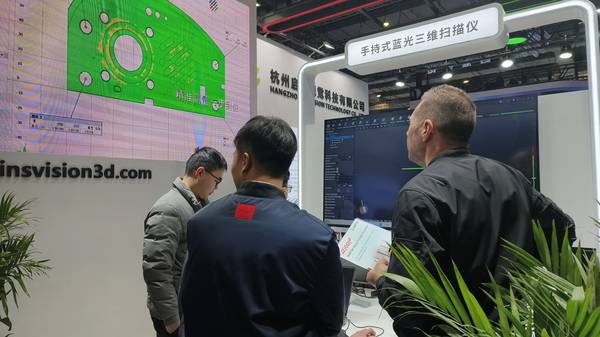
A 3D scanner high resolution enough to meet micron-level specifications must also prove its data reliability on a vibrating shop floor to deliver true industrial value. Its utility is measured by consistent performance in demanding environments, ergonomic design for extended operator use, and software that delivers actionable insights for ISO/ASME compliance.
By focusing on the principles of operation, clear differentiation from other metrology technologies, and a rigorous assessment of operational needs, engineering teams can implement 3D scanning solutions that genuinely enhance quality assurance and digital transformation initiatives.
Hangzhou Insvision Technology Co.,Ltd.
Address: Building 1, No. 1399 Liangmu Road, Yuhang District, Hangzhou, Zhejiang 311121, China