

Beyond the Blueprint: The Operational Value of Handheld 3D Scanning in Modern Manufacturing
In precision manufacturing, the gap between design intent and physical part is where profit margins erode.
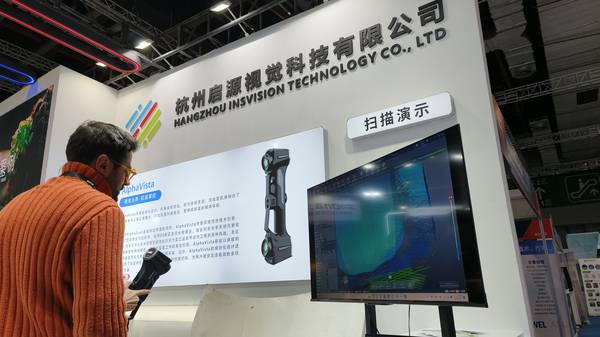
In precision manufacturing, the gap between design intent and physical part is where profit margins erode. Traditional inspection methods, reliant on fixtures, manual touch-points, and specialized training, often create bottlenecks that compromise delivery schedules and inflate labor costs. The strategic question is no longer whether to adopt advanced measurement, but how to implement it without disrupting proven workflows.
INSVISION developed the AlphaScan handheld 3D scanner to bridge this gap. It is engineered for industrial environments where the need for speed, precision, and traceability collides with the realities of complex geometries, legacy parts, and high-mix production.
The Measurement Bottleneck in Industrial Workflows
Conventional quality control processes struggle with scale and complexity. Validating a medium to large component can require dedicated fixtures, numerous manual measurements, and significant data compilation time. This turns quality teams into data loggers, diverting skilled personnel from root-cause analysis and process improvement.
The challenge amplifies during reverse engineering or first-article inspection, where comparing an as-built part to its CAD model for deviation analysis becomes a time-intensive puzzle.
Selection Dimensions and Field Checks
| Focus Area | Decision Point | Deployment Note |
|---|---|---|
| The Measurement Bottleneck in Industrial Workflows | Conventional quality control processes struggle with scale and complexity. | Validating a medium to large component can require dedicated fixtures, numerous manual measurements, and significant data compilation time. |
| Streamlining Operations with Integrated 3D Scanning | The INSVISION AlphaScan fundamentally reconfigures the inspection timeline. | It captures comprehensive geometry data over large areas (up to 650mm x 550mm per scan) in a fraction of the time required by traditional method… |
| Quantifying Quality: Traceability and Labor Optimization | Consistent quality requires consistent measurement. | The AlphaScan’s standardized scanning protocol minimizes the variability introduced by individual operator technique, ensuring that a part inspe… |
| The Strategic Return: Building Long-Term Cost Efficiency | Investing in a metrology-grade 3D scanning device like the INSVISION AlphaScan is an investment in scalable operational resilience. | The dividends are realized across multiple fronts: |
The operational cost isn’t just in hours spent; it’s in delayed decisions, inconsistent data across shifts, and the high cost of late-stage defect discovery. INSVISION designed the AlphaScan to integrate directly into these workflows, providing a single tool for capture, analysis, and reporting that operators can deploy with minimal retraining.
Streamlining Operations with Integrated 3D Scanning
The INSVISION AlphaScan fundamentally reconfigures the inspection timeline. It captures comprehensive geometry data over large areas (up to 650mm x 550mm per scan) in a fraction of the time required by traditional methods. This reduces the repetitive cycle of part repositioning and probe realignment.
The true efficiency gain lies in integration. From scan to report, the workflow is contained. Operators capture a dense point cloud, and the PTB-certified software immediately processes it for comparison against the reference CAD model, generating an intuitive color-map deviation analysis.
This direct path from physical object to actionable insight allows for immediate decisions on part acceptance, rework, or process adjustment.
For reverse engineering, this capability is transformative. Teams can digitize legacy components or tooling for which original drawings are lost or never existed, creating ready-to-use CAD models. This accelerates refurbishment projects and process improvements, reducing dependency on external drafting specialists and shortening the timeline from scan to manufacturable file.
Quantifying Quality: Traceability and Labor Optimization
Consistent quality requires consistent measurement. The AlphaScan’s standardized scanning protocol minimizes the variability introduced by individual operator technique, ensuring that a part inspected on the first shift is measured identically on the third. This supports robust quality traceability, with digital reports providing auditable evidence for internal standards and customer compliance.
In high-mix, low-volume environments, flexibility is key. The system’s adaptive scanning eliminates the need for custom fixtures or unique measurement routines for every part number. Inspectors can quickly reconfigure digital parameters, maintaining comprehensive inspection coverage without a linear increase in labor hours as product variety expands.
Integrated GD&T (Geometric Dimensioning and Tolerancing) tools further compress the analysis phase. Inspectors can perform full dimensional assessments aligned with ASME/ISO standards directly within the platform, bypassing manual calculations or disruptive data exports to external software.
The Strategic Return: Building Long-Term Cost Efficiency
Investing in a metrology-grade 3D scanning device like the INSVISION AlphaScan is an investment in scalable operational resilience. The dividends are realized across multiple fronts:
- Rework Reduction: Early detection of out-of-tolerance conditions allows for corrective action when it is least expensive—often at the workstation where the issue originated, not at final assembly or after shipment.
- Labor Optimization: Guided workflows and AI-assisted algorithms lower the expertise barrier, enabling newer team members to produce reliable data quickly. This allows organizations to deploy inspection capabilities more broadly without protracted training programs.
- Delivery Cadence: By removing measurement bottlenecks, production flow improves. Faster inspection cycles mean parts move to the next stage without delay, protecting on-time delivery schedules.
- Continuous Improvement: The historical dataset of scan results provides concrete evidence of process capability and variation trends, fueling data-driven initiatives to enhance manufacturing precision over time.
For engineers, quality managers, and procurement professionals evaluating measurement technology, the INSVISION AlphaScan represents a pragmatic step forward. It delivers immediate workflow efficiency while building a foundation of data integrity that supports lean manufacturing principles and Industry 4.0 objectives, translating directly into long-term operational value and cost efficiency.
Hangzhou Insvision Technology Co.,Ltd.
Address: Building 1, No. 1399 Liangmu Road, Yuhang District, Hangzhou, Zhejiang 311121, China