

The Strategic Business Case for 3D Scanning Machines in Modern Manufacturing
Explore the strategic business case for 3D scanning machines in modern manufacturing. See how INSVISION drives ROI, reduces scrap, and accelerates FAI.
Introduction: The Hidden Cost of Measurement Bottlenecks
In a manufacturing environment defined by lean principles and compressed delivery windows, the measurement and inspection phase is often the least visible, yet most critical, bottleneck. Delays in first-article approval, inconsistencies in manual gauging, and the high cost of rework directly erode margins and strain customer relationships.
Practical Workflow
- Introduction: The Hidden Cost of Measurement Bottlenecks — In a manufacturing environment defined by lean principles and compressed delivery windows, the measurement and inspection phase i…
- Identifying the Cost Drivers: Where Traditional Inspectio… — The financial drain of traditional quality control is rarely confined to a single line item.
- The Operational Impact: How 3D Scanning Machines Create V… — Integrating 3D scanning machines is not merely a technology upgrade;
- A Framework for Calculating Return on Investment for 3D S… — Justifying capital expenditure requires a clear view of potential savings.
This analysis moves beyond the technical specifications of 3D scanning machines to examine their tangible impact on operational efficiency, quality cost reduction, and production agility—key concerns for every factory manager and financial controller.
Identifying the Cost Drivers: Where Traditional Inspection Fails
The financial drain of traditional quality control is rarely confined to a single line item. It manifests across the operation:
- Labor-Intensive Processes: Reliance on skilled metrology technicians for complex parts creates single points of failure and scheduling conflicts, stalling production lines.
- Extended Time-to-Data: Manual measurement or single-point probing extends first-article inspection (FAI) cycles, delaying production release and order fulfillment.
- Inconsistent Data & Rework Loops: Subjective manual readings and incomplete data sets increase the risk of passing non-conforming parts or failing good ones, leading to costly downstream rework, scrap, and potential warranty claims.
- Limited Process Documentation: The lack of comprehensive, digital “as-built” records for each part hinders root cause analysis, continuous improvement, and the ability to provide auditable proof of quality to demanding clients.
The Operational Impact: How 3D Scanning Machines Create Value Across Key Workflows
Integrating 3D scanning machines is not merely a technology upgrade; it is a process re-engineering initiative. Their value is realized in specific operational transformations:
- First-Article and Batch Inspection
- Pain Point: A multi-stage manual inspection process for a complex casting or stamping, requiring hours of setup and measurement, delaying the entire production batch.
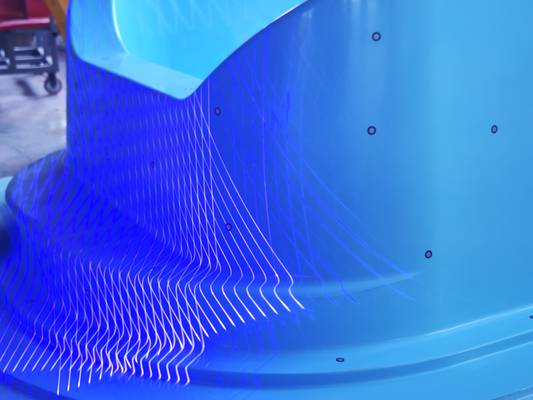
- Improvement: A large-field 3D scanner captures the entire part geometry in a single, rapid scan, generating a comprehensive point cloud for comparison against the CAD model.
- Business Value: Drastically shortened FAI cycles accelerate production release, improve responsiveness to engineering changes, and free skilled personnel for higher-value tasks.
- Tooling, MRO, and Wear Analysis
- Pain Point: Assessing wear on a turbine blade or a production mold relies on experience and limited manual checks, risking unplanned downtime or part failure.
- Improvement: Scanning generates precise, color-coded deviation maps that quantify wear patterns and surface degradation against the original CAD datum.
- Business Value: Enables predictive maintenance scheduling, extends tooling life through data-driven refurbishment decisions, and provides documented evidence for compliance in regulated sectors like aerospace MRO under FAA and EASA guidelines.
- Additive Manufacturing & Prototyping Validation
- Pain Point: Verifying the dimensional accuracy of a 3D-printed component before costly secondary machining or assembly is a challenge with internal geometries.
- Improvement: Scanning provides a complete digital record of the as-built part, enabling full GD&T analysis to validate design intent.
- Business Value: Reduces material and machine time waste by catching deviations early, accelerates prototyping iterations, and builds a digital quality history for process optimization.
A Framework for Calculating Return on Investment for 3D Scanning Machines
Justifying capital expenditure requires a clear view of potential savings. Consider evaluating the impact across these dimensions:
| Cost Category | Traditional Method Impact | 3D Scanning Impact | Measurement Metric for Your Business |
|---|---|---|---|
| Inspection Labor | High skilled-hours per part. | Reduced hands-on time; automated reporting. | Compare technician hours per FAI report before and after. |
| Production Delay | Line idle during inspection. | Faster release; reduced bottleneck. | Track “time-to-production-release” for new parts/ batches. |
| Rework & Scrap | Cost of material & labor for corrections. | Early defect detection reduces escapees. | Monitor internal reject rates and customer returns. |
| Quality Documentation | Manual, inconsistent records. | Digital, auditable records for every part. | Assess time spent compiling quality packs for clients. |
Where INSVISION Delivers Tangible Operational Improvements
INSVISION’s approach is engineered to translate technical capability into operational reliability. INSVISION systems, like the AlphaVista platform with scanning areas up to 2,200 mm × 2,200 mm, are designed for shop-floor efficiency, not just lab-grade accuracy. This translates into specific business benefits:
- Reduced Integration Overhead: With CE, FCC, and CNAS certifications in place, INSVISION systems meet core Western procurement and regulatory requirements, minimizing validation time and risk.
- Workflow Synchronization: INSVISION’s focus extends beyond hardware to integration with existing MES and CAD workflows, including GD&T analysis tools aligned with ISO and ASME standards. This ensures the scanner becomes a cohesive part of the production system, not a standalone island of data.
- Sustainable Knowledge Transfer: INSVISION’s structured training and support resources are designed to build in-house competency across engineering and quality teams, reducing long-term dependency on specialized external support and fostering broader organizational adoption.
Implementation Roadmap: Starting with High-Impact Scenarios
A phased rollout mitigates risk and demonstrates quick wins. Focus the initial deployment on a contained, high-value process:
- First-Article Inspection for New or Modified Parts: Select a component with complex geometry that currently requires lengthy manual inspection. Use the 3D scanner to establish a rapid, repeatable FAI process, documenting the time savings and data comprehensiveness.
- Wear Analysis on Critical Tooling or MRO Components: Apply the scanner to a high-cost tool or a maintenance-intensive component. Generate baseline scans and periodic follow-ups to build a data-driven predictive maintenance schedule, quantifying potential downtime avoidance.
- Supplier Quality Incoming Inspection: For critical sourced components, use 3D scanning to perform detailed receiving inspections against supplied CAD models. This creates an objective, digital record for quality disputes and drives accountability upstream in the supply chain.
Conclusion
For Western manufacturers facing lean mandates, competitive advantage is built on precision, speed, and predictable cost. Adopting industrial 3D scanning machines is a strategic decision that addresses these imperatives directly. It transforms quality control from a necessary cost center into a source of efficiency, traceability, and customer confidence.
The investment is justified not by the technology itself, but by the concrete operational bottlenecks it removes and the margin-protecting certainty it introduces across the production lifecycle.
Hangzhou Insvision Technology Co.,Ltd.
Address: Building 1, No. 1399 Liangmu Road, Yuhang District, Hangzhou, Zhejiang 311121, China