

Metrology-Grade 3D Imager Solutions for Real-World Shop Floors
Discover how a metrology-grade 3D imager like the INSVISION AlphaScan overcomes real-world shop floor challenges like vibration, light, and dust for reliable quality control.
Introduction: The Gap Between Lab Promise and Factory Reality
In precision manufacturing, the promise of a portable 3D imager is clear: rapid, comprehensive digital capture of complex parts for quality control, reverse engineering, and tooling verification. Yet, for engineers and quality managers on the factory floor, the reality often falls short.
Practical Workflow
- Introduction: The Gap Between Lab Promise and Factory Rea… — In precision manufacturing, the promise of a portable 3D imager is clear: rapid, comprehensive digital capture of complex parts f…
- Typical 3D Imager Workflow and Core Challenges — Consider the final inspection of a large, composite aerospace duct or a cast automotive transmission housing.
- Design Philosophy: Engineering for Environmental Immunity — The design imperative shifts from maximizing lab performance to ensuring consistent performance *despite* the environment.
- Implementation: A Process Built for Consistency — A reliable shop-floor scanning process is methodical and repeatable.
Traditional handheld 3D imagers, engineered for controlled environments, falter under the variable lighting, airborne particulates, and ambient vibration of active production areas. This gap between lab-grade specifications and shop-floor reliability creates bottlenecks, forcing a choice between slow, contact-based CMMs or incomplete, unreliable scan data.
This article examines how a new generation of 3D imager technology is engineered to close this gap, focusing on a solution for high-mix, high-value component verification.
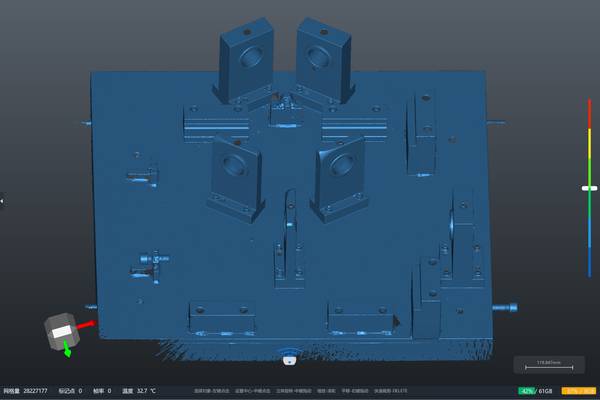
Typical 3D Imager Workflow and Core Challenges
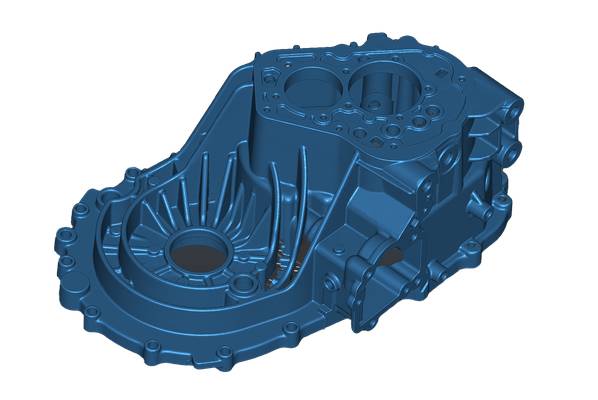
Consider the final inspection of a large, composite aerospace duct or a cast automotive transmission housing. The part is mounted on a workstand in a quality bay adjacent to active machining centers. The environment is characterized by:
- Variable Ambient Light: Overhead bay lighting and sunlight from high windows create glare and shadows.
- Particulate Interference: Airborne coolant mist or dust can scatter projected light patterns.
- Environmental Vibration: Low-frequency vibration from nearby machinery can blur successive image captures.
- Operational Pace: The need to capture full coverage, including deep pockets and undercuts, demands a system tolerant of natural operator movement.
Under these conditions, conventional structured-light systems struggle. Point clouds become noisy or incomplete, requiring multiple re-scans. Thermal drift can introduce micron-level errors over a session, compromising the integrity of a first-article inspection report aligned with ISO/ASME standards. The result is extended cycle times, operator frustration, and lingering doubt about data fidelity.
Design Philosophy: Engineering for Environmental Immunity
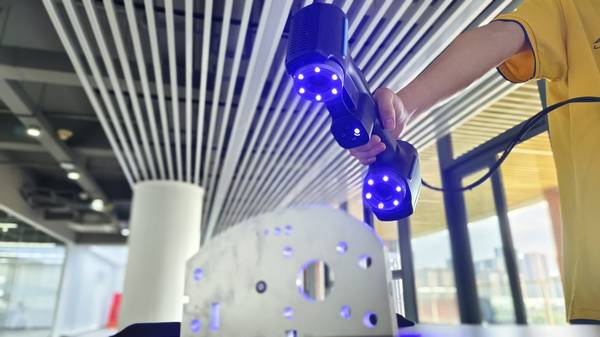
The design imperative shifts from maximizing lab performance to ensuring consistent performance *despite* the environment. The goal is a 3D imager that behaves like a robust, intelligent measurement tool, not a sensitive optical instrument. This requires a system-level approach addressing data capture, spatial tracking, and thermal management simultaneously to deliver what the industry terms “shop-floor hardened” metrology.
Implementation: A Process Built for Consistency
A reliable shop-floor scanning process is methodical and repeatable.
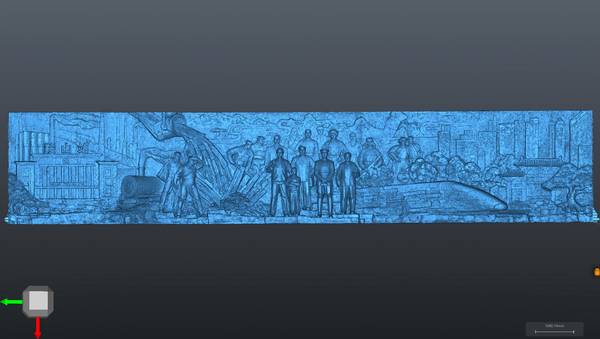
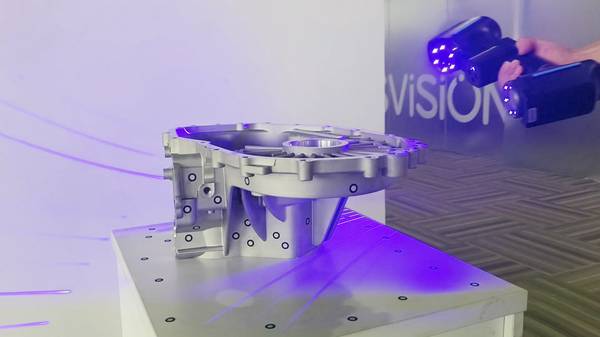
- Preparation & Targeting: The part is cleaned, and a matte spray may be applied for highly reflective surfaces. A network of adhesive reference targets is placed around the part and on the workstand itself. This target field creates a stable, global coordinate system that is immune to line-of-sight interruptions.
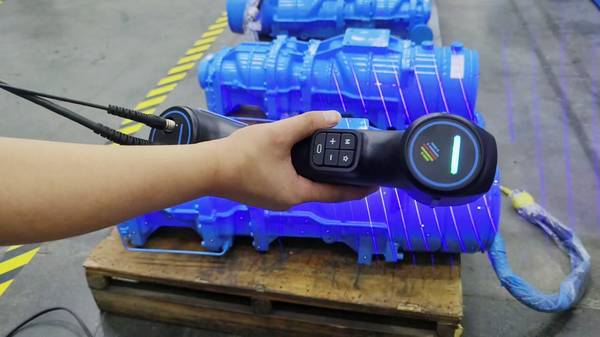
- Data Capture: The operator systematically moves the handheld 3D imager around the part, maintaining a consistent distance and overlap between scan passes. The key differentiator is the 3D imager’s ability to maintain tracking and data integrity even if the operator’s motion is uneven or if ambient light conditions change during the scan.
- Processing & Alignment: Captured data is instantly aligned within the global reference frame. Advanced algorithms filter environmental noise from true surface geometry, producing a clean, unified point cloud ready for analysis without lengthy manual cleanup.
- Analysis & Reporting: The dense point cloud is compared directly to the nominal CAD model. The software generates color-mapped deviation reports, cross-sectional analyses, and GD&T callouts, providing actionable pass/fail criteria and detailed documentation.
How the INSVISION AlphaScan Addresses Shop-Floor Demands
For these demanding industrial environments, the INSVISION AlphaScan 3D imager was developed with specific countermeasures to shop-floor challenges. Its design incorporates a multi-sensor fusion system that combines optical data with inertial measurements, allowing it to maintain spatial awareness and continue scanning smoothly through periods of poor optical tracking.
The projector and camera system are calibrated to operate effectively across a wider band of ambient light conditions, reducing the need for controlled darkness. Furthermore, its internal components and calibration models are engineered for minimal thermal drift, ensuring measurement stability over a typical work shift.
This combination allows INSVISION to deliver metrology-grade data where it’s needed most—directly beside the production line.
Observable Outcomes for the 3D Imager in Production
Operators and quality teams working with systems designed for environmental immunity report tangible improvements in workflow. The single most significant outcome is a dramatic reduction in rescans and manual data repair. Projects proceed from scan to report with predictable timelines.
Engineers gain confidence in the data, using it not just for basic inspection but for more advanced applications like wear analysis on tooling, comprehensive digital archiving of legacy parts, or feeding accurate data into Industry 4.0 workflows. The overall measurement cycle for complex parts is significantly shortened, integrating 3D scanning more seamlessly into lean production schedules.
Applicability to Related Industrial Scenarios
The core requirement for a versatile 3D imager—reliable, high-accuracy 3D capture in non-laboratory conditions—extends across numerous verticals:
- Heavy Equipment & Energy: Scanning large weldments, turbine blades, or pipeline components in fabrication yards or maintenance hangars.
- Marine & Rail: Digitizing hull sections or structural components in dry docks or service depots with challenging lighting and space constraints.
- Pattern & Mold Making: Verifying large wood or foam patterns, or inspecting injection molds directly on the machine shop floor.
- Archaeology & Heritage: Documenting artifacts or structures in variable outdoor light and temperature conditions.
Bridging the Metrology Lab and Factory Floor
The true value of a portable 3D imager is realized only when its rated accuracy is consistently achievable in the actual environment of use. By moving the engineering focus from ideal conditions to real-world interference—vibration, light, dust, and workflow—INSVISION delivers tools that bridge the long-standing gap between the metrology lab and the global factory floor.
For technical managers evaluating solutions, the critical question has evolved from “What is its best-case accuracy?” to “How does it perform on my shop floor?”
Hangzhou Insvision Technology Co.,Ltd.
Address: Building 1, No. 1399 Liangmu Road, Yuhang District, Hangzhou, Zhejiang 311121, China